Votre panier est vide


The most popular advice about aloe vera juice drinks is to start with the benefits. That's backwards. The first question should be what is in the bottle, because inner-leaf gel, decolorized whole-leaf extract, latex-containing material, and diluted concentrate can all appear under similar marketing language.
I've seen that distinction matter from the farm floor to the processing line. Two drinks can begin with the same plant yet deliver very different experiences because harvesting, filtration, stabilization, and testing determine which aloe compounds remain. A thoughtful choice starts with the leaf, not the front-label promise.
A shopper stands in front of a crowded shelf, comparing two green bottles. Both say “aloe vera juice.” One lists inner-leaf gel. The other mentions whole-leaf extract, added water, flavoring, or concentrate. The labels look related, but they don't describe the same drink.
Aloe vera juice drinks are a broad product category, not one standardized formula. A beverage may contain clear inner-leaf gel, a decolorized whole-leaf extract, a flavored aloe formulation, or a concentrate reconstituted with water or another juice. The National Institute of Environmental Health Sciences explains that aloe is regulated as a dietary supplement rather than as a drug, so products aren't guaranteed to have uniform strength, purity, or safety.
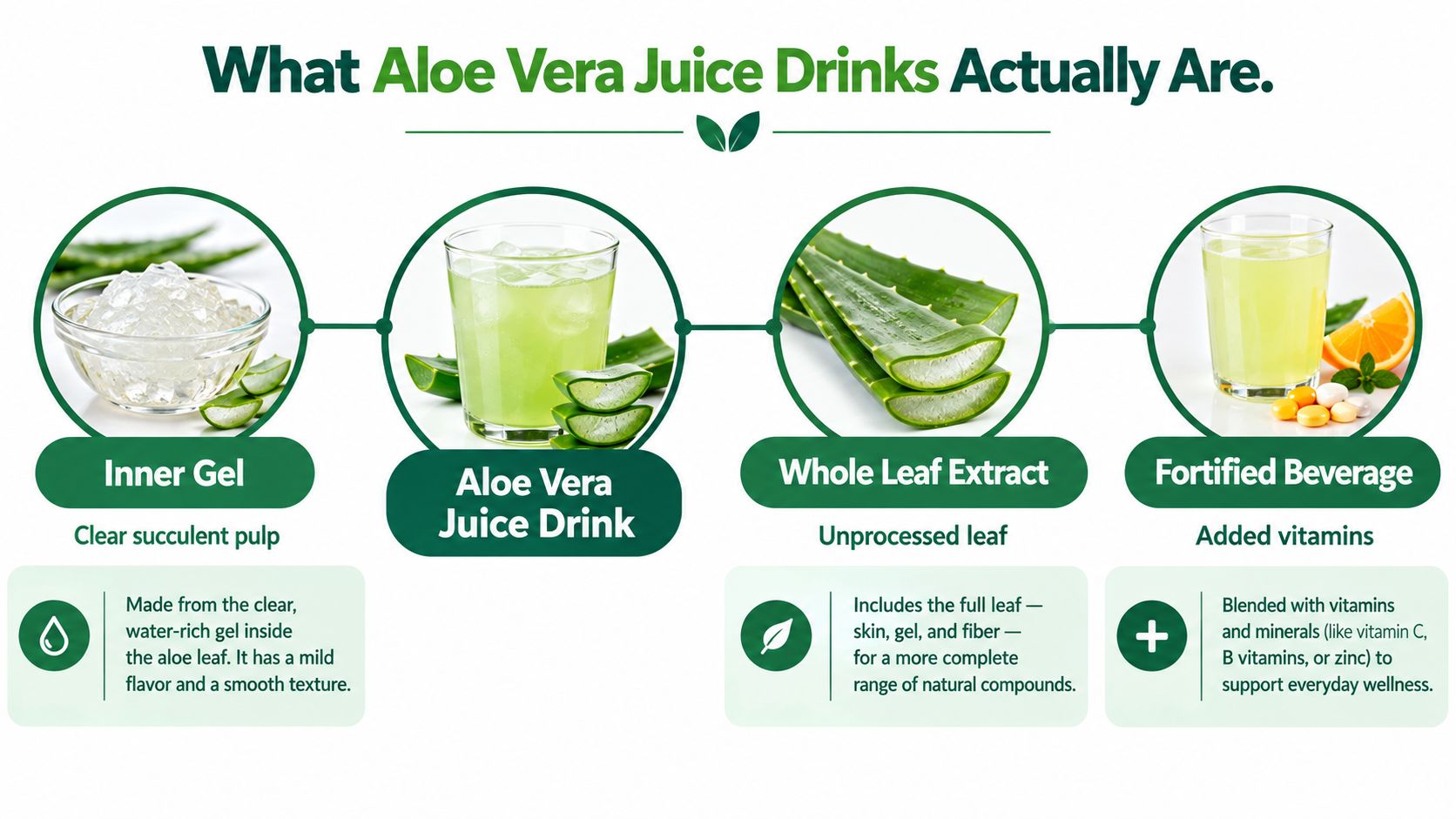
Inner-leaf gel comes from the clear succulent pulp at the center of the leaf. It's the form most often associated with a non-laxative daily wellness drink, provided the manufacturer removes the surrounding latex and verifies the finished product.
Whole-leaf extract uses more of the plant. It may be processed to remove unwanted compounds, but the label should explain how the material was purified and what testing confirms the final composition.
Latex-containing material is a different concern. Aloe latex sits between the outer rind and the inner gel and contains anthraquinones such as aloin. These compounds are associated with laxative effects, abdominal cramping, and diarrhea, so a drink intended for regular use needs clear information about latex removal and aloin control.
Flavored and fortified beverages add another layer. Water, fruit juice, sweeteners, vitamins, or other ingredients can make a drink easier to enjoy, but they can also dilute the aloe content. Check the ingredient list and Supplement Facts panel rather than assuming that a prominent aloe image tells you how much inner-leaf gel you're drinking.
Practical rule: Read “inner leaf,” “inner fillet,” “whole leaf,” “decolorized,” and “aloin” before you read the benefit claims.
To understand aloe quality, separate the leaf into its working parts. The tough outer rind protects the plant. Just beneath it is a yellow latex layer. Inside that is the clear gel that processors collect for many drink formulations.
The gel contains high-molecular-weight polysaccharides, including acemannan and related acetylated glucomannans. These substances aren't interchangeable with aloin. Research published in the Journal of Agricultural and Food Chemistry describes acemannan and aloe fructans as candidate prebiotic substrates, meaning their relevance may depend on how they survive digestion and interact with colonic microbiota.
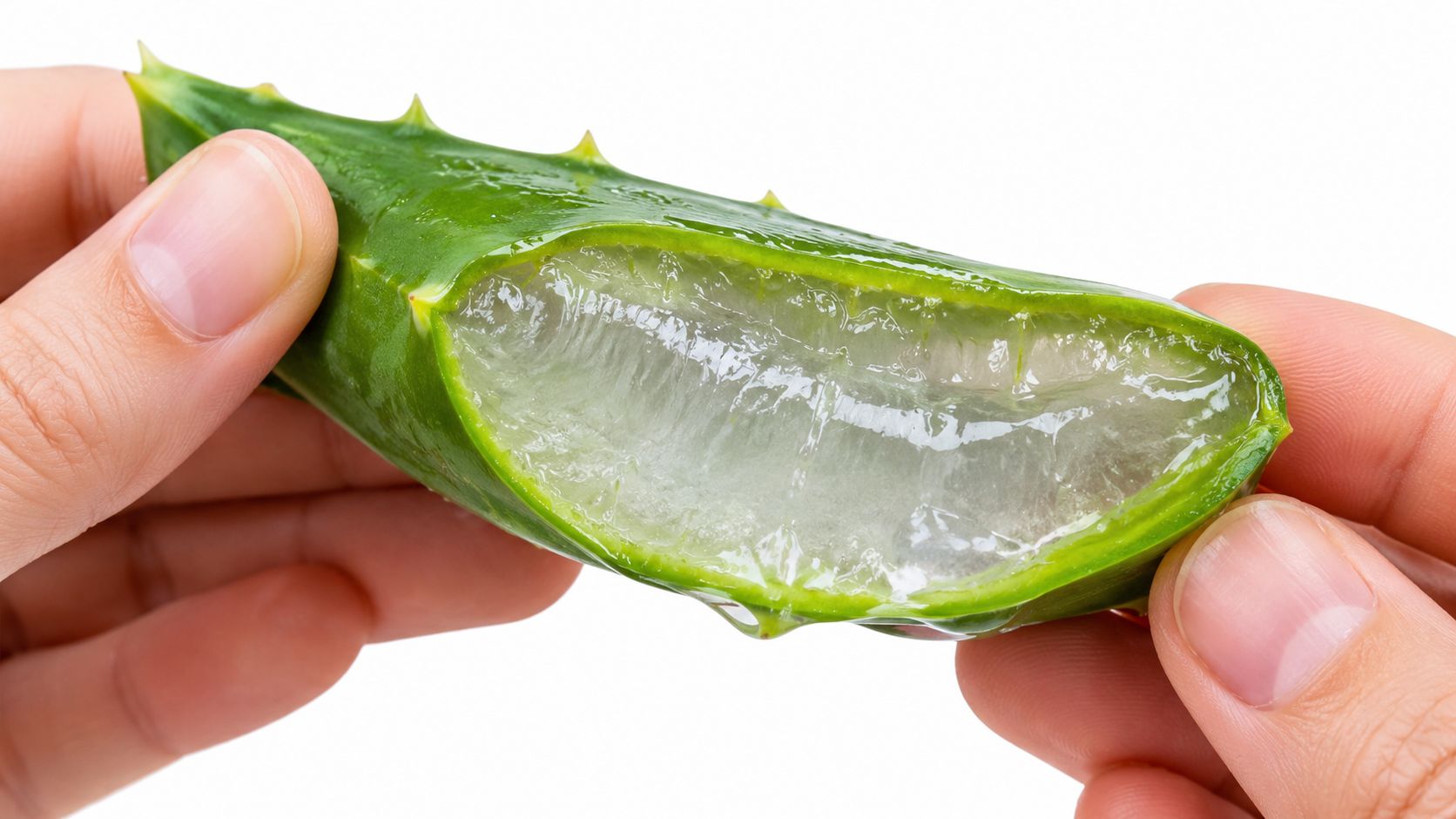
Aloin belongs primarily to the latex portion and is associated with laxative activity. The NIEHS aloe safety overview distinguishes preparations containing inner-leaf gel from non-decolorized whole-leaf material and notes that the National Toxicology Program found clear evidence of carcinogenic activity in male and female rats given non-decolorized whole-leaf aloe extract over two years, based on large-intestinal tumors.
That finding doesn't mean every aloe drink is the same as the preparation studied. It does mean a responsible manufacturer must identify the plant portion used, control processing, and test the finished beverage. Industry commonly uses an upper-limit standard of 10 parts per million of aloin, while NIEHS notes that U.S. labeling requirements don't require aloin disclosure.
AloeCure products use inner-leaf gel, according to the company's product information. The relevant quality question isn't how many impressive compounds a label lists. It's whether the producer can show that the drink preserves the desired gel polysaccharides while keeping latex-associated compounds controlled.
People often talk about aloe as if the plant has one unified effect. It doesn't. The consumer feels the result of a preparation, not an abstract plant identity. A clean inner-leaf gel drink and a whole-leaf extract can differ in composition, tolerance, and intended use.
The NCCIH evidence summary reports that short-term oral use of aloe gel has appeared safe for up to 42 days in research, while oral aloe latex can cause abdominal pain, cramps, and diarrhea. It also records cases of acute hepatitis associated with oral aloe-leaf extracts used for periods ranging from 3 weeks to 5 years.
That's why the first quality question is always simple: which part of the leaf is in the bottle?
The aloe plant is only the raw material. Processing determines quality, including whether a drink keeps the character of clean inner-leaf gel or becomes a diluted, heavily altered beverage.
A producer may use chemical treatment, enzymes, charcoal filtration, heat, or concentrate reconstitution. Each choice can affect the finished drink's texture, flavor, concentration, and polysaccharide profile. Concentrate can simplify transport and blending, but water added later means the bottled beverage is not the same material that left the original processing line. This guide to aloe vera juice concentrate explains that distinction in practical terms.
Organic certification describes farming practices. It does not show whether the gel was concentrated, filtered, enzymatically clarified, or blended with added water. Farming and processing answer separate quality questions.
A vertically integrated producer controls more stages of the chain. The farm can manage harvest timing, the processing team can move fresh leaves quickly, and the bottling operation can connect each batch with its source. AloeCure describes a vertically integrated model in which its parent company farms aloe, hand-harvests USDA- and EU-certified organic plants, and processes the gel on-site within 12 hours of harvest. The company also describes a proprietary, patented, fully natural process that avoids chemicals, enzymes, concentrates, and charcoal filtration.
These are product and process claims for shoppers to check against the label, certification records, testing information, and traceability materials. A company description alone does not replace independent evidence.
Fresh aloe gel changes after harvest. Heat, oxygen exposure, filtration choices, and extended holding can alter it before bottling. A controlled cold chain aims to preserve the original gel profile, while aggressive clarification or filtration may remove or change polysaccharides along with unwanted material.
The ACS review notes that acemannan exposure depends on beverage composition, dose, molecular-weight distribution, and processing. A broad “aloe content” statement therefore leaves important questions unanswered. A stronger specification identifies inner-leaf gel or whole-leaf extract, documents relevant polysaccharide markers where analytically justified, and supports stability through shelf life.
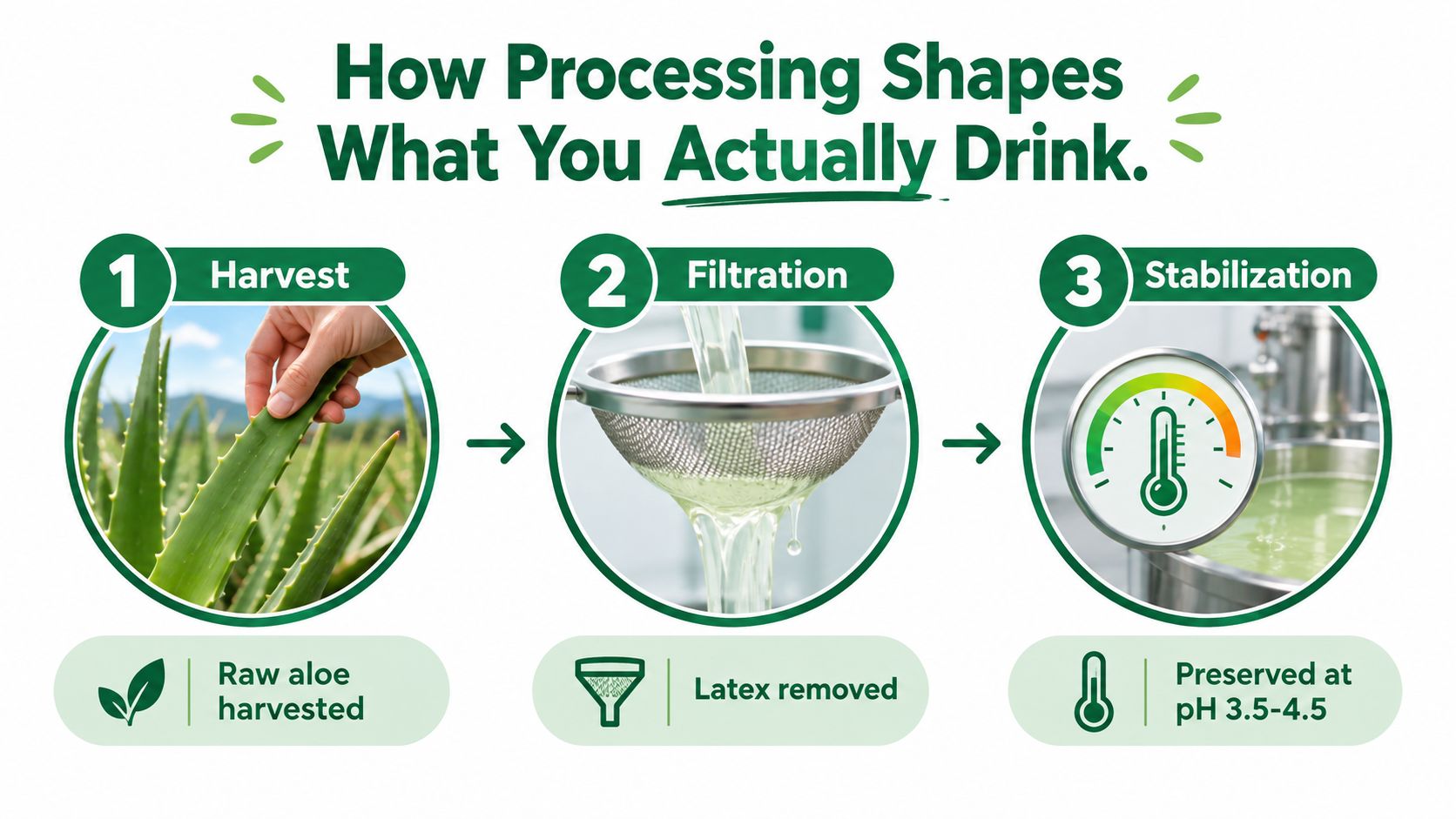
The practical lesson is simple: “organic” tells you about the farm, while processing information tells you more about the drink. Look for the leaf portion, concentration method, filtration approach, and traceability details before judging the bottle.
Here's a visual look at the farm-to-bottle process:
A quality aloe vera juice drink belongs in general wellness language, not medical promises. Processing matters here: a clean inner-leaf gel beverage may retain a different profile from a diluted concentrate, so a label cannot support claims that the product itself does not substantiate.
The FDA defines a structure/function claim as a statement about how a dietary ingredient affects the body's structure or function, or helps maintain it. The FDA guidance on structure/function claims supports careful wording such as:
“Skin vitality from within” should prompt questions about the ingredients, the leaf portion used, and the evidence behind the claim. “Immune support” deserves the same scrutiny. Aloe gel contains polysaccharides and other constituents, yet human research remains limited and can vary with preparation and processing.
The NCCIH evidence review covers oral aloe research involving digestive, metabolic, skin, and wound-healing topics. It also emphasizes incomplete long-term human toxicology data. A systematic review included 10 studies and reported that oral aloe might lower blood glucose in people with diabetes and blood lipid levels in people with hyperlipidemia. The authors still found clinical effectiveness insufficiently defined.
Aloe is approved by the U.S. Food and Drug Administration as a food additive for flavor, according to NIEHS. That status does not establish therapeutic effectiveness for every beverage, especially when formulas and processing methods differ.
Use aloe vera juice drinks as one optional part of a balanced routine, alongside food, water, movement, and rest. For evening beverage comparisons, the SleepHabits sleep drink guide provides a separate perspective on drink-based wellness habits.
A good label answers five questions quickly. What part of the leaf was used? How was it processed? What does testing verify? Who controlled the supply chain? What else was added?
Use this checklist before you buy:
| Quality Signal | What to Look For | Red Flag |
|---|---|---|
| Organic certification | USDA or EU organic certification that you can verify | Organic language without a clear certification reference |
| Leaf specification | Inner-leaf, inner fillet, or a detailed whole-leaf purification statement | Vague “aloe blend” wording |
| Aloin control | A stated specification of 10 parts per million or below where the company provides one | No information about aloin or latex control |
| Independent testing | Third-party testing for identity, purity, and relevant quality markers | Only front-label marketing claims |
| Traceability | A clear farm-to-bottle account with batch and sourcing information | A brand that can't explain who grows or processes the aloe |
Added water isn't automatically a problem, but it tells you the beverage may be diluted or reconstituted. Fillers, sweeteners, and flavor systems can also change what you're buying. The Supplement Facts panel should make the serving and ingredient amounts understandable instead of hiding the aloe behind a broad proprietary blend.
A vertically integrated producer farms and processes its own aloe rather than purchasing anonymous bulk juice for bottling. AloeCure states that its parent company has owned aloe farms for 25 years and uses an 8-step traceability promise. Those details offer a benchmark for the kind of documentation a premium producer should be prepared to provide, whether you choose that brand or another.
For another way to compare plant-based beverages, you can browse the pressed juice lineup on Loyaltie and apply the same questions about ingredients, processing, and sourcing. For aloe-specific buying criteria, this aloe vera juice brand guide gives shoppers another reference point.
Start with the label, then start conservatively. A practical opening serving for many adults is 1 to 2 fluid ounces per day, taken before a meal or according to the product directions. Individual responses vary, so increasing slowly makes more sense than assuming a larger serving will provide greater support.
Aloe products are not interchangeable. The NCCIH safety summary reports that short-term oral use of aloe gel has appeared safe for up to 42 days in research, while latex can produce abdominal pain, cramps, and diarrhea. If a drink causes an unwanted response, pause use and review the ingredient and processing information instead of pushing through it.
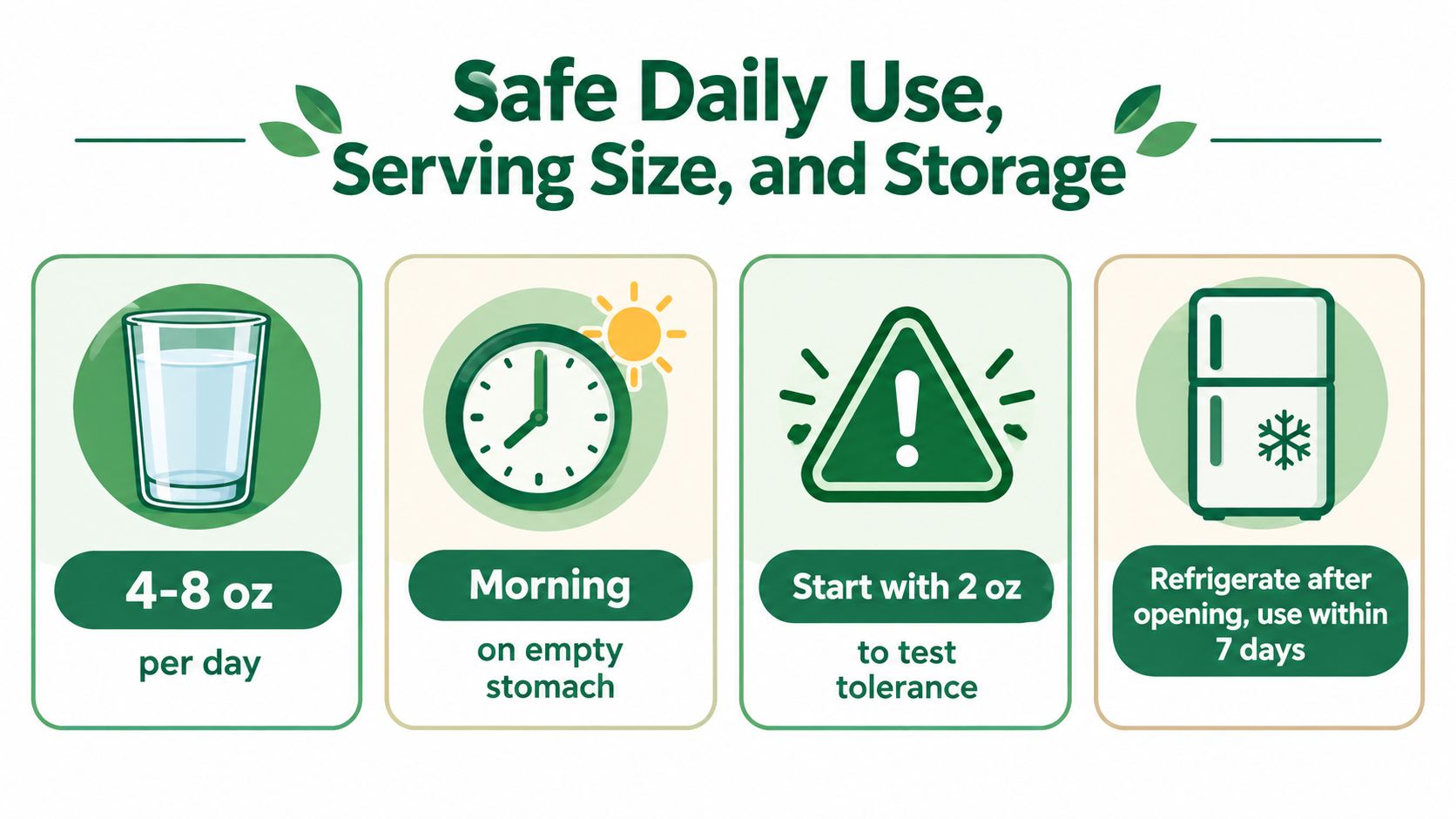
Take the drink at a consistent time, such as before breakfast or before another meal. People who are pregnant, nursing, managing ongoing health concerns, or taking other supplements should ask a qualified healthcare professional before adding oral aloe. Children and pets shouldn't be given a product unless a qualified professional specifically recommends it.
Refrigerate an opened bottle and follow the printed storage window. Keep the cap clean, avoid drinking directly from the bottle, and don't use a product with an unusual smell, appearance, or taste. For more detailed product guidance, see AloeCure's aloe vera juice dosage information.
If your product uses structure/function claims on its labeling, FDA requires the following disclaimer in boldface type:
These statements have not been evaluated by the Food and Drug Administration. This product is not intended to diagnose, treat, cure, or prevent any disease.
FDA also requires the company to notify the agency of the claim text and other required information no later than 30 days after first marketing the supplement with that claim, as explained in FDA's notification guidance. The claim itself isn't pre-approved, so the company remains responsible for truthful, nonmisleading wording and adequate substantiation.
Aloe vera juice drinks work best when they fit a routine you already keep. AloeCure offers Natural, Grape, and Lemon flavor options, so you can choose a plain profile for mixing or a fruit-forward option for a quick pour.
Try one of these approaches:
A gentle seven-day pattern can make the habit easier:
Avoid treating a beverage routine as a substitute for professional guidance. You can pair an aloe drink with other wellness products, but review the full ingredient list when combining supplements. A capsule, joint formula, or evening product may contain ingredients that deserve separate consideration.
For regular shoppers, Subscribe and Save offers 20% off with flexible delivery, while priority processing is described as 1 to 2 days. A 90-day money-back guarantee can make it easier to test a routine without committing to a flavor you won't use.
When is the best time to drink one? Choose a consistent time that fits your routine, such as before breakfast or another meal. The label's directions should take priority.
Can I mix it with other drinks or supplements? Mixing with water or a smoothie is practical. Review all ingredients before combining supplements, and ask a qualified professional if you're unsure.
Is it suitable for children, pets, or pregnancy? Don't give oral aloe to children or pets without professional guidance. Anyone who is pregnant or nursing should consult a qualified healthcare professional first.
How should I travel with an opened bottle? Keep it refrigerated, use a clean cap, and follow the printed storage window. For longer storage, choose an unopened bottle and check its label.
These statements have not been evaluated by the Food and Drug Administration. This product is not intended to diagnose, treat, cure, or prevent any disease.
Choose an aloe vera juice drink with a clearly identified inner-leaf gel, transparent processing details, relevant testing, and traceable farm-to-bottle sourcing. Visit AloeCure to compare organic aloe vera juice options, choose Natural, Grape, or Lemon, and explore Subscribe and Save for 20% off your recurring order.
Les commentaires sont approuvés avant leur publication.