Votre panier est vide


What if the most important difference between two jars of coconut oil isn't the word virgin on the label, but what happened in the first hours after harvest? That question changes how you shop. It shifts your focus from broad wellness promises to origin, timing, moisture, testing, and storage. Traditions Tropical Coconut Oil is a useful case to learn from because its identity is built around those practical details.
You're standing in front of a shelf and every jar looks similar. One says virgin, another says expeller-pressed, another promises simple ingredients. A shopper beside you picks up Traditions Tropical Coconut Oil and asks the question most shoppers skip. Who made this, where, and in what way?
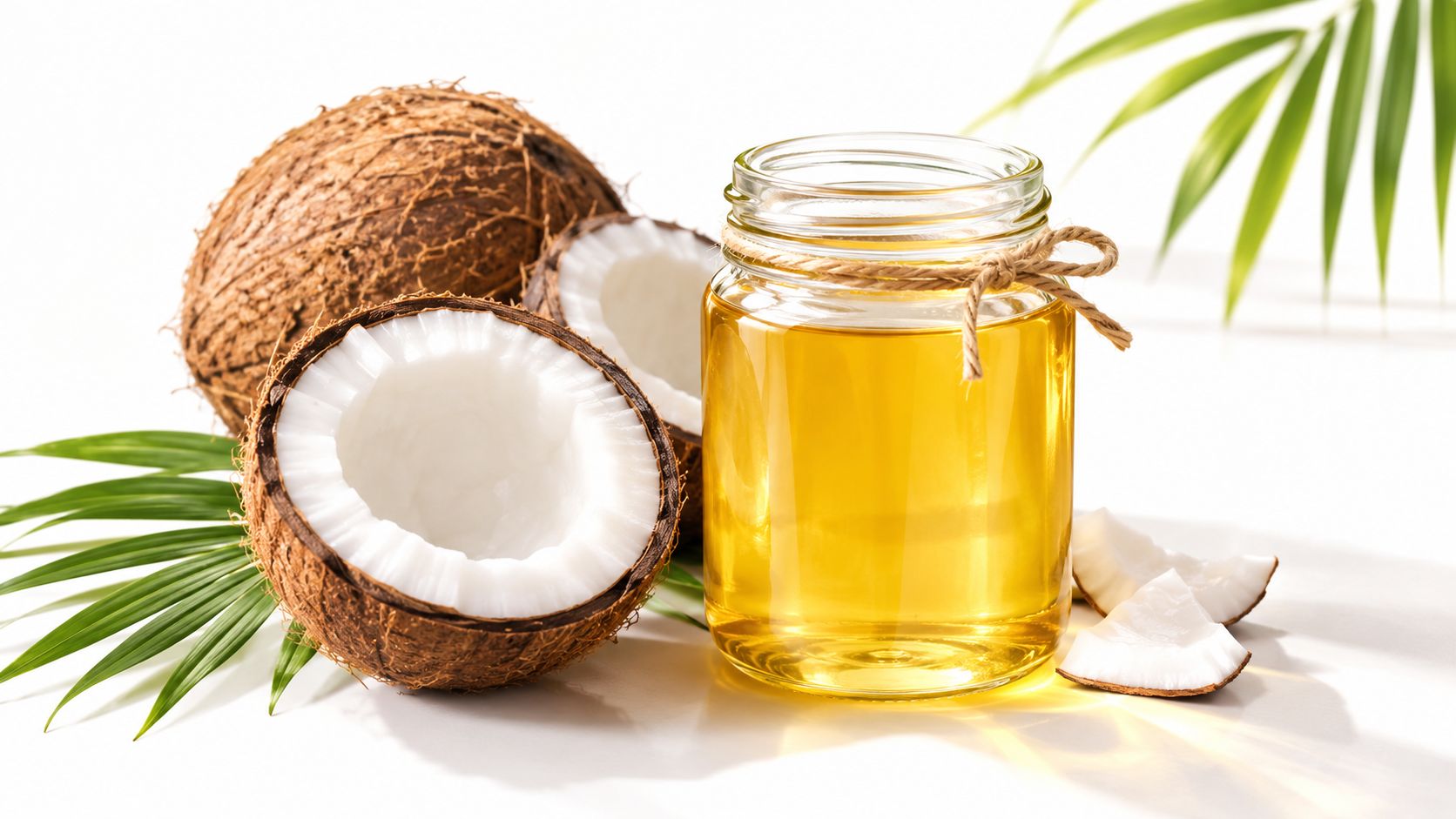
The brand traces its United States virgin coconut oil business to 2001, when it began exporting virgin coconut oil from the Philippines to the American market, and the company states it was the first business to import virgin coconut oil from the Philippines into the United States, according to the Healthy Traditions history and FAQ page. Its broader business was founded in 2002 by Brian Shilhavy, and the name changed from Tropical Traditions to Healthy Traditions in 2017, as described on that same company page. That timeline matters because Philippine origin and direct importation weren't later additions. They were central from the start.
The company distinguishes its Gold Label oil, described as small batch work by Philippine family producers using fresh coconuts, from its Green Label oil, made at a centralized Philippine facility under quality control procedures. It is like bread from a small bakery compared with bread from a larger bakery that follows a set system. Neither description alone proves quality, but it tells you what questions to ask about batch size, consistency, and testing.
That same step by step curiosity helps with topical routines too, including the ideas explored in this guide to aloe vera and coconut oil for hair care routines. You're not just buying an oil. You're choosing a sourcing model and a processing story you can check.
A useful first filter is simple. If a brand can't explain origin, harvest timing, and production method in plain language, you don't have enough information to compare it fairly.
Philippine sourcing sounds like a marketing phrase until you place it on a map. Coconut was cultivated in more than 90 countries, global production reached 59 million tons in 2016, and Asia accounted for 83.8% of that output, according to figures compiled in the coconut oil concept paper hosted by the Government of Tripura. The Philippines sits near the center of that map, not at its edge.
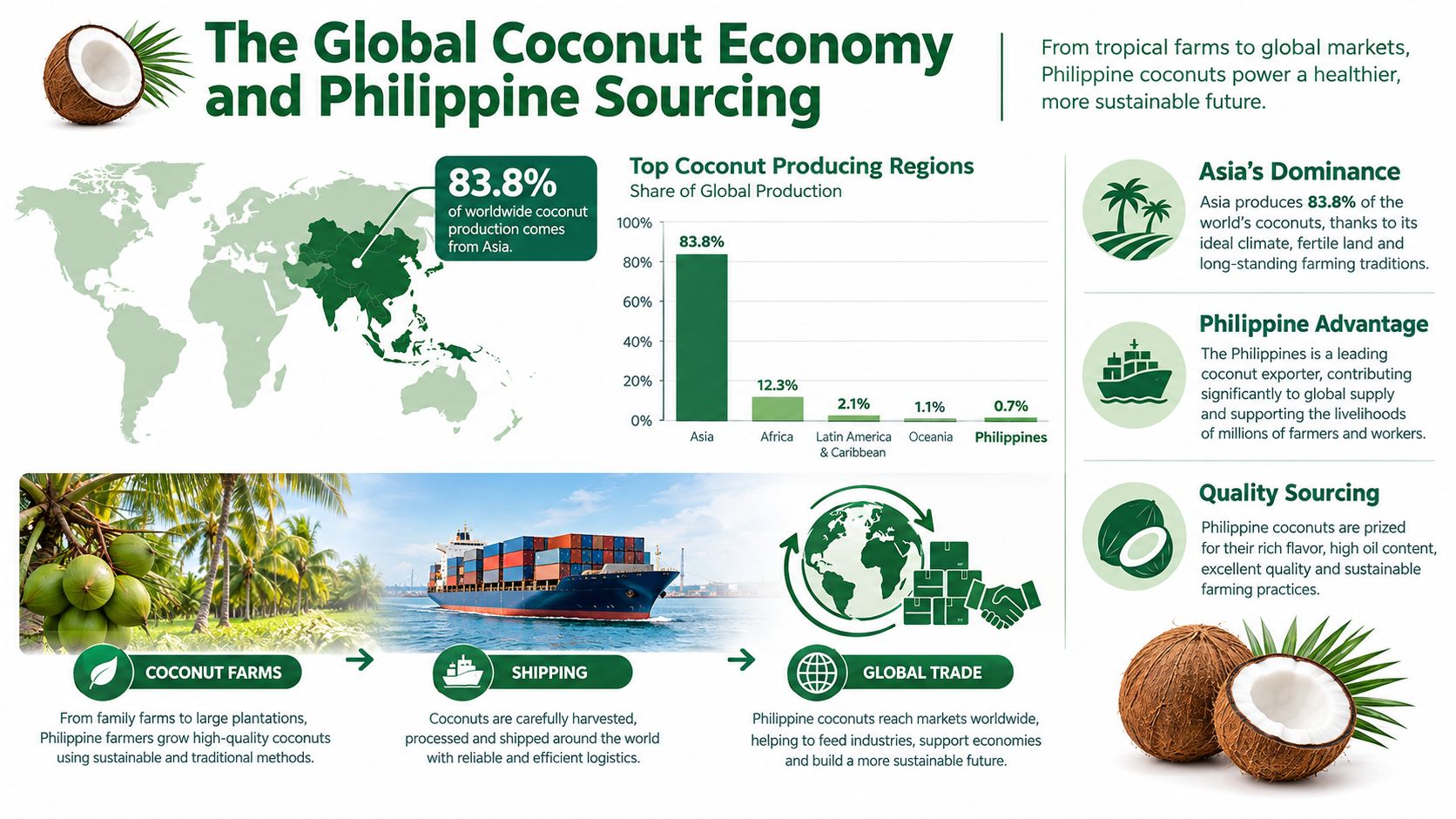
The same ranking puts a few countries well ahead of the rest:
That drop deserves a pause. The top two producers alone account for more than half of that 2016 output, which means "coconut oil" on a label can describe very different harvests and handling systems depending on origin.
History points in the same direction. Extracting oil from dried coconut meat, or copra, became established during the 1880s, and by 1924 the Dutch East Indies and the Philippine Islands together represented nearly 62% of global copra and coconut oil production. Coconut oil output later rose from 1.6 million metric tons in 1961 to 3.2 million metric tons in 2018, with a peak of 3.8 million tons in 2010.
For you as a buyer, origin is a starting point, not a guarantee. A leading producing country can still ship oils made in very different ways, so the useful question is how coconuts are grown, handled, and moved to processing. The checklist in this guide to what sustainable farming practices involve in practice gives you concrete questions to bring to that conversation with any brand.
Wet milling is easier to understand if you picture making coconut milk at home, then waiting for the richer portion to separate. Gold Label oil doesn't start with dried copra stored for later industrial extraction. It starts with fresh coconut meat, and timing is part of the method.
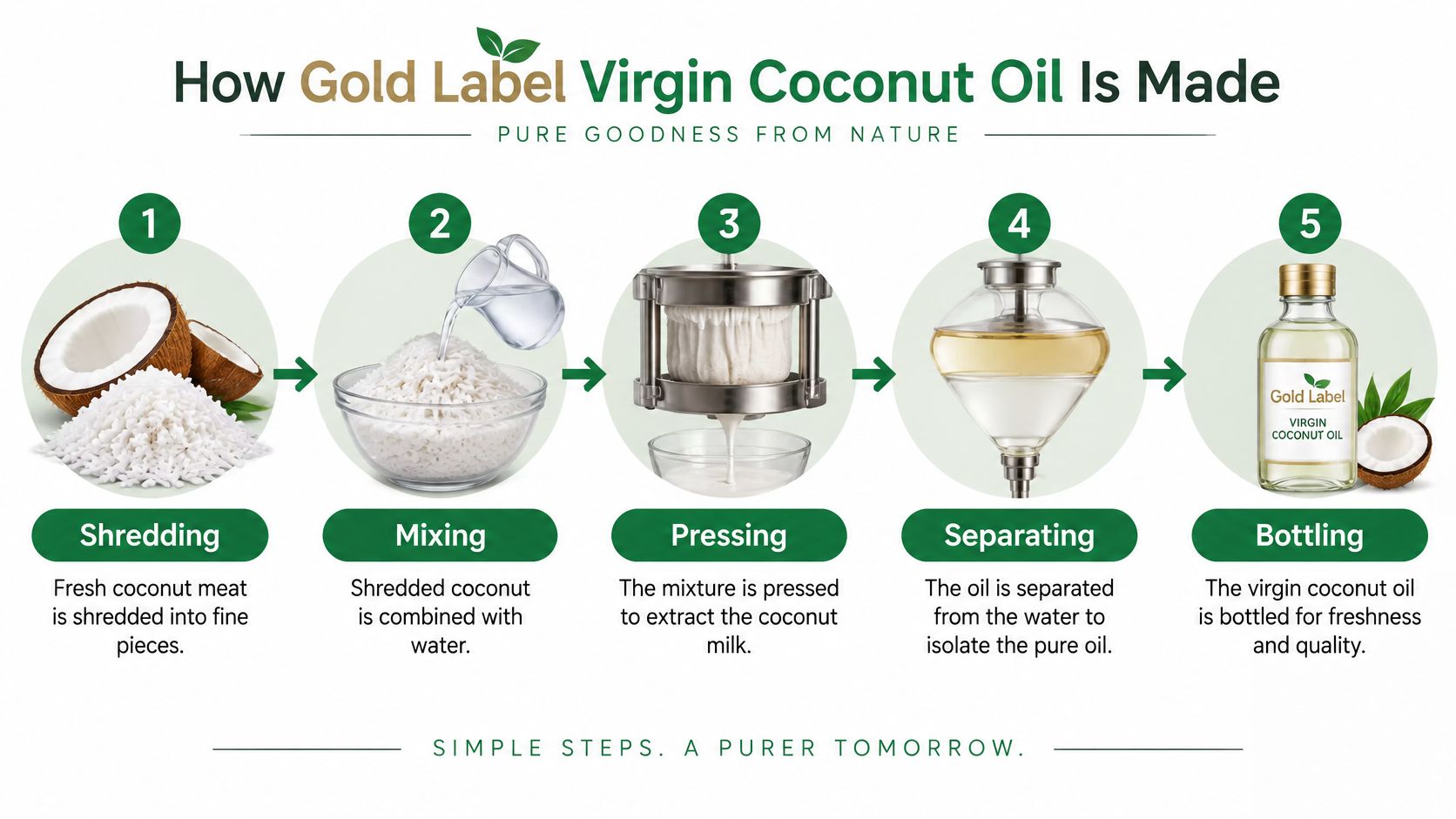
Why does timing matter? Fresh coconut material contains water and nutrients that can support microbial change if it sits too long. Shorter storage before milling reduces opportunities for deterioration and for hydrolytic rancidity, which is a type of breakdown linked to water acting on fats.
Watching the sequence can make the separation step clearer.
The heating step often confuses readers. It isn't described as bleaching or chemical deodorizing. Its stated purpose is moisture control. Batch testing reportedly targets moisture below 0.1%, and that's a practical benchmark because water speeds hydrolysis and can increase free fatty acid formation during storage, as explained on the product collection page above.
The manufacturer also reports independent testing for antioxidant levels. Don't overread that claim. Without disclosed laboratory methods and units, you can't compare antioxidant numbers fairly across brands.
Coconut oil behaves differently from many liquid plant oils because of its fatty acid profile. In simple terms, fatty acids are the building blocks of fat. Some have more double bonds in their structure, and those bonds are more vulnerable to oxygen. Coconut oil has relatively few of those vulnerable points.
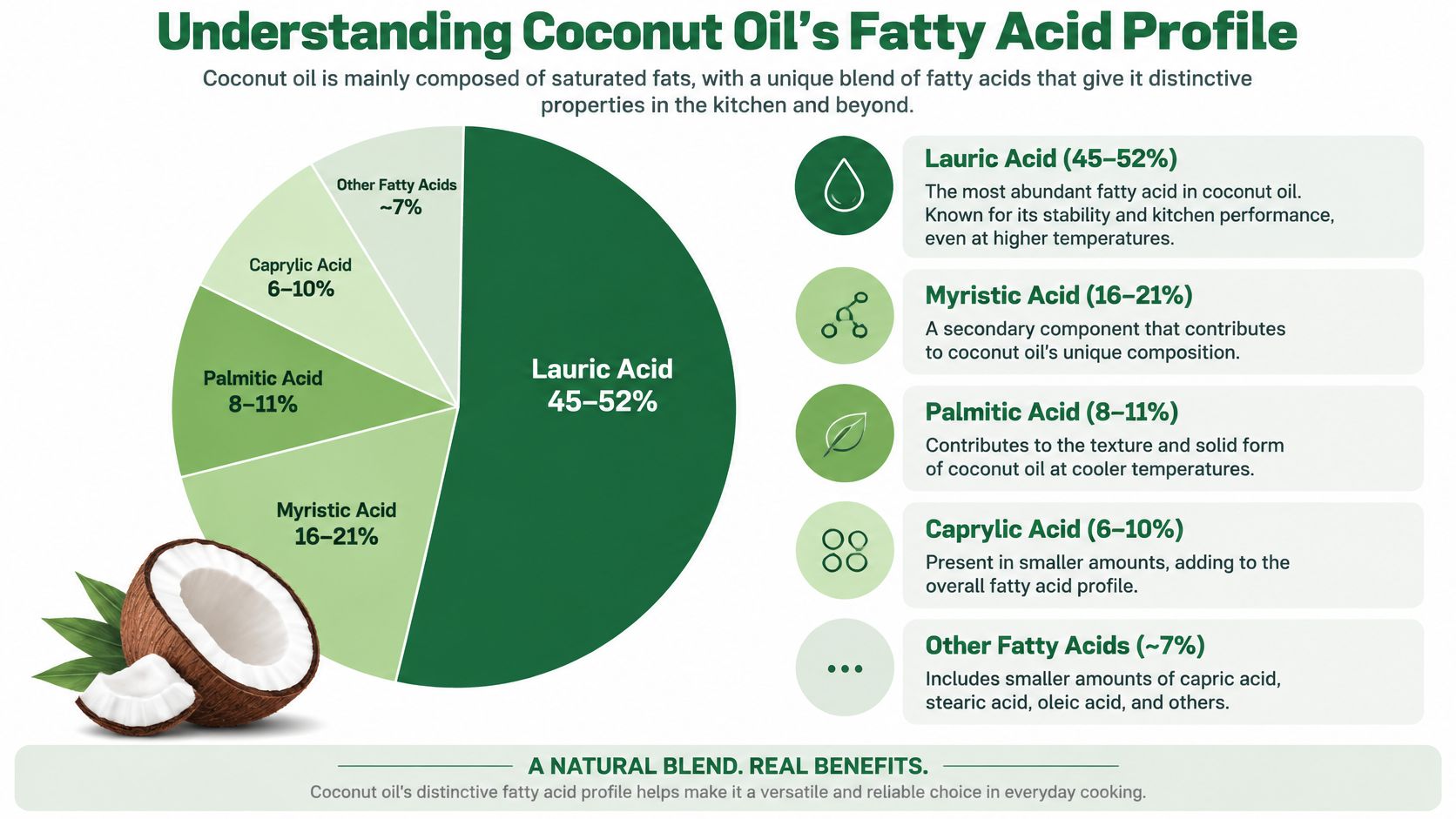
Heat, light, oxygen, moisture, and repeated heating can still raise peroxide and free fatty acid values. Peroxide value is one marker of early oxidation. Free fatty acid value can rise when fats break down, especially when water is present.
Some readers confuse coconut oil with concentrated medium chain products. They're not the same purchase, which is why a separate resource on the best MCT powder for ketone production can help you compare categories before you buy either one. Whole coconut oil still contains its full natural mix of fatty acids, not only selected fractions.
A clear boundary: Fatty acid composition can explain texture, melting, and storage stability. By itself, it shouldn't be treated as evidence of a specific personal outcome.
That distinction keeps your expectations realistic. You can appreciate why the oil is solid at cooler room temperatures and useful in certain recipes without turning chemistry into a promise.
The question most shoppers ask isn't about chemistry. It's personal and practical. What happens if you use coconut oil every day, and what should you use the rest of the time?
Recent findings give a more restrained picture than many product pages suggest. A 2025 meta analysis of coconut oil supplementation found statistically significant changes in weight and BMI, but the effects were extremely small and judged not clinically meaningful, and waist circumference did not improve, as reported in the BMC Nutrition meta analysis on coconut oil supplementation. A broader 2025 analysis covering 15 trials and more than 600 participants found no evidence that consuming roughly 10 to 50 g daily reduced body weight, BMI, or waist size, in the findings summarized alongside that research.
Think in two modes instead of all or nothing.
Occasional flavor and cooking use means you choose coconut oil when its aroma, texture, or heat behavior suits the dish. You're judging it as a culinary fat.
Routine daily supplementation means you add it every day expecting a measurable body change. The recent evidence above doesn't support that expectation as a weight focused strategy.
Current dietary guidance summarized with that research indicates replacing saturated fat sources such as coconut oil with unsaturated vegetable oils lowers LDL cholesterol without affecting blood pressure. That doesn't make coconut oil unusable. It makes rotation sensible. Olive, rapeseed, and sunflower oils can cover many everyday meals, and the IFM Gourmet Food Store olive oil guide is a helpful companion when you're comparing how olive oil fits into regular cooking.
Portion context matters more than slogans. If coconut oil supports healthy energy metabolism as part of your normal eating pattern, that language still needs appropriate evidence behind it and shouldn't be stretched into a guaranteed result. A balanced plate, total energy intake, and what oil you're replacing will shape the actual world effect far more than a single ingredient claim.
Labels can narrow your choices, but they can't finish the job for you. Words such as virgin, organic, and expeller pressed describe aspects of sourcing or extraction. They don't by themselves prove purity, safety, or better skin performance for every person.
A useful outside benchmark comes from cosmetic standards work. A 2025 draft East African Standard for cosmetic coconut oil specifies the oil may be refined or virgin and sets a combined finished product limit of 10 mg/kg for lead, mercury, and arsenic, according to the draft East African Standard for cosmetic coconut oil. You may never buy under that standard, but it shows what serious quality language looks like. It names contaminants and gives a limit.
Independent technical guidance describes coconut oil's established cosmetic role as an emollient that softens and hydrates skin. That function supports normal skin comfort and helps maintain the skin's natural moisture feel. It shouldn't be confused with a promise to address a named skin condition.
Global shoppers face another wrinkle. Standards and enforcement vary by market, so a familiar word on one label may not carry identical oversight elsewhere. The same careful label reading helps with drinks too, as shown in this comparison of coconut water vs plain water, where ingredients and intended use matter more than a tropical image. Apply that habit here and you'll make calmer choices.
Wellness language has rules, and learning them protects you from exaggerated marketing. Under Section 403(r)(6) of the Federal Food, Drug, and Cosmetic Act, a dietary supplement company making a structure or function, nutrient deficiency, or general wellness claim must possess substantiation showing the claim is truthful and not misleading before using it, as explained in FDA guidance on substantiation for dietary supplement claims. A disclaimer can't fix a claim that lacks adequate substantiation.
A structure/function claim describes the role of a substance in maintaining the structure or function of the body, a definition the FDA sets out in its dietary supplement labeling guide chapter on claims. These claims don't receive FDA preapproval. They still must be truthful, not misleading, and supported by evidence.
The manufacturer must notify FDA no later than 30 days after first marketing a dietary supplement with a structure/function claim, including the claim text and other required information, according to the FDA page on structure/function claims. That filing is not approval and it's not permission to launch first and find evidence later.
Safer template language stays positive and normal. Examples include supports healthy function, promotes general wellness, helps maintain normal body function, and supports the body's natural processes, but only when evidence supports the specific use. Comparable care with everyday food language is also discussed in this article on liver focused olive oil routines and label reading, where wording and context shape what a reader reasonably expects.
When this type of claim appears on a label, FDA requires this disclaimer in boldface, as stated on the FDA notifications page for structure/function claims: This statement has not been evaluated by the Food and Drug Administration. This product is not intended to diagnose, treat, cure, or prevent any disease.
For broader educational consistency, that same required wording is presented here as: These statements have not been evaluated by the Food and Drug Administration. This product is not intended to diagnose, treat, cure, or prevent any disease.
You now have a decision framework that works beyond one brand. Start with origin, then move to processing, then check evidence, and finish with how you'll use and store the jar at home. That order prevents a strong story from replacing basic quality checks.
Traditions Tropical Coconut Oil earns attention for reasons you can verify. Its Philippine roots, early direct importation story, small batch Gold Label model, and wet milling details are specific. Specifics are good because you can ask follow up questions about moisture, batch testing, packaging date, and production consistency.
Products that support healthy daily function and promote general wellness fit best when they join habits you already maintain, not when they're expected to replace those habits.
That principle also explains why sourcing control matters in other plant categories. Brands that farm, process, and produce under one integrated system can describe each step with fewer gaps. Whether you're judging coconut oil or another botanical product, traceability helps you connect a finished jar or bottle back to a farm and a process.
Choose the option you can explain in one minute to a friend. If you can name where it's from, how it's made, how it was tested, and why it fits your routine, you've made an informed choice.
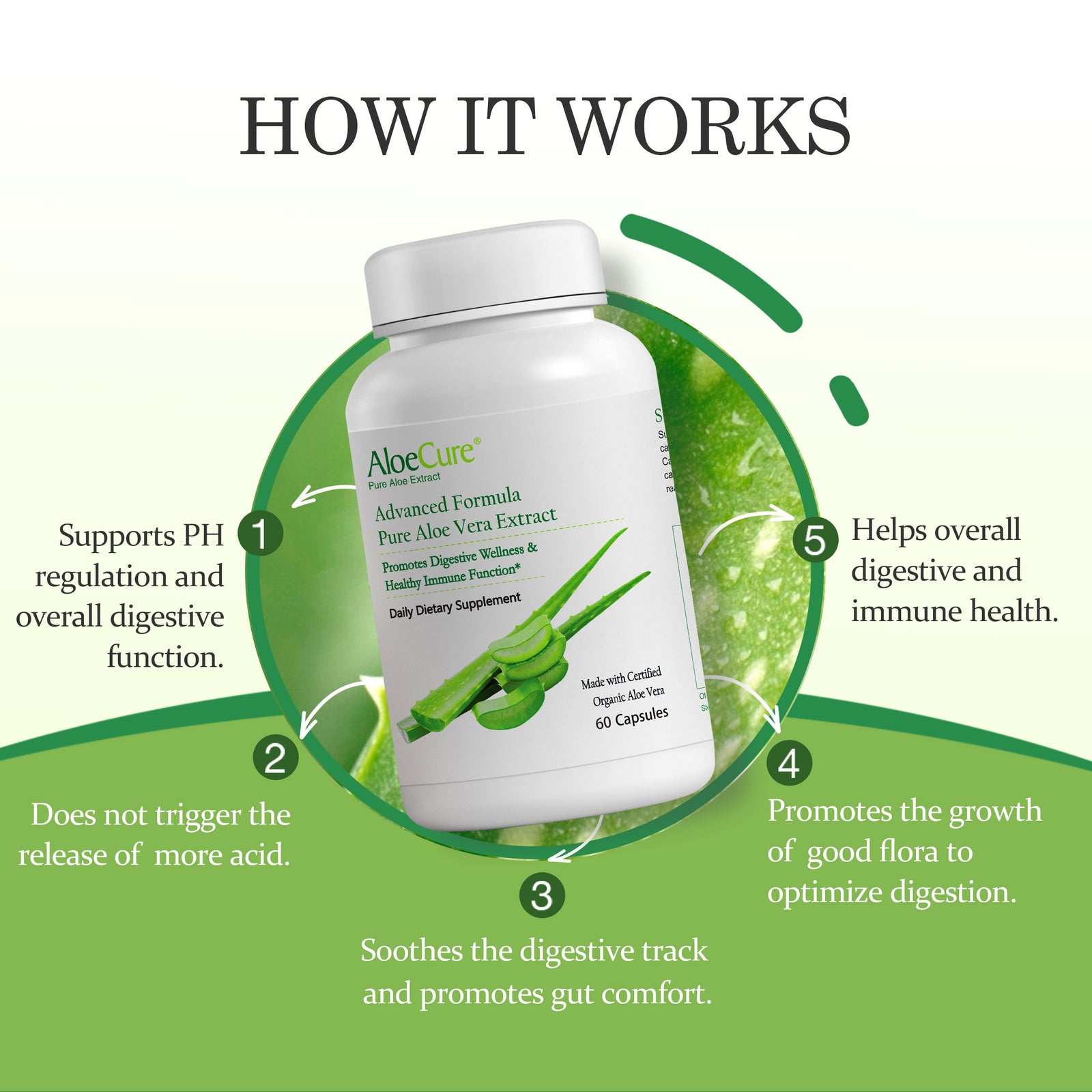
If you value that same farm to finished product traceability in your daily routine, explore how AloeCure grows, processes, and produces its own certified organic aloe products to support healthy digestive function and promote everyday wellness. Visit the product pages to compare juices and capsules, learn about Subscribe and Save for 20% off subscriptions, and choose the option that fits your goals with confidence.
Les commentaires sont approuvés avant leur publication.