Votre panier est vide


Cocoa butter is a moisturizer, not a sunscreen. Independent in-vitro testing measured its SPF at approximately 12, a level the researchers concluded is insufficient for safe standalone sun protection, so use it with a tested broad-spectrum sunscreen rather than instead of one.
Does a rich, plant-based butter count as natural sun care just because it feels protective on skin? That assumption confuses two different jobs: conditioning the skin and demonstrating tested ultraviolet protection. Cocoa butter can make skin feel softer and help reduce moisture loss, but comfort alone doesn't show how well a product protects against UV.
A tan or less-dry feeling doesn't prove that a product is protecting you, either. SPF primarily reflects protection against UVB-related erythema, the skin response used in testing; it isn't a promise of unlimited time outdoors. What matters is the performance of the complete product, not the reputation of one ingredient.
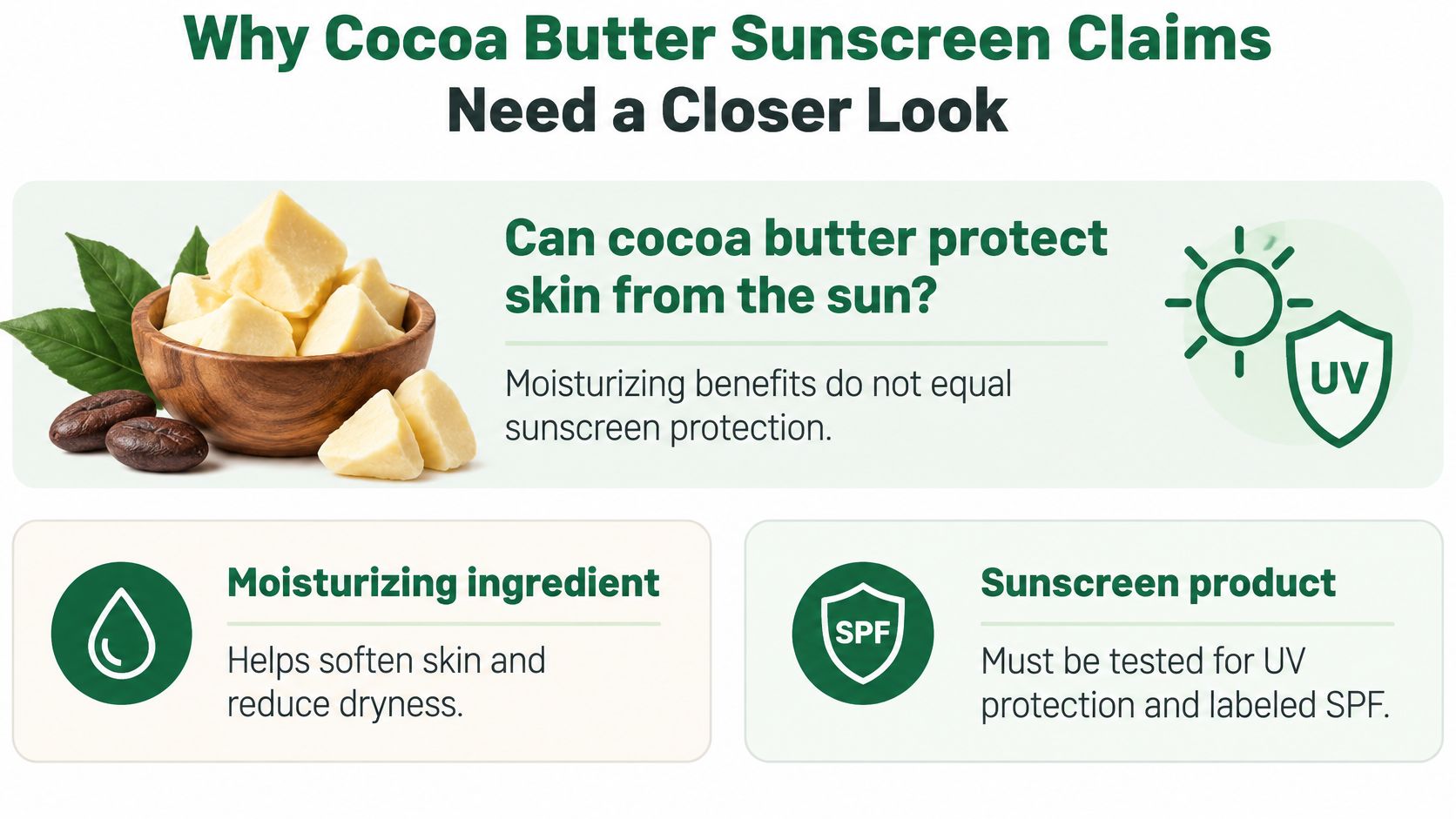
Pick up a product labeled "cocoa butter sunscreen" and you could be holding any of three things: a moisturizer containing cocoa butter, a finished sunscreen that uses it as a supporting ingredient, or a product whose marketing implies the butter itself blocks UV. Only a finished, tested formula can legitimately carry an SPF claim, and the ingredient's reputation does nothing to establish one.
In an in-vitro comparison of vegetable oils and butters, cocoa butter did register some UV absorbance under laboratory conditions. The researchers running that comparison still concluded the natural materials they examined offered too little protection to serve as standalone sunscreens. "Some measured absorbance" and "safe sun protection" are two very different conclusions, and knowing which one a product's marketing rests on is the skill this section is about.
Cocoa butter forms a lipid-rich layer on the skin's surface, slowing moisture loss and leaving dry skin feeling comfortable. That occlusive film tells you nothing about how much UV is reaching your skin. A product can feel thick, rich, and reassuring while providing no tested protection at all.
A tan is equally unreliable as evidence. SPF describes performance against a defined testing endpoint, mainly UVB-driven redness, not permission to extend time outdoors.
Practical rule: Treat cocoa butter as a moisturizer unless the finished product carries an SPF claim supported by testing on the complete formula.
Ingredient reputation and product performance are separate questions. Cocoa butter answers the first one well, and the next sections look at what answers the second.
The key detail is what the instruments were pointed at. In the raw-material comparison noted earlier, researchers spread individual oils and butters on a test plate, shone UV through the film, and used spectrophotometry plus the ISO 24443:2012 method to estimate absorbance. That setup can rank ingredients under controlled conditions. It cannot predict how a cream behaves after emulsifiers, preservatives, fragrance, pigments, and real-world application enter the picture.
| Measurement in that lab setup | What it can show | What it cannot show |
|---|---|---|
| UV absorbance of a raw ingredient film | Whether one butter or oil absorbs more than another in the same test | Whether a finished product meets an SPF label claim |
| In-vitro SPF estimate | A comparative signal under the stated method | Protection on skin at the thickness people actually apply |
| Ingredient ranking | Which raw material performed best in that comparison | A safe reason to replace sunscreen |
Read that way, cocoa butter's relative position is less exciting than the headline. A better score inside a narrow test still left the researchers judging these natural ingredients insufficient on their own, as noted earlier.
A separate formulation study measured titanium dioxide alone and in oil-in-water emulsions with cocoa, murumuru, or cupuaçu butter. The tested products had SPF values from 4 to 5 and critical wavelengths from 383.0 to 386.7 nanometers; adding the butters did not increase measured SPF compared with titanium dioxide alone, even though the wavelength results hinted at some UVA-range absorption (2016 formulation study).
Absorbing some UV is only one part of protection. A sunscreen film also has to stay even, keep particles dispersed, resist photodegradation, and remain at the intended thickness on skin. If cocoa butter changes the oil phase, it may improve glide or comfort while leaving the measured SPF flat.
So the research supports a narrow conclusion: cocoa butter can be a useful emollient in a formula, and it may show measurable absorbance in a lab method, but the tested formulas still relied on sunscreen active ingredients for protection.
An SPF number isn't a general score for a product's quality. It comes from comparing how much UV radiation is needed to reach a defined testing endpoint when sunscreen is applied with how much is needed without it. The FDA says sunscreens must follow the applicable SPF procedure before receiving an SPF label (FDA explanation of sunscreen testing and labeling).
This is why a raw ingredient's laboratory reading can't stand in for a finished product's result. Manufacturers formulate a product, test that complete formula, and support the claims that appear on its label. Cocoa butter may be part of the base, but its presence doesn't prove an SPF.
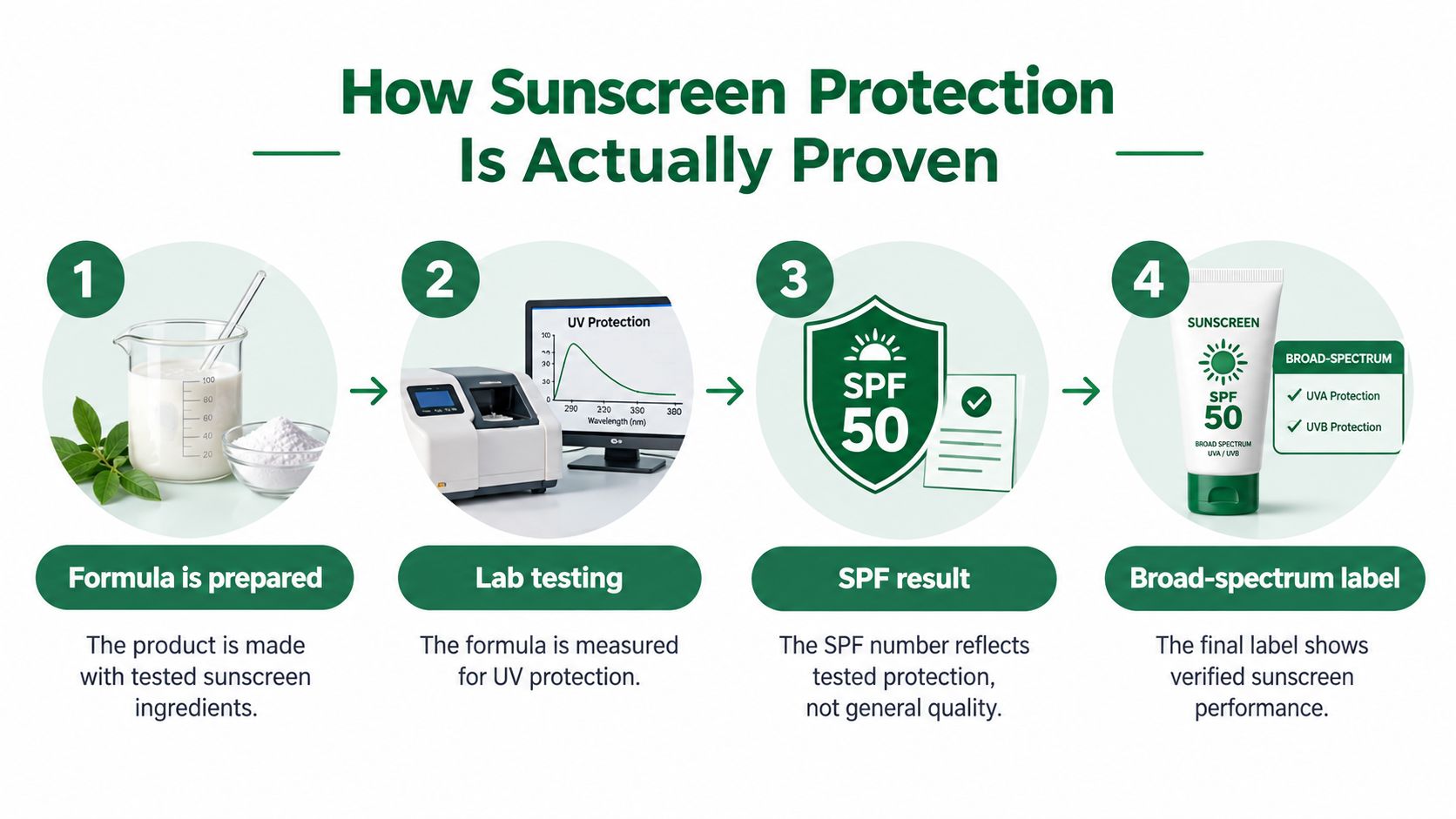
The FDA identifies two distinct procedures. The SPF test measures protection primarily against UVB-related sunburn, while the Broad Spectrum test measures protection against both UVA and UVB. In the U.S., a product can carry the “Broad Spectrum SPF” statement only after meeting the applicable requirements, including a critical wavelength of at least 370 nanometers (FDA sunscreen labeling and effectiveness guidance).
That threshold applies to the tested product, not to a claim inferred from one ingredient. Even if cocoa butter contributes to a product's texture or alters how the formula absorbs light, the complete sunscreen still needs to meet the relevant testing requirements.
For a practical overview of habits that complement product testing, see this guide to protecting your skin during beach days. For a related discussion of aloe and sun care, read what aloe vera can and can't do in sunscreen.
Here's the takeaway: don't assign an SPF to cocoa butter on its own, and don't assume that adding it to a formula raises protection. Look for claims supported by testing of the complete product.
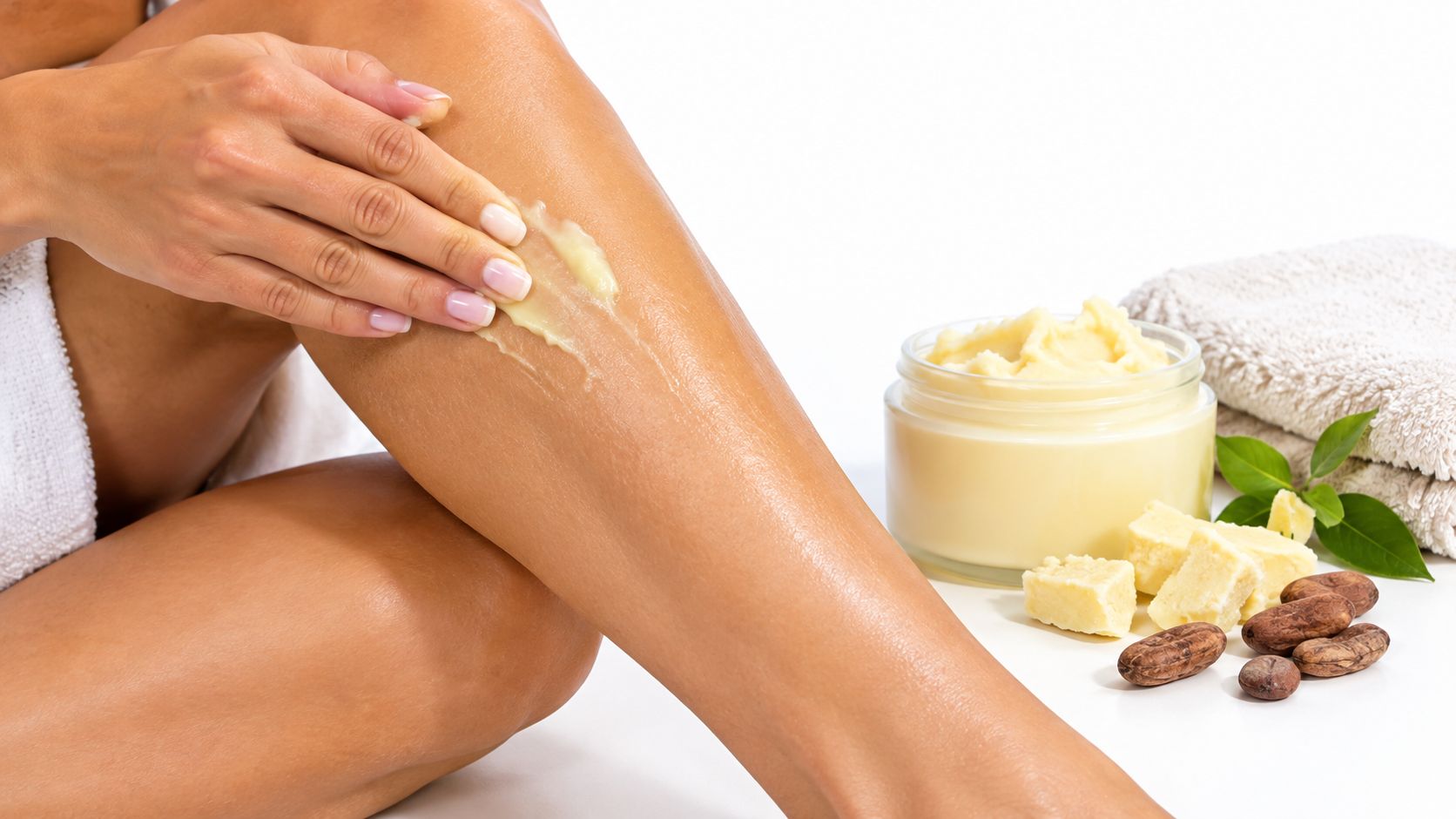
Cocoa butter has a real role in skincare, just not the role of a verified UV filter. As an emollient, it helps soften the skin's surface and gives creams a richer texture. Its lipid-rich layer can also help reduce moisture loss, which is why it's used in products designed to leave skin feeling conditioned.
Those qualities can be useful in a moisturizer or as a supporting ingredient in a sunscreen formula. The distinction is between skin feel and moisture support on one hand, and validated UV protection on the other. One doesn't establish the other.
| Cocoa butter can contribute | Cocoa butter doesn't establish |
|---|---|
| A rich, emollient texture | A validated SPF for a finished product |
| A lipid-rich surface layer that helps reduce moisture loss | Broad-spectrum protection |
| A conditioned, softer skin feel | The product's application directions or reapplication needs |
This is why a product developer may choose cocoa butter to improve occlusivity, spread, or sensory feel while relying on tested sunscreen ingredients and finished-formula testing to support a protection claim. A consumer can make the same distinction: choose a cocoa-butter cream because it suits your moisturizing routine, not because the ingredient name implies sunscreen performance.
If you enjoy a richer moisturizer, apply it as skincare and use a tested sunscreen separately during the day. For a closer look at how cocoa butter can fit into a cosmetic cream, see this guide to cocoa butter cream for the face.
You can use a cocoa-butter moisturizer and sunscreen in the same routine. Keep their jobs clear and apply the moisturizer first, then finish with a tested broad-spectrum sunscreen. A rich layer can take time to settle, so wait until the skin feels settled before applying sunscreen over it.
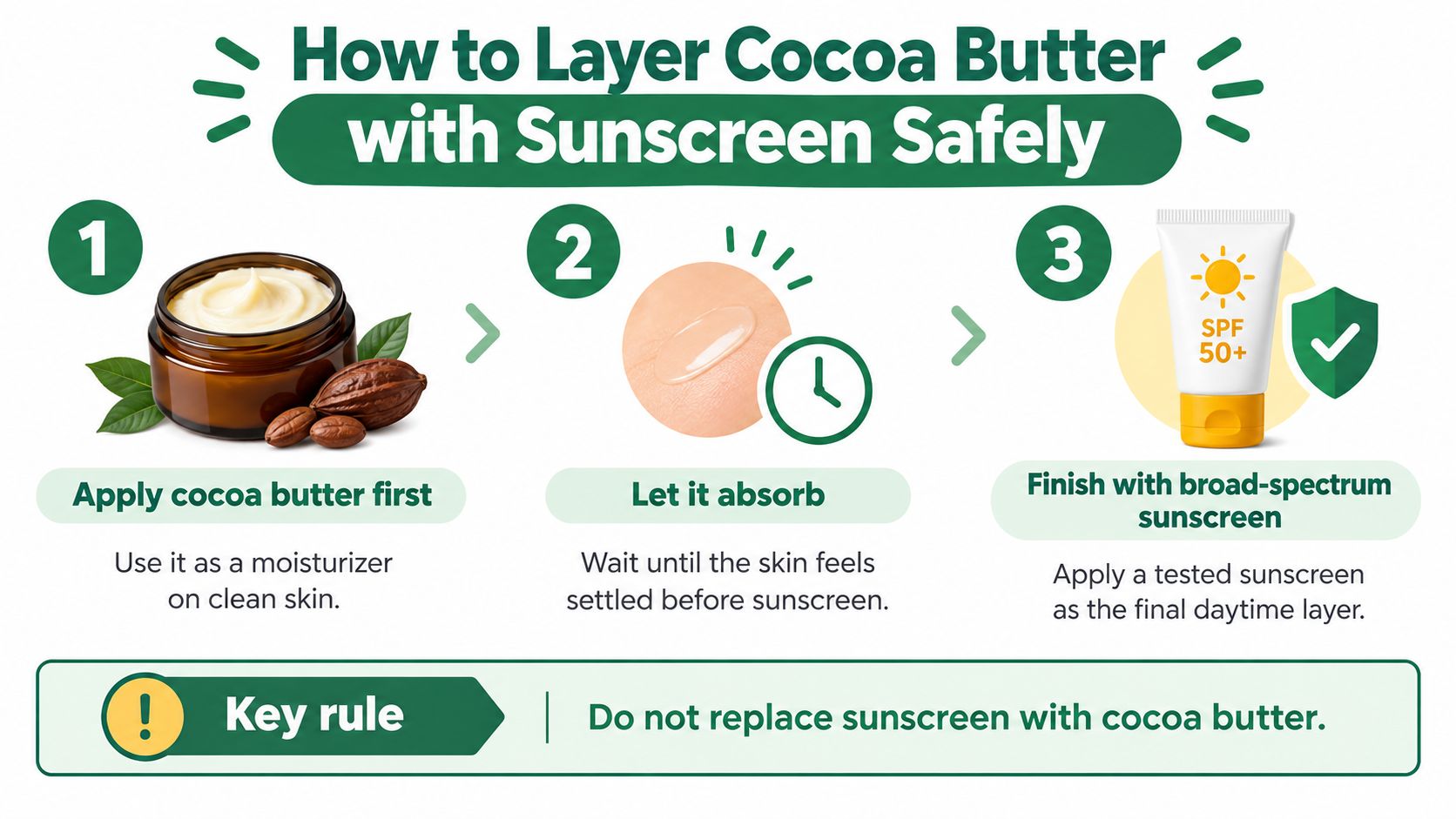
Using a moisturizing base doesn't extend the sunscreen's protection time. Nor should a product that prominently features cocoa butter be treated as sunscreen if it doesn't have a supported SPF claim.
Keep the order simple: moisturizer first, sunscreen last, and follow the sunscreen label for how to use and reapply it.
If a particular cocoa-butter cream leaves a heavy layer or makes it harder for you to apply sunscreen evenly, use less, choose a lighter moisturizer, or keep cocoa butter for another part of your routine. The best sequence is the one that lets you apply the sunscreen according to its directions and repeat the routine consistently.
A label tells you what a manufacturer claims about a product, but the regulatory route behind those claims can vary by market. In the United States, sunscreens are generally regulated as over-the-counter drugs, while many European and Asian markets regulate them as cosmetics. That means approval pathways and labeling expectations aren't identical worldwide.
The available filters differ, too. The FDA hasn't approved a new sunscreen filter since the 1990s, while newer filters are available in some other countries. Australia's regulator is reviewing testing requirements after a 2025 consumer report raised concerns about inaccurate SPF labeling (review of sunscreen testing and labeling issues). These differences don't make a product's origin proof of performance. They make it more important to check the actual label and the market authorization.
The direction of photoprotection research is also widening beyond UVB alone, with more attention to UVA1 and visible light. Tinted formulas containing iron oxides are one example of products designed with visible-light protection in mind. That doesn't mean every tinted product offers the same coverage; the specific formula and its claims still matter.
Ask what supports the exact product's claim, not what the ingredient sounds like.
Cocoa butter can remain a valuable conditioning ingredient in a formula, but it isn't a substitute for evidence about the finished product. When in doubt, evaluate the sunscreen claim and directions rather than relying on words such as “natural” or “plant-based.”
A simple routine is easier to repeat: use a moisturizer that feels comfortable, then apply a tested broad-spectrum sunscreen as directed. Cocoa butter may suit someone who likes a richer, conditioning layer, but individual products can feel different on different skin. Introduce new products gradually and keep the routine uncomplicated while you decide whether the texture works for you.
If a rich cream makes sunscreen harder to apply evenly, adjust the amount or choose another moisturizer. The priority is a sunscreen layer you can apply as directed, not fitting a particular ingredient into every step. Avoid treating the moisturizing base as a source of added protection unless the finished product has a supported sunscreen claim.
Think of plant-based skincare as part of caring for normal skin function and everyday comfort. It doesn't need to replace sun protection to have a place in a routine. For more ideas about maintaining moisture in a simple skincare routine, explore natural skin hydration.
Consistency matters more than making the routine elaborate. Choose products you can use comfortably, follow the sunscreen label, and keep the distinction clear: moisturizer supports skin feel, sunscreen provides the tested protection.
Cocoa butter can condition skin, while a tested broad-spectrum sunscreen provides the protection supported by the finished product's testing. Choose sunscreen with a regulated SPF and broad-spectrum or equivalent UVA labeling, use your moisturizer for comfort, and reapply as directed.
For plant-based wellness and skincare, AloeCure describes a vertically integrated approach: the company farms its aloe, processes it on-site within 12 hours of harvest, and offers pure aloe vera skincare through its sister company ALODERMA. Explore the product range and Subscribe & Save option for ongoing routine support.
Explore AloeCure for plant-based aloe products, including pure aloe vera skincare from ALODERMA, made by a company that farms and processes its own aloe. If you're building a steady wellness routine, see whether Subscribe & Save, with 20% off subscriptions, fits the way you shop.
Les commentaires sont approuvés avant leur publication.