Votre panier est vide


You're staring at the ceiling after a long, screen-heavy day. Your body feels tired, but your mind hasn't received the message that the day is over. A sleep support supplement may seem like a simple answer, yet the right choice depends on why sleep feels difficult, which ingredients you tolerate, how much you're taking, and whether the label gives you enough information to make a sound decision.
The useful question isn't “What's the best sleep support supplement?” It's “Which formula, format, dose, and quality standard fit my sleep goal?” That shift can help you choose more thoughtfully and build a routine that supports healthy sleep habits rather than replacing them.
At 10:30 p.m., one person may need support with falling asleep. Another may fall asleep quickly but wake during the night. A third may sleep for what seems like enough time yet feel sluggish the next morning. These are different experiences, so a single formula won't necessarily suit all three people.
A product designed around melatonin may be most relevant to sleep timing and sleep onset, while a blend built around relaxation ingredients may better fit an evening routine dominated by mental tension. A prolonged-release format may suit someone who wants support later in the night, whereas immediate-release melatonin is generally positioned closer to the beginning of sleep. The ingredient profile should match the goal instead of relying on a large serving size to do everything.
Read the Supplement Facts panel before you focus on the front label. Look for the exact amount of each active ingredient, the serving size, the suggested timing, and whether the product contains a blend that hides individual doses.
A transparent label helps you answer practical questions:
Practical rule: Choose for the sleep goal first, then compare dose, delivery format, and label clarity.
Quality also matters because two products with similar front-label promises may differ in sourcing, testing, manufacturing controls, and consistency. A gummy may be convenient, while a capsule may make precise dosing easier. A powder may fit a calming evening beverage, but it requires careful measuring and a compatible routine.
The global category has crossed the multibillion-dollar threshold. One independent estimate values it at about USD 7.8 billion in 2026 and projects roughly USD 12.8 billion by 2033, with an implied 5% CAGR. Melatonin remains the leading ingredient segment, with estimates placing its share at 35% or 30% in 2025, depending on the report (Fairfield Market Research sleep supplement market estimate). That scale gives shoppers more choice, but it also makes careful comparison more important.
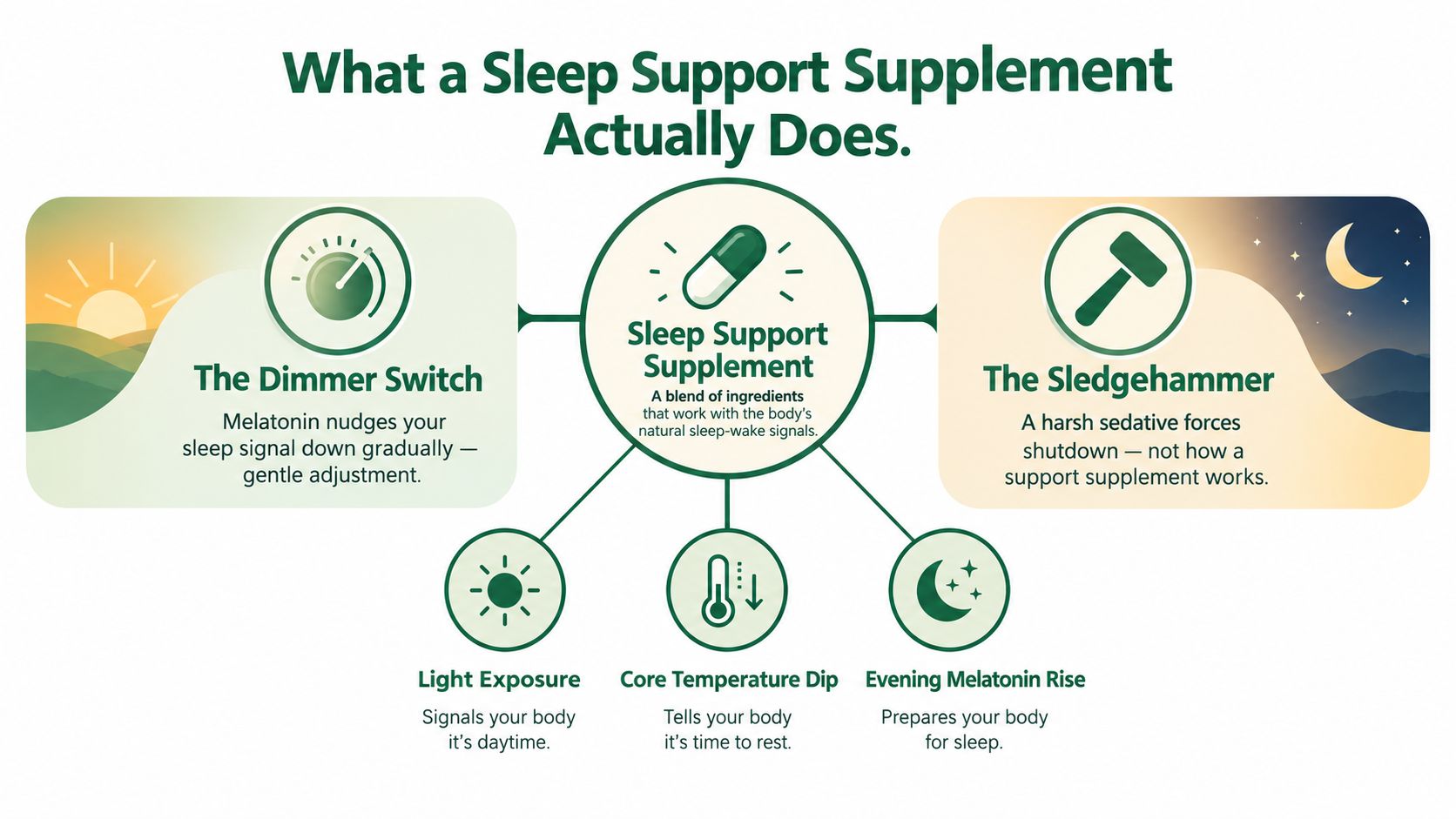
A sleep support supplement is generally a blend of ingredients intended to work with the body's natural sleep-wake signals. It isn't one single type of product. The formula may focus on sleep timing, evening relaxation, overnight continuity, or a combination of these goals.
Melatonin is best understood as a dimmer switch, not a sledgehammer. It can provide a cue associated with the body's evening sleep signal. That's different from forcing the body into an abrupt shutdown. The timing of light exposure, the evening environment, and a consistent bedtime still influence how useful that cue feels.
Herbal ingredients such as valerian and chamomile are commonly included in formulas intended to promote relaxation. Amino acids such as L-theanine and GABA are also used in some blends for an evening calming effect. These ingredients don't all act through the same pathway, and a product's overall experience depends on its combination, serving size, and delivery form.
Collagen combinations serve another purpose. A formula pairing collagen peptides with sleep-supportive nutrients may appeal to people who want a nighttime wellness routine that includes support for skin, joints, and other tissues alongside sleep-focused ingredients. That broader positioning still shouldn't be confused with a promise to manage a medical condition.
The practical distinction is simple: a supplement aims to support existing physiology, while a sedating product may be intended to force a stronger effect. For that reason, “natural” doesn't automatically mean suitable for everyone, and “non-habit-forming” should be understood as a product-positioning statement that still requires responsible use.
The main ingredient families differ in both purpose and evidence. A useful label review starts by asking what each compound is intended to contribute, rather than treating every inclusion as interchangeable.
Melatonin is the most established historical sleep-support ingredient. A meta-analysis summarized through NIH and NCBI sources found an average reduction in sleep-onset latency of about 7 minutes and an increase in total sleep duration of about 8 minutes compared with placebo. Another PubMed meta-analysis reported a statistically significant improvement in sleep quality, with a Pittsburgh Sleep Quality Index weighted mean difference of -1.24, a 95% confidence interval from -1.77 to -0.71, and p = 0.000 (PubMed melatonin meta-analysis).
Independent guidance commonly suggests starting adults at 0.5 to 1 mg, with a usual effective range of 1 to 5 mg, taken about 20 to 60 minutes before sleep (Sleep Foundation melatonin dosage guidance). Clinical references describe studied adult doses ranging from 0.1 mg to 10 mg, sometimes taken up to 2 hours before bedtime, and identify both prolonged-release melatonin at 2 mg and immediate-release melatonin at 2 mg to 6 mg among studied regimens (NCBI clinical reference). These ranges are not a recommendation to choose the highest amount. Lower dosing may be a more sensible starting point.
Valerian root, chamomile, lemon balm, and ashwagandha often appear in relaxation-oriented formulas. Valerian, chamomile, and lemon balm are commonly associated with a calming evening ritual, while ashwagandha is generally positioned as an adaptogenic botanical for everyday stress support.
The evidence for these ingredients is mixed and formulation-dependent. Extract type, plant part, dose, extraction method, and combination with other ingredients can change the product's profile. A label that names the plant without identifying the extract details leaves important questions unanswered.
L-theanine is often chosen for a calmer mental transition into bedtime. Glycine is associated with processes that may support the body's normal nighttime temperature pattern. GABA appears in some relaxation blends, although its role can vary according to the product and formulation.
Magnesium deserves cautious interpretation. A recent review concluded that evidence remains insufficient for routine use in insomnia, while a 21-day double-blind study examined 1 g per day of magnesium-L-threonate in 80 adults aged 35 to 55 with self-assessed sleep problems, using subjective measures and objective wearable tracking (magnesium-L-threonate study and review). That makes magnesium a potential adjunct to evaluate carefully, not a proven first-line answer. For a closer look at forms and label considerations, see this guide to magnesium supplement selection.
Collagen peptides paired with sleep-supportive nutrients create a broader nighttime wellness concept. The pairing may appeal to someone who wants one routine that includes melatonin for sleep timing and collagen as a structural protein source. AloeCure's Melatonin + Collagen Sleep Support is one example of that combined format.
The important point is transparency. Check the amount of collagen, the amount of melatonin, serving instructions, and any additional ingredients. A multi-purpose formula can be convenient, but convenience shouldn't prevent you from understanding what you're taking.
A low-and-slow approach gives you useful information without immediately exposing you to a stronger serving than you need. Start with the lowest labeled melatonin dose, which is often 0.5 mg, and adjust only if sleep onset remains slow after you've used the product consistently and followed the label.
Timing matters because melatonin is a chronobiotic, meaning its effects can change according to when you take it. Common guidance places it about 20 to 60 minutes before sleep, while clinical references describe some regimens taken earlier in the evening. A higher amount can create next-day grogginess without adding meaningful support for falling asleep.
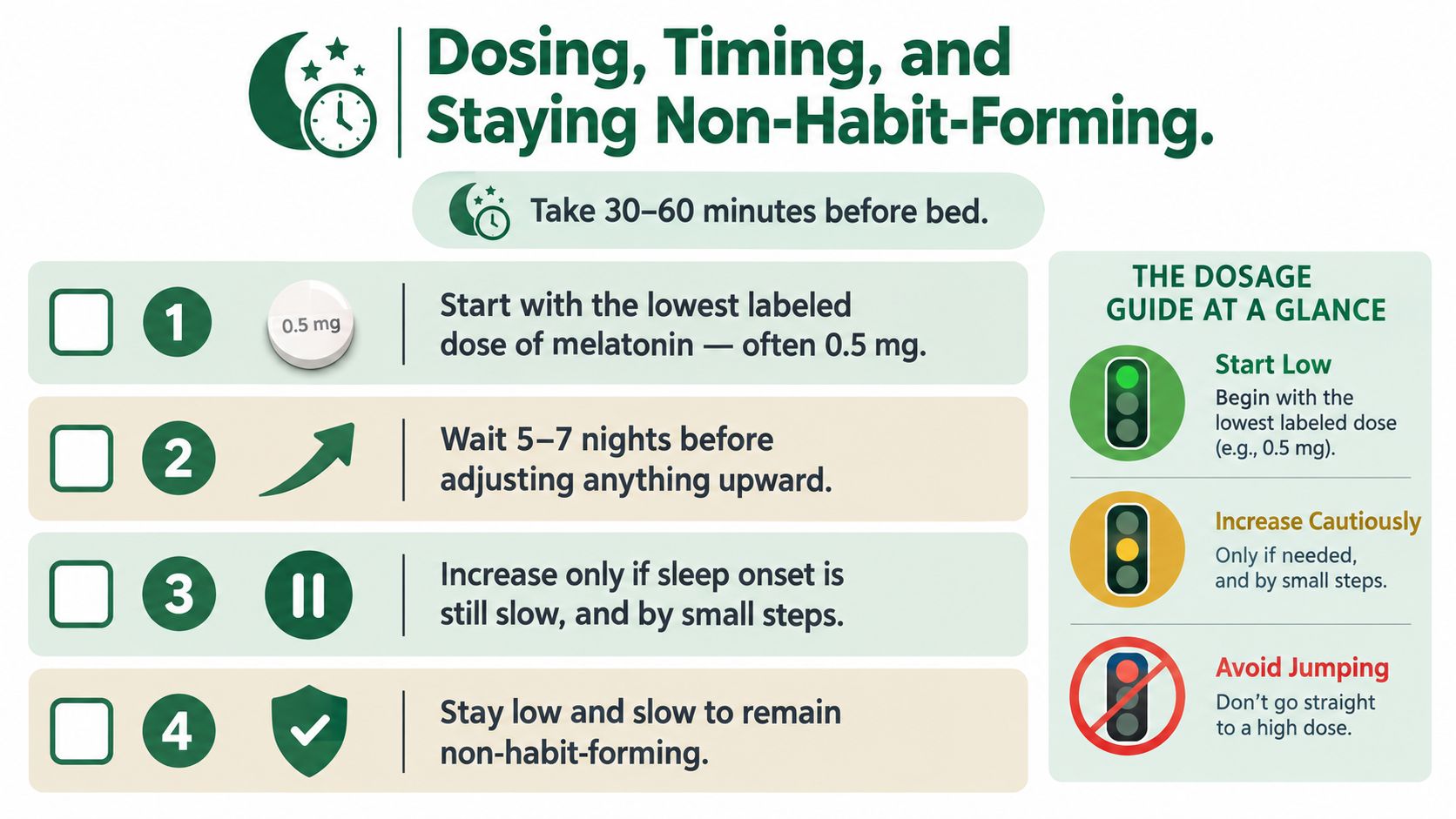
Use one formula at a time when possible. If you change the product, dose, bedtime, and evening beverage all at once, you won't know which change affected your experience.
A supplement's “non-habit-forming” positioning doesn't remove the need for care. Responsible use means avoiding impulsive increases, checking ingredient overlap, and asking a qualified healthcare professional about personal circumstances. People who are pregnant, taking medications, managing an ongoing health concern, or preparing for a procedure should seek individualized advice before using a new supplement.
If you're considering magnesium, L-theanine, or another amino acid alongside melatonin, introduce changes carefully rather than starting several products together. You can also review melatonin side-effect considerations before choosing a routine.
Consistent lights-out habits remain central. Dim the room, reduce stimulating screen exposure, and give the formula a predictable setting in which to work. Supplements should support sleep hygiene, not substitute for it.
Delivery format changes how easy a product is to use and how precisely you can follow its serving instructions. Capsules often provide straightforward dosing with minimal flavor ingredients. Gummies may taste better and fit some routines, but they can add sugars and make precise formulation more challenging. Tablets can be shelf-stable and compact, while powders allow flexible mixing and may suit a warm, caffeine-free evening drink.
| Format | Dose Precision | Onset | Portability | Watch For |
|---|---|---|---|---|
| Capsules | Usually straightforward | Depends on the formula | High | Capsule materials and inactive ingredients |
| Gummies | Can be less precise | Depends on the formula | High | Added sugars, flavorings, and serving size |
| Tablets | Straightforward when clearly labeled | Depends on the formula | High | Larger tablets and compression agents |
| Powders | Flexible but measuring-dependent | Depends on the formula | Moderate | Scooping accuracy, flavorings, and allergens |
A strong label identifies the exact milligram amount per serving, not merely the total quantity of a proprietary blend. It should also list excipients, manufacturer contact details, country-of-origin information where provided, and clear storage and use instructions. Quality seals and independent testing can add useful verification, but shoppers should still understand what each certification covers.
Look for recognized third-party programs such as USP, NSF, or Informed Sport when relevant to your needs. Good manufacturing practice controls, commonly described as CGMP, also matter because they address manufacturing consistency and quality systems.
A company that provides lot testing or a certificate of analysis gives you more information than one that relies only on broad front-label language. Claims such as “natural,” “clean-label,” or “drug-free” don't prove potency or consistency on their own. For a practical walkthrough, use this guide on how to read supplement labels.
You can apply the same scrutiny to powdered botanical ingredients. A detailed Aroma Warehouse moringa buyer guide illustrates the kind of sourcing and product-detail questions shoppers can ask before buying any plant-based powder.
FDA explains that structure/function claims can describe the role of a nutrient or dietary ingredient in normal body structure or function, but they can't state that a product diagnoses, treats, cures, or prevents a disease. Labels using those claims must carry the required disclaimer, and manufacturers must submit a notification to FDA no later than 30 days after first marketing a product with a structure/function claim (FDA structure/function claims; FDA notification requirements). FDA also notes that these claims aren't subject to premarket review or authorization in the same way as health claims (FDA label claim guidance).
Vertical integration means one company controls more stages of production instead of passing raw materials through a chain of unrelated brokers and contractors. That control can make ingredient origin, processing conditions, and batch records easier to trace.
AloeCure's parent company, AGHG, owns and operates its aloe farms, hand-harvests USDA- and EU-certified organic aloe, and processes the aloe on-site within 12 hours of harvest, according to the publisher's company information. The farms are described as sustainably certified and operate as agro-tourismos that welcome more than 250,000 people every year. Those company-specific claims should be verified through the brand's own documentation and current certification records.
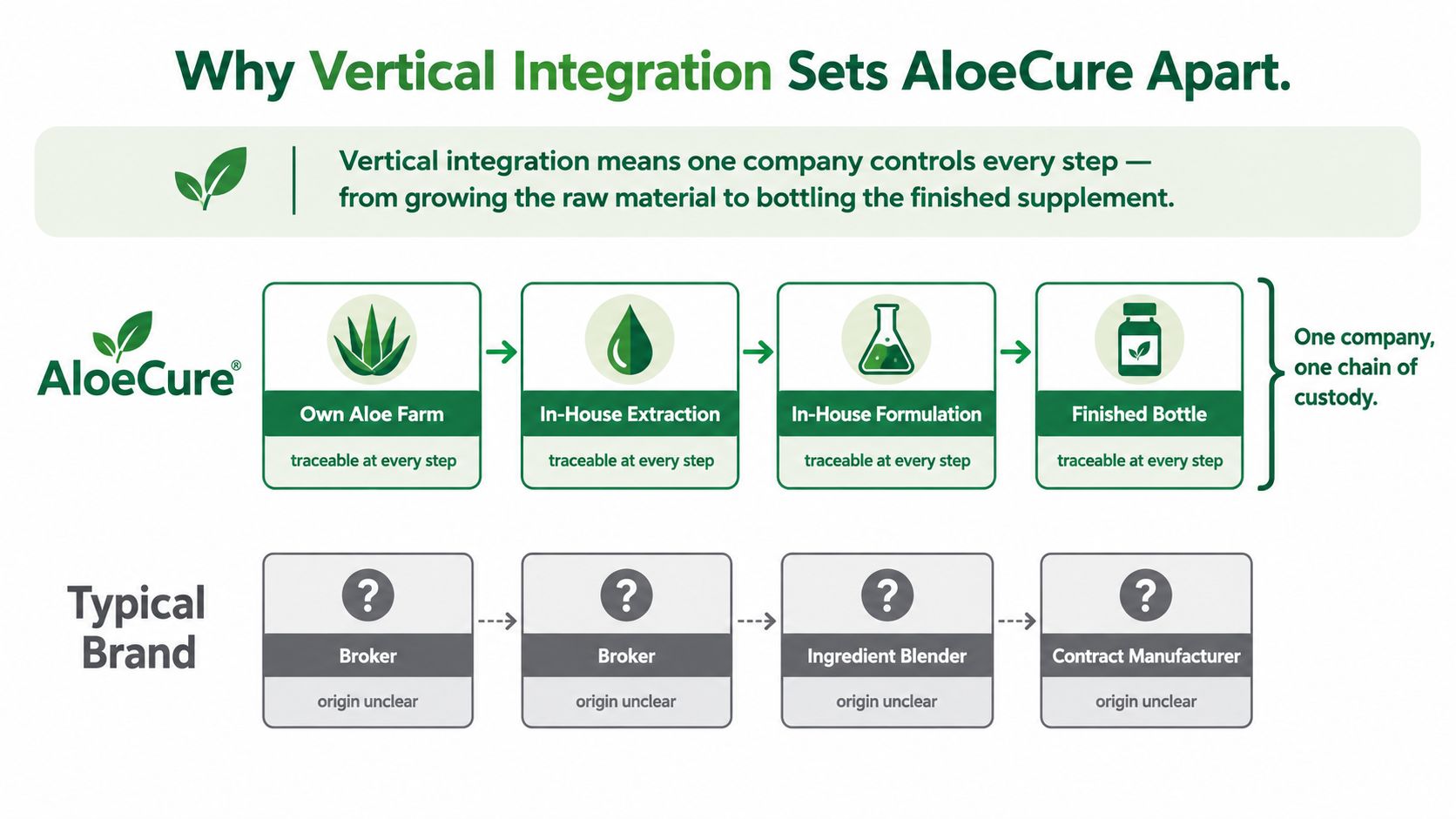
A vertically integrated model can support clearer chain-of-custody records. It may reduce uncertainty around where a plant material originated, how it was processed, and which party handled it before the finished product was packaged. It doesn't automatically prove that every finished ingredient is superior, so shoppers should still request certificates, review testing information, and inspect the Supplement Facts panel.
AloeCure describes its aloe processing method as proprietary, patented, and natural, and says it avoids chemicals, enzymes, concentrates, and charcoal filtration. Those details relate specifically to its aloe operations, not automatically to every ingredient in a sleep formula. For a Melatonin + Collagen product, the relevant quality questions still include the origin and testing of the melatonin and collagen, finished-batch controls, and clear serving information.
Traceability is useful when the brand can connect its claim to records, certifications, and a specific finished lot.
A company that farms and processes its own aloe can credibly explain that portion of its supply chain. That's different from claiming that vertical integration alone guarantees a particular nighttime experience. Use it as one quality signal alongside transparent dosing, independent testing, manufacturing controls, and a clear customer-service channel.
Use this checklist before selecting a sleep support supplement:
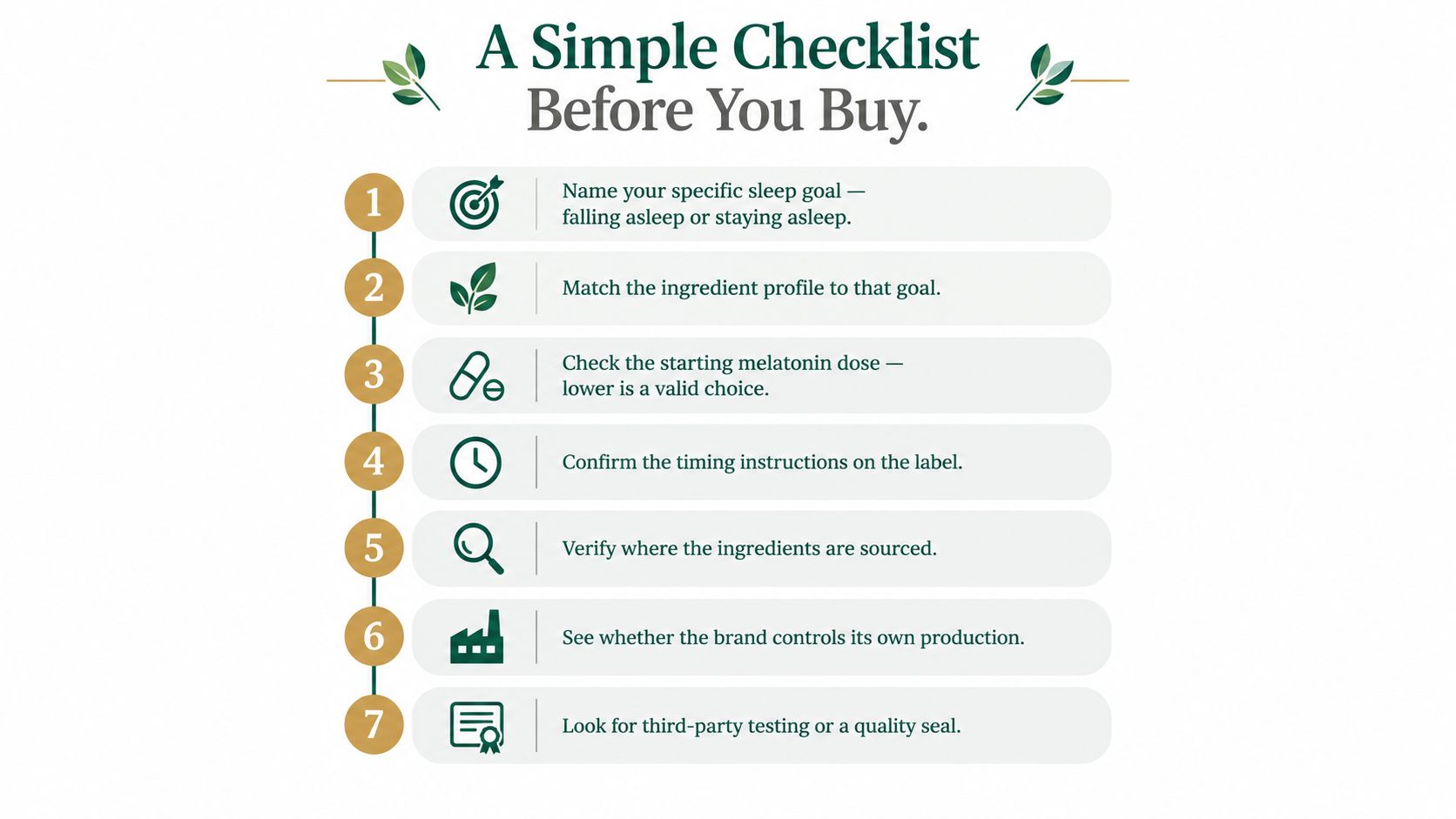
After you've chosen a product, keep your routine steady and track bedtime, estimated sleep onset, night waking, morning alertness, and any unwanted effects. Re-evaluate after two weeks rather than changing the dose after one difficult night. If the product doesn't fit your routine or you experience concerning effects, pause and seek professional guidance.
Can melatonin be combined with magnesium or L-theanine?
Some formulas combine these ingredients, but personal suitability depends on your health circumstances, other products, and medications. Ask a qualified healthcare professional before combining supplements.
Is nightly use appropriate?
A consistent routine may suit some adults, while intermittent use may suit others. Follow the product label, avoid increasing the serving impulsively, and monitor next-day alertness.
How do I read a Supplement Facts panel?
Find each active ingredient and its amount per serving. Be cautious with proprietary blends that list a combined amount without showing the dose of every component. Check fillers, sweeteners, allergens, serving size, and manufacturer contact information.
What should I expect at first?
Keep expectations realistic. A supplement may support a sleep routine, but it won't replace consistent lights-out habits, a suitable bedroom environment, or individualized professional advice. Product quality also varies across the category.
These statements have not been evaluated by the Food and Drug Administration. This product is not intended to diagnose, treat, cure, or prevent any disease.
AloeCure offers Melatonin + Collagen Sleep Support for adults who want a clearly defined nighttime formula combining melatonin and collagen. Visit AloeCure to review the product details, compare the label with your sleep goal, and explore Subscribe & Save options with 20% off.
Les commentaires sont approuvés avant leur publication.