Votre panier est vide


If most studies report a positive result, why doesn't that tell you whether glucosamine chondroitin will help your knees on your morning walk? That gap sits at the center of this topic. Study counts describe groups, averages, and specific doses. Your decision is personal. You'll choose one product, take it on your schedule, and judge whether your own comfort and mobility change in a way you can clearly notice.
Glucosamine is an amino sugar found naturally in cartilage. Chondroitin sulfate is a sugar-based molecule that's also a normal part of cartilage, and both are sold as dietary supplements in capsule, tablet, and powder forms.
Readers often get tripped up by capsule size. A large capsule doesn't mean a large dose of either ingredient, because fillers and other ingredients take up space. Compare the milligrams per serving on the Supplement Facts panel instead.
| Ingredient | Common label form | Daily amount in the largest U.S. study | Typical source |
|---|---|---|---|
| Glucosamine | Glucosamine hydrochloride or sulfate | 1,500 mg per day | Often shellfish-derived or made by fermentation |
| Chondroitin | Chondroitin sulfate | 1,200 mg per day | Usually from animal cartilage |
| Combined | One capsule or tablet with both | 1,500 mg plus 1,200 mg per day | Most common pairing in published studies |
Those studied amounts give you a reference point, not a prescription. The 2006 trial report in The New England Journal of Medicine used glucosamine hydrochloride at 1,500 mg per day and chondroitin sulfate at 1,200 mg per day for 24 weeks. If a product you are considering lists half those amounts per daily serving, that's a real difference worth noting before you buy. You're no longer looking at the same intake that researchers studied.
Serving size matters just as much. Some labels list amounts per capsule, others per two or three capsules. Multiply carefully so you know what a full day provides, and check whether the directions match that serving. A bottle that looks like a month's supply can run out much sooner if the daily serving is several capsules.
Quick check: Write down the milligrams per day for each ingredient, not the total capsule weight. That one habit prevents most dose confusion.
Glucosamine is usually made from shellfish shells or produced by fermentation. Chondroitin usually comes from animal cartilage. Those details matter if you have a shellfish allergy, and they matter if you prefer vegetarian or vegan products. A label that doesn't state the source leaves you guessing, so ask the brand directly before ordering.
Form matters for a simpler reason too. Powders let you mix a serving into a drink, but they make it easy to scoop inconsistently. Capsules and tablets keep each serving fixed, though some people find larger tablets hard to swallow. Pick the form you'll take consistently, because an uneven routine makes your later tracking hard to interpret.
If a label lists a different amount than the studied amounts above, don't treat that as a deal breaker by itself. Just note the difference. You'll use that note again when you run the quality checks later, and again when you decide what a fair personal trial looks like.
Think of the cartilage in a joint as the padding in a well-used sofa cushion. A firm, water-holding filling keeps the surface springy under pressure. When that filling thins or dries out, the cushion feels flat and every shift in weight is easier to notice.
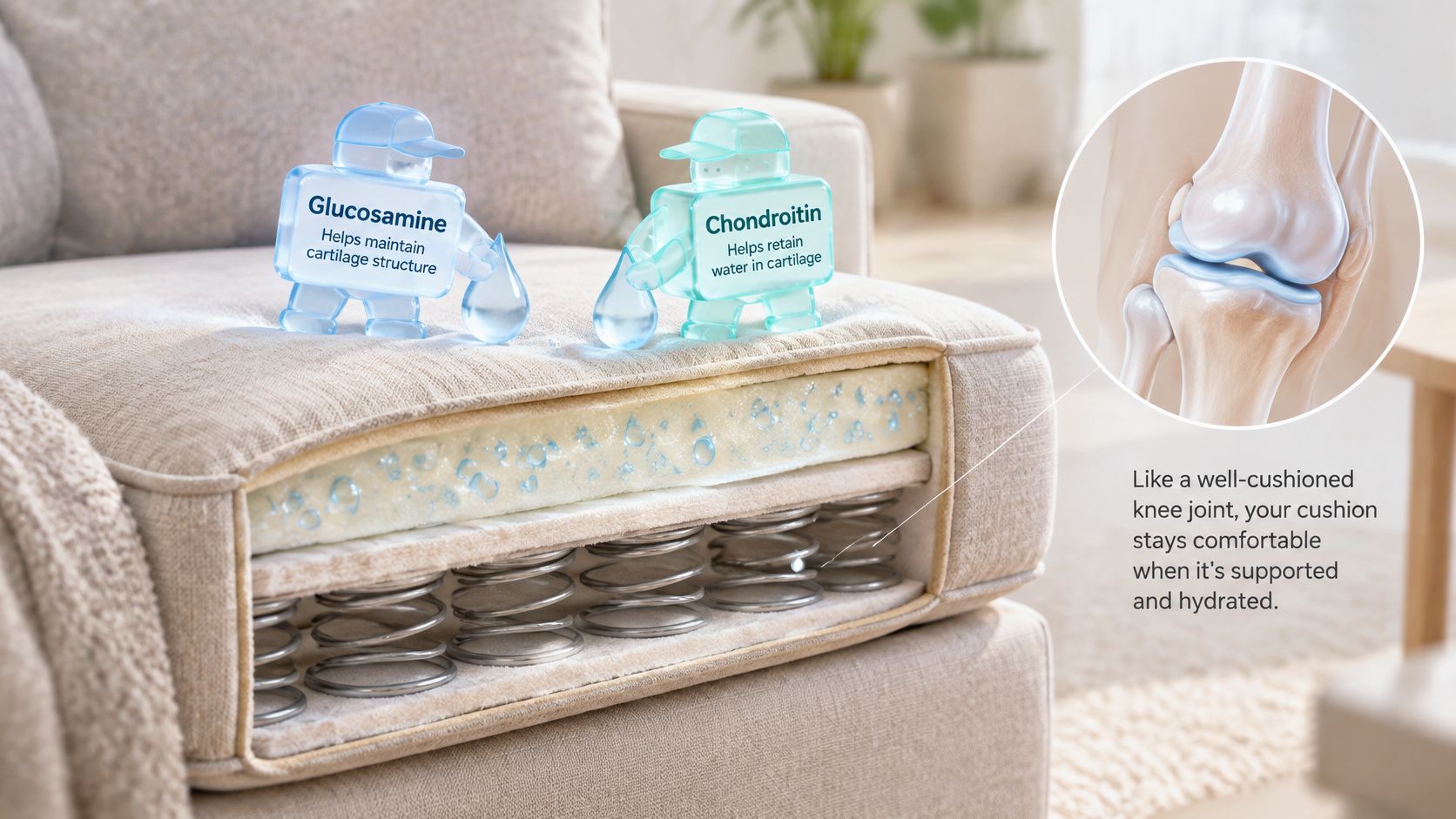
Glucosamine is a building block your body uses to make long molecules that form the cartilage matrix, the mesh that gives cartilage its structure. Chondroitin sulfate is one of those matrix molecules, and it's known for attracting and holding water. That water is part of what helps cartilage stay resilient when you stand, walk, or climb stairs.
The supplement idea follows from that picture. If you supply these building blocks from outside the body, you may support healthy joint function and help maintain the structure of cartilage that's already there. That's the proposed mechanism, and it's why these ingredients are marketed for everyday mobility rather than for immediate, same-day effects.
Be clear about the limits. This mechanism is a hypothesis drawn from laboratory work and smaller human studies. It isn't proof that a supplement rebuilds cartilage in any given person, and it doesn't mean every product delivers its ingredients to the joint in the same way. Promotional copy sometimes skips that distinction, so hold onto it.
Your body makes these materials on its own, but it tends to do so less efficiently as you age and as daily activity adds up over years. That's the gap supplements aim to fill. Whether filling it changes how your joints feel is a separate question, and only your own tracked response can answer it for you.
The supplement supplies raw materials. Whether they help any one person depends on that person's response over time.
How much should a pile of positive studies change your mind about a supplement? Start with scale, because scale shapes how much weight a headline deserves. A 2025 systematic review published in the journal Nutrients screened 2,013 articles and included 146 studies on glucosamine and/or chondroitin, with nearly 60% randomized controlled trials. Most addressed joint discomfort and mobility, and many efficacy studies reported positive outcomes.
That sounds decisive. A count of positive studies does not tell you whether a benefit was large enough to notice on a walk, which formulation was used, how long people took it, or whether the combination beat either ingredient alone. Those details are where your decision lies, and they are why the rest of this section separates a trial average from your own experience.
A well-known benchmark is the large trial sponsored by the National Institutes of Health. Researchers randomly assigned 1,583 adults with knee discomfort lasting at least six months to glucosamine, chondroitin, both together, an active prescription comparator, or placebo for 24 weeks. Random assignment and a placebo group matter because they let you separate the supplement's effect from natural ups and downs in how joints feel.
Across all participants, neither ingredient alone nor the combination produced a statistically significant improvement over placebo in the share of people reporting at least 20% less pain. The full trial report in The New England Journal of Medicine sets the responder rates at 60.1% with placebo, 64.0% with glucosamine, 65.4% with chondroitin, and 66.6% with the combination. Six in ten people improved on an inactive capsule. That is why testimonials cannot settle this question.
One exploratory finding looked different. About 22% of participants, roughly 354 people, entered with moderate-to-severe pain. In that subgroup, the published subgroup analysis reports 79.2% of the combination group reaching at least 20% less pain, compared with 54.3% on placebo, with P=0.002. That same review found the most common regimen was 1,500 mg glucosamine plus 1,200 mg chondroitin daily.
| Group | Share reaching at least 20% less pain (moderate-to-severe subgroup) |
|---|---|
| Placebo | 54.3% |
| Glucosamine alone | No significant subgroup result reported |
| Chondroitin alone | No significant subgroup result reported |
| Glucosamine plus chondroitin | 79.2% |
Read that table against the placebo row, not against zero. The combination showed no significant benefit in participants with mild pain. The subgroup was much smaller than the full trial, so it is not proof for everyone with stronger symptoms. What it does suggest is that baseline severity may shape who notices a difference. That is a reason to track your own starting point carefully rather than assume a group average predicts your result.
A useful way to judge your response is to pick two or three movements you do most days, such as climbing stairs, walking to the store, or rising from a chair, and score comfort and ease from 0 to 10 for four weeks. Compare the pattern with your starting scores, not with a single good or bad day. Positive study counts can tell you a treatment is worth testing. Your own tracked pattern is what tells you whether it is working for you.
Large studies haven't identified major general safety problems at the studied amounts, and side effects in the big trial were described as mild and infrequent. That's reassuring. It doesn't make these supplements risk-free for every person, and the specific exceptions below are the ones worth your attention.
The National Center for Complementary and Integrative Health summary on glucosamine and chondroitin safety and evidence notes that glucosamine can increase blood-glucose levels in some individuals and that both ingredients have been associated with increased bleeding risk in people taking a specific prescription blood thinner. It also notes that evidence is insufficient to establish safety during pregnancy or breastfeeding.
This is the detail most product pages leave vague. A reported case in the interaction record for this combination describes a 69-year-old man whose INR rose from 2.58 to 4.52 four weeks after starting glucosamine hydrochloride and chondroitin sulfate. A higher INR means stronger anticoagulation, which raises bleeding concern.
Keep that case in proportion. Clinical studies using about 1,500 mg glucosamine and 1,200 mg chondroitin daily have generally not reported bleeding complications, so this concern rests largely on case reports rather than proof of a common interaction. The practical step is still clear. If you take a prescription blood thinner, talk with your prescriber before starting, changing, or stopping either supplement, arrange any recommended INR monitoring, and never adjust a prescription on your own.
Natural origin doesn't remove the possibility of interactions. A plant or animal source tells you where an ingredient came from, not how it behaves alongside your medicines.
If you track blood sugar, check your readings after starting and review any change with a clinician instead of guessing at the cause. If you have a shellfish allergy, confirm the glucosamine source on the label before you buy, since shellfish-derived and fermentation-based versions both exist. If you're pregnant or breastfeeding, ask a clinician first, because safety hasn't been established for those stages.
| Situation | What to do first |
|---|---|
| Taking prescription blood thinners | Ask the prescriber before starting or stopping; arrange recommended INR monitoring |
| Tracking blood sugar or taking medicines that affect it | Check readings after starting and review them with a clinician |
| Shellfish allergy | Check the glucosamine source on the label before buying |
| Pregnant or breastfeeding | Ask a clinician first; evidence on safety is not sufficient |
| Taking several prescription medicines | Bring the full medicine list and the product label to the appointment |
Bring the actual product label to that conversation. Ingredient forms and daily amounts differ between brands, and your clinician can only judge the product you're really considering.
Quality checks won't tell you whether a supplement will help you. They tell you whether the bottle contains what the label promises, made under controlled conditions. Run these six checks in a store aisle or on a product page. For a refresher on panels and serving math, our guide on reading a supplement label step by step walks through each line.
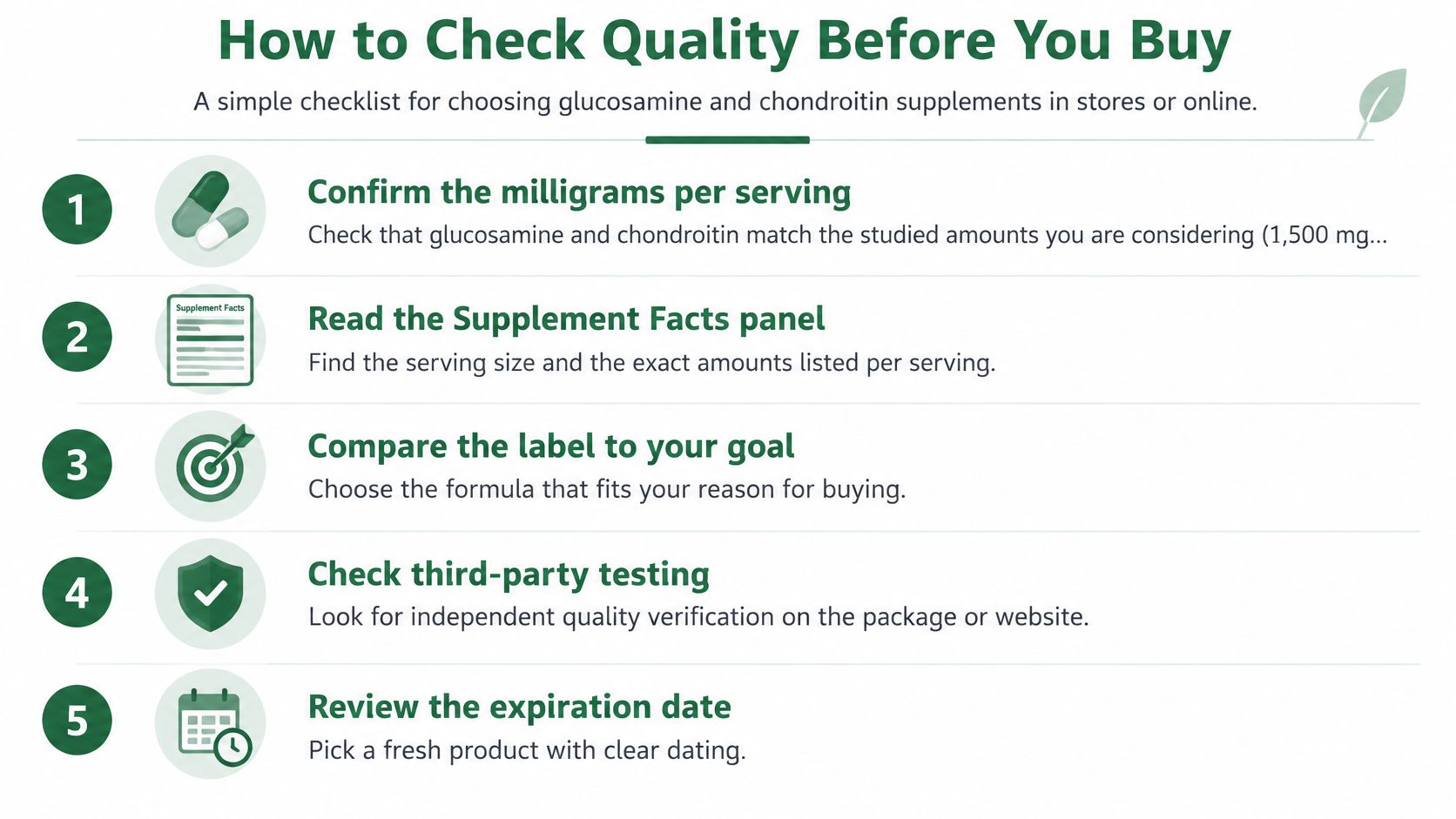
None of these checks establishes a medical outcome. They show how carefully a product is made, which is the part you can verify before spending money.
There's no single winner here, because the right option depends on your goal, your preferences, and what you're willing to do daily. The table puts four options on the same criteria so you can compare clearly.
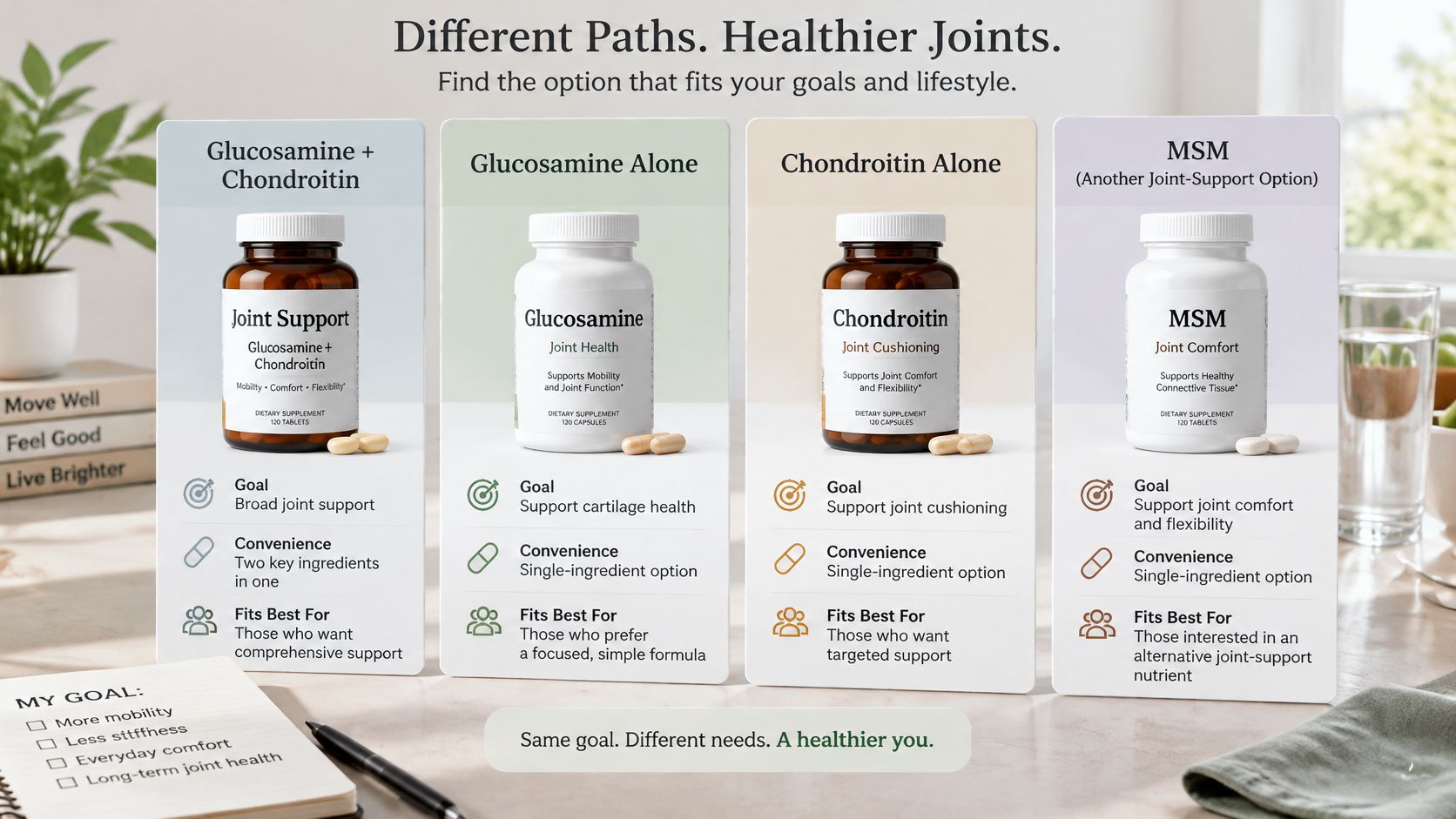
| Option | What it provides | Evidence to check | Best fit |
|---|---|---|---|
| Glucosamine plus chondroitin | Building blocks proposed to support existing cartilage structure | Mixed results; large U.S. trial showed no overall advantage over placebo; subgroup benefit exploratory | Readers who want a labeled dose to test for a set period |
| Plant-based joint formula (VeraFlex) | Plant-based ingredients from AloeCure | Review the ingredient studies listed on the product page before buying | Readers who prefer a plant-based formula |
| Daily movement and strength training | Supports mobility and general activity | Track your own walking distance and stair ability over time | Readers who want no-cost habits alongside any supplement |
| Body weight and protein habits | Everyday load management and muscle support | Track body weight and daily protein intake consistently | Readers working on everyday routines |
Glucosamine chondroitin suits a reader who wants a defined daily dose and a clear before-and-after comparison. Its evidence is mixed, so it asks for patience and honest tracking rather than optimism. If you go this route, give it the same fair trial you'd give any other option.
A plant-based route suits readers who'd rather avoid shellfish or animal-derived ingredients. VeraFlex is our plant-based joint formula, and its product page lists the full ingredient panel and study details to review before buying. Judge it with the same tracking method, not with a lower bar. Our overview of everyday habits that support comfortable joints covers the routine side of that choice.
The short video below walks through how these options differ in daily use.
Movement and daily habits cost nothing and support general activity regardless of which supplement you pick. Some readers also explore supplements alongside supportive recovery wear from Thermo Recovery Wear as part of a broader comfort routine. Whatever you choose, test one option at a time. Start three things at once and you'll never know which one mattered.
A tracked trial turns a vague impression into a decision you can defend. Our guide on how long supplements take to show an effect explains why setting the period in advance matters.
For the plant-based route, VeraFlex Healthy Joint Support is priced at $29.95 USD, and subscribers can sign up for 20% off. For adults, VeraFlex is taken as 2 capsules twice daily for the first 7 days, then 2 capsules daily or as recommended by a physician, and we recommend taking it in the morning when you start your day. Wording such as "supports healthy joint function" and "promotes comfortable mobility" describes support for normal function, and the FDA page on structure/function claim notifications explains that manufacturers must hold substantiation and submit claim notification no later than 30 days after first marketing.
These statements have not been evaluated by the Food and Drug Administration. This product is not intended to diagnose, treat, cure, or prevent any disease.
Ready to run your own tracked trial with a plant-based formula made by a vertically integrated grower and producer? Visit AloeCure to review the VeraFlex ingredient panel, current directions, and subscription savings, then set your baseline before your first capsule so your results mean something.
Les commentaires sont approuvés avant leur publication.