Votre panier est vide


You've eaten reasonably well, but your day still feels unpredictable. Some mornings start with heaviness, while other days bring gas, bloating, or an uncomfortable lack of regularity. You may reach for a convenient capsule because you want steady digestive comfort without rebuilding your entire routine around supplements.
That's where prebiotic and probiotic capsules benefits become easier to understand. These formulas work with the microscopic community inside your digestive system, supplying helpful microorganisms, the fibers that nourish them, or both. The most useful approach isn't to assume every product works for everyone. It's to match the ingredient type, strain identity, delivery format, and personal wellness goal with realistic expectations.
Your digestive system is home to a busy ecosystem of microorganisms. Think of it as a city rather than a single organ. Different residents process available nutrients, produce useful compounds, and interact with the surrounding environment. When the community has suitable food and favorable conditions, it can support comfortable digestion and normal daily function.
That internal city responds to everyday life. Food choices, limited dietary variety, travel, changes in routine, and daily stress can all influence the environment where microorganisms live. You might notice the result as an unsettled stomach, occasional bloating, or bowel habits that feel less predictable than you'd like. These experiences don't automatically point to a specific condition, but they can make ordinary activities feel less comfortable.

A balanced internal environment supports normal digestive processes, nutrient handling, and communication between the digestive system and other body systems. Prebiotics and probiotics don't replace a varied diet, hydration, movement, or medical guidance. They can provide targeted support when your everyday routine leaves gaps.
Consumer interest in these products is not new. In the 2012 National Health Interview Survey, about 4 million U.S. adults, or 1.6% of adults, reported using probiotics or prebiotics during the previous 30 days, and these products ranked as the third most commonly used dietary supplement category outside vitamins and minerals. The survey also recorded use among 300,000 children ages 4 to 17, or 0.5%, during that period. The survey data and category context are summarized in this evidence review.
The lesson is practical: capsules have become a familiar way to support digestive wellness, but familiarity shouldn't replace careful selection. The internal ecosystem differs from person to person, so the same formula may not create the same experience for everyone.
Practical perspective: A capsule can support your routine, but it works within the larger environment created by your food, hydration, sleep, movement, and daily stress.
Start with a garden analogy. Probiotics are like seeds, because they contain live microorganisms selected for a particular purpose. Prebiotics are like fertilizer, because they provide fermentable fibers that existing or introduced microorganisms can use as fuel.
The distinction matters because the two ingredients perform different jobs:
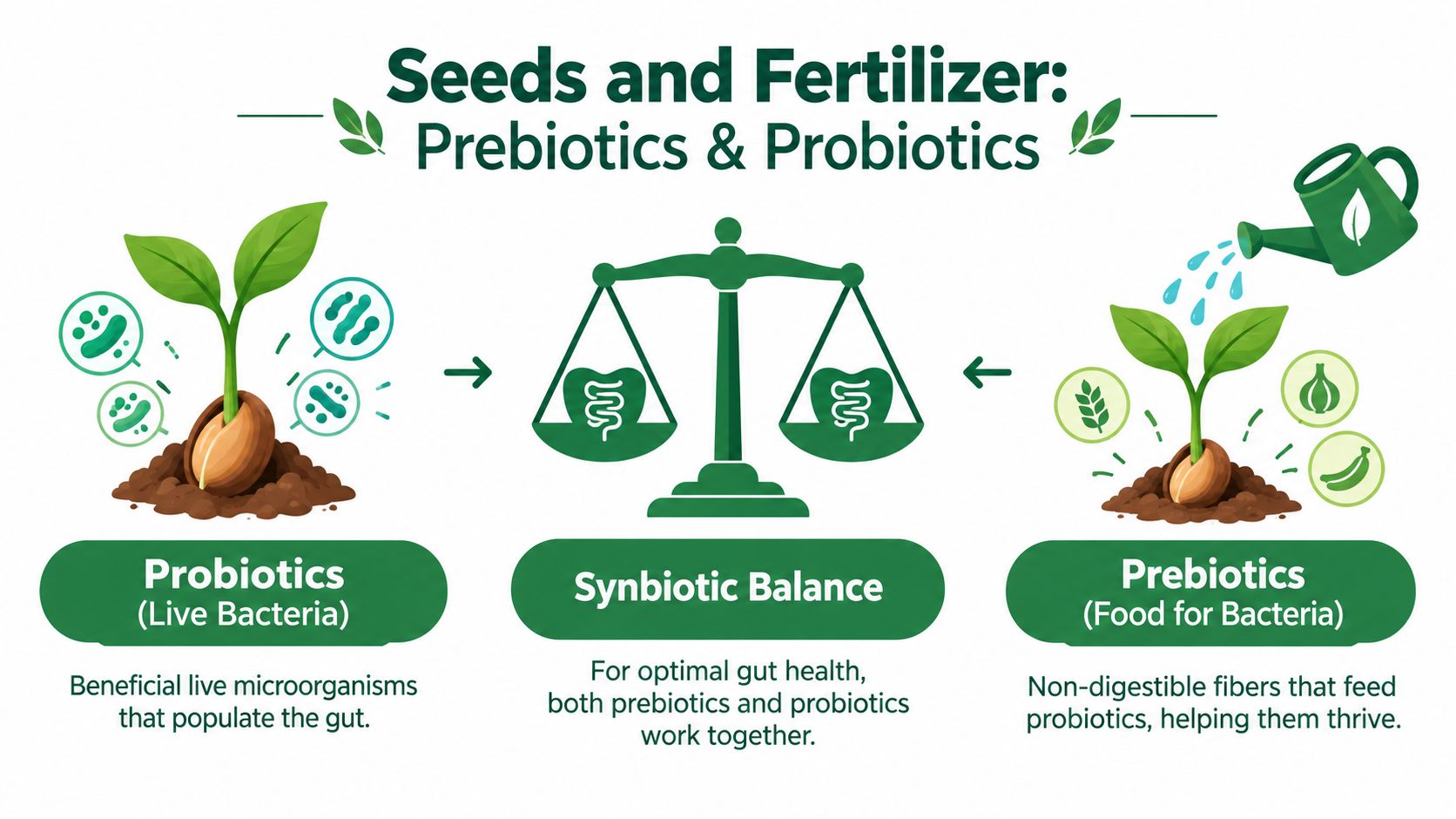
A probiotic-only capsule gives you the seeds, but not necessarily the preferred food source. A prebiotic-only capsule provides fuel for the microorganisms already present, but it doesn't add selected strains. A combined product attempts to coordinate both sides of the relationship.
The evidence supports that distinction. A meta-analytic summary reported an increase in Bifidobacterium abundance with prebiotics, SMD 1.09, 95% CI 0.31 to 1.86, p<0.001, and with probiotics, SMD 0.40, 95% CI 0.06 to 0.75, p<0.05. The same review cautioned that results weren't fully consistent across studies, reinforcing the importance of strain identity, viable counts, and a matched substrate. See the full evidence summary.
For a plain-language comparison of these categories, learn how prebiotics and probiotics differ. The clearer the distinction, the easier it is to choose a capsule based on what you want to support.
A synbiotic capsule begins with a simple sequence. You swallow the product, its delivery system carries the ingredients through digestion, and the prebiotic fibers become available to microorganisms in the lower digestive environment. Those microorganisms ferment the fibers and produce short-chain fatty acids, including butyrate.
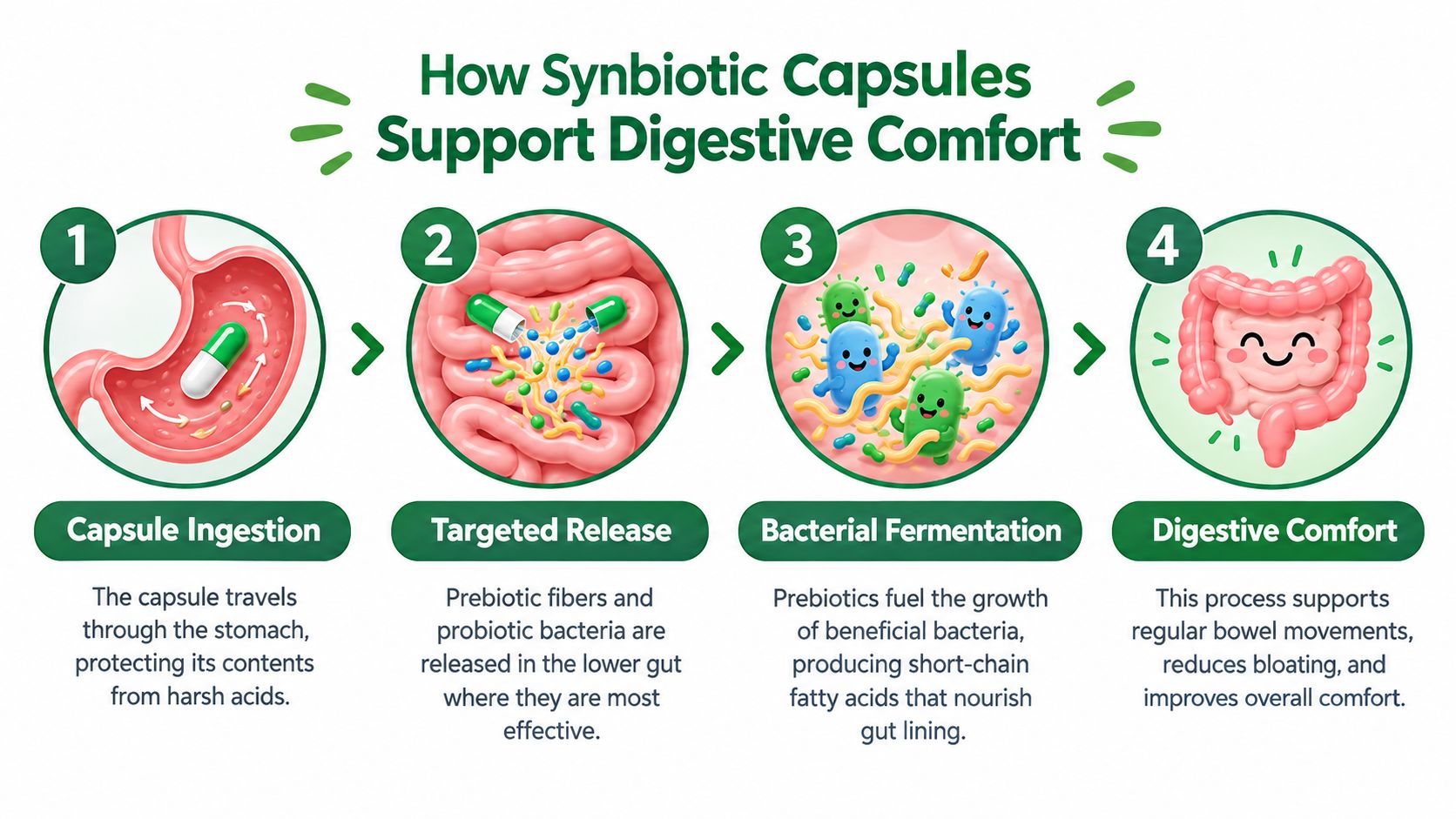
Fermentation is the key biological handoff. The body doesn't use every prebiotic fiber directly. Instead, selected microorganisms use the fiber as a substrate, producing metabolites that can support the intestinal lining and normal bowel function.
A 2026 review of prebiotics reported consistent increases in beneficial bacteria such as Bifidobacterium and Lactobacillus, along with increased short-chain fatty acid production. It associated these changes with stool frequency and consistency, intestinal barrier function, and immune-response modulation. Read the prebiotic review.
A separate 2026 randomized, placebo-controlled trial evaluated a multi-species synbiotic delivered through a capsule-in-capsule system. Daily supplementation significantly improved digestive quality of life, bloating, gas, abdominal discomfort, and bowel habits. The trial also reported sustained increases in microbial diversity, enrichment of beneficial taxa, higher fecal butyrate, and reduced CRP. Because the article's product claims must remain within structure/function boundaries, the useful takeaway is that a combined formula can support normal microbial activity and digestive comfort, not that it addresses a named medical condition. Review the trial details.
The probiotic supplies selected live microorganisms. The prebiotic gives them a usable food source. When the strain and substrate are well matched, the formula may create a more coherent delivery system than a generic blend that combines ingredients without explaining their relationship.
The microbiome doesn't operate in isolation. The intestinal lining, immune tissues, microbial metabolites, and nervous system communicate through several overlapping pathways. Supporting the gut environment can therefore be part of a broader wellness routine that includes immune function, mental balance, nutrition, and recovery.

A healthy intestinal barrier helps maintain the boundary between the digestive contents and the surrounding tissues. Microbial fermentation produces compounds that participate in this environment, while the gut-associated immune system responds to signals from both the microbes and the food passing through.
Use compliant language for this broader role:
These statements describe normal structure and function. They don't promise a universal result, and they don't imply that a supplement diagnoses, treats, cures, or prevents any disease.
The gut-brain connection adds another layer. Microbial metabolites can communicate with the nervous system through chemical and nerve-related pathways. That doesn't mean a capsule creates a particular mood or replaces foundational habits. It means a well-supported digestive environment can fit within a routine designed to promote overall vitality and a balanced response to everyday demands.
This short video offers additional context for readers who want a visual explanation of the gut-brain relationship:
A Mayo Clinic summary makes the important point that probiotics and prebiotics haven't been proven to improve health for everyone. A 2025 umbrella meta-analysis found that prebiotics and synbiotics may improve markers of gut barrier function such as lipopolysaccharide, but results were highly heterogeneous, and probiotic and synbiotic findings had very low certainty for some outcomes. Read the consumer guidance.
The better question isn't “Do these capsules work?” Ask which ingredient, strain, substrate, and wellness goal fit your needs.
Capsule quality starts before the finished bottle. A label may list impressive-sounding ingredients, but the useful details are the identity of the probiotic strains, the viable count, the stability of the delivery system, and the quality of the prebiotic substrate.
| Formula type | What it provides | When it may fit |
|---|---|---|
| Probiotic-only | Selected live microorganisms | A targeted routine built around clearly identified strains |
| Prebiotic-only | Fermentable fibers for microbial food | Someone prioritizing substrate support from a botanical or fiber source |
| Synbiotic | Probiotics paired with prebiotics | A coordinated approach that supplies both live microorganisms and fuel |
Look for genus, species, and strain identity rather than a broad bacterial label. Check whether the product identifies viable counts and explains how potency is maintained through the product's shelf life. A formula should also make the prebiotic source clear, because “fiber blend” doesn't tell you whether the substrate is intentionally matched to the included microorganisms.
A pure botanical substrate can be more meaningful than a generic filler. Inner-leaf aloe, for example, can provide a plant-based foundation within a broader capsule formula when it is harvested and processed carefully. The source, handling time, filtration choices, and testing standards all influence what reaches the finished product.
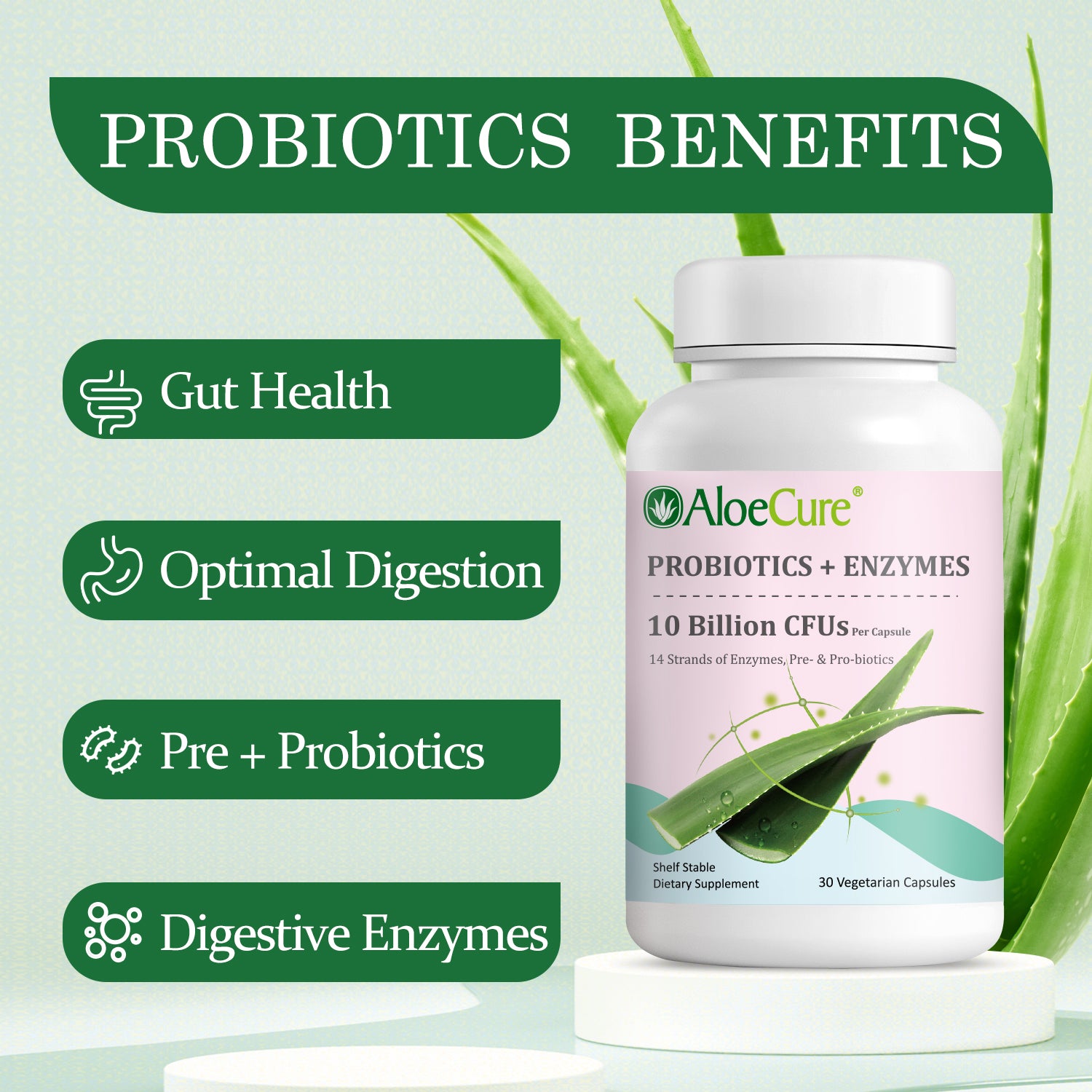
AloeCure's Pre+Probiotic & Digestive Enzyme Blend combines probiotic strains, prebiotics, and digestive enzymes in capsule form. The company operates a vertically integrated model, farming its aloe, processing it, and producing its own products. Its stated process avoids chemicals, charcoal filtration, concentrates, and enzymes during aloe processing, using pure inner-leaf aloe as a botanical substrate. Use this guide to read supplement labels more critically.
Vertical integration doesn't automatically prove that a product will work for every person. It does provide greater control over sourcing and processing. Third-party certifications, traceability records, storage conditions, and transparent testing add further value when you're comparing formulas.
A capsule routine works best when it fits an ordinary day. Begin with the product label, since ingredients, capsule design, and serving guidance differ between formulas. Some are intended to be taken with food, while others may be used separately. Timing should follow the specific formulation rather than a universal rule.
A simple setup can keep the habit manageable:
Microbiome changes and digestive habits can develop gradually. For more on what to expect, learn how to tell if probiotics are working. The 2020 systematic review and meta-analysis found improved global symptom scores in adults using probiotics, while also reporting substantial variation between studies. Evidence for prebiotics was scarce in that review. Read the adult evidence review.
Set a useful expectation: Look for a steady pattern in everyday comfort, not a dramatic promise after a single capsule.
Ask a qualified healthcare professional before starting a supplement if you are pregnant, immunocompromised, caring for a child, or managing a complex health concern. A 2026 review reported that most biotics were well tolerated, while identifying safety concerns in vulnerable pediatric populations. Safety can vary by strain, population, and condition. Review the safety discussion.
These statements have not been evaluated by the Food and Drug Administration. This product is not intended to diagnose, treat, cure, or prevent any disease.
A well-supported microbiome is one part of a larger daily system. Food supplies fibers and nutrients, movement supports normal body function, hydration helps maintain comfortable routines, and sleep gives the body time to recover. Prebiotics, probiotics, and digestive enzymes can fit into that framework as targeted support rather than as substitutes for the fundamentals.
Use a simple four-part routine:
Whole-body wellness also includes the evening routine. If you're exploring gentle ways to support rest during changing life stages, learn more about natural sleep for menopause as a separate educational resource. It's useful to keep each wellness goal in its proper context rather than expecting one capsule to do everything.
AloeCure's Subscribe & Save program offers 20% off subscriptions, flexible delivery, a 90-day money-back guarantee, and thousands of verified reviews. The company also states that its vertically integrated operation farms, processes, and produces its own aloe products, with traceability and third-party certifications supporting its manufacturing approach.
If you're ready to make synbiotic support part of a consistent wellness routine, explore AloeCure's Pre+Probiotic & Digestive Enzyme Blend and review the label, delivery details, and subscription option. Choose Subscribe & Save for 20% off, then build your daily plan around steady use, hydration, nourishing foods, and realistic expectations.
Les commentaires sont approuvés avant leur publication.