Votre panier est vide


At 2 a.m., you aren't looking for a theory of better sleep. You're staring at the ceiling, checking the clock again, and wondering why the body won't settle even when the mind is exhausted. The room is quiet, but the nervous system isn't. A phone screen adds light to an already delayed evening, tomorrow's tasks start replaying, and bedtime turns into a negotiation.
That's why generic advice falls flat. Natural sleepless nights relief isn't one thing. The person who can't fall asleep needs a different plan than the person who wakes at 3 a.m., and both need something different from the person who gets enough hours but still wakes up unrefreshed. The strongest approach is to match the pattern first, then choose habits and ingredients that fit it.
One of the clearest modern sleep patterns looks like this: a capable adult gets through the day on momentum, pushes work and chores into the evening, then expects the body to switch off on command. It rarely works that cleanly. Late light exposure, irregular meals, stress carryover, and constant mental stimulation all keep the system alert long after bedtime.
The scale of the problem is no longer niche. A 2026 systematic review estimated that 852,325,091 adults worldwide have insomnia, equal to a global prevalence of 16.2%, and 414,967,941 adults have severe insomnia, equal to 7.9% (global prevalence review). That's roughly 1 in 6 adults dealing with a meaningful nighttime struggle.
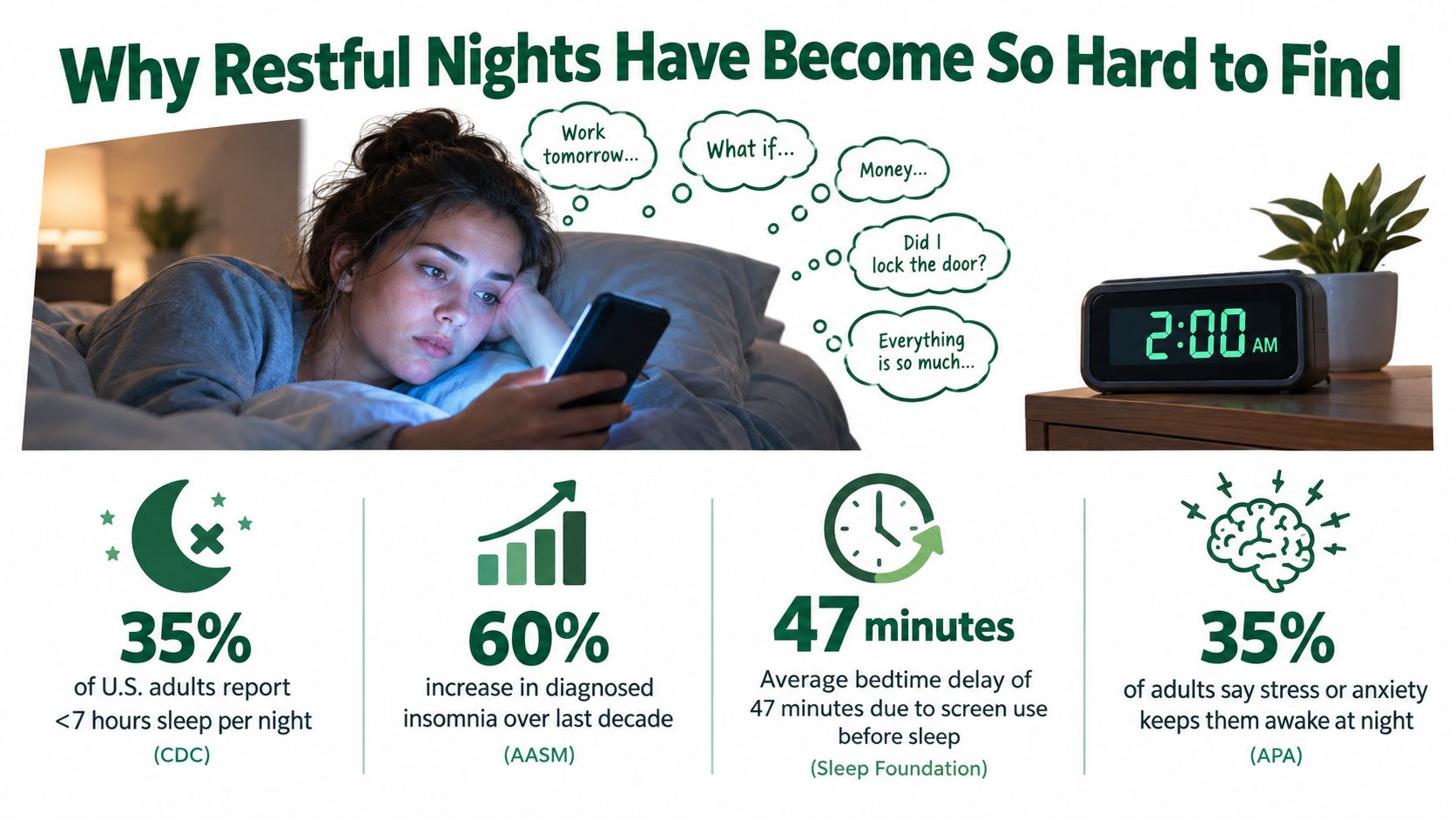
Sleep usually gets disrupted by overlap, not a single cause.
Practical rule: If your evenings feel “tired but wired,” the problem usually isn't lack of effort. It's a mismatch between your body's timing cues and your daily inputs.
The useful question isn't “what's the strongest natural product?” It's “what kind of bad night do you have most often?” That answer changes the plan. Some ingredients fit delayed sleep onset. Others make more sense when the issue is tension, mental overactivation, or evening physical discomfort.
That distinction matters because evidence for over the counter nighttime support is promising but still inconclusive overall, with stronger support concentrated in a smaller set of ingredients such as melatonin and valerian, while many other options show weaker or uneven support (2025 scoping review summary). Broad promises are easy. Accurate matching is harder, and more useful.
Before choosing any natural sleepless nights relief plan, classify the pattern. Most adults lump every rough night into one category, but the body doesn't. A person who lies awake for a long time at the start of the night isn't dealing with the same issue as someone who wakes repeatedly or someone who sleeps a full stretch and still feels flat in the morning.
| Pattern | Typical Signs | Common Drivers | Best-Fit Natural Supports |
|---|---|---|---|
| Sleep onset pattern | You get into bed tired but stay awake while the mind keeps running | Delayed body clock, late light, mental activation, evening stimulation | Light timing, screen reduction, low-dose melatonin, calming wind-down |
| Middle-of-the-night waking | You fall asleep fairly easily, then wake and feel alert again | Stress reactivation, room environment, evening alcohol, physical discomfort | Consistent routine, bedroom adjustments, relaxation practices, ingredient choice based on the trigger |
| Poor sleep quality | You sleep for enough hours but wake unrefreshed | Fragmented sleep architecture, tension, poor environment, inconsistent schedule | Schedule consistency, room setup, stress regulation, carefully matched support |
Use a short note on paper or your phone before you start changing things.
You don't need perfect precision. You need pattern recognition.
If your rough nights mostly happen at the front end of the night, think timing and nervous system downshifting. If they happen after a few hours of sleep, look harder at environment, stress carryover, and evening physical triggers.
Most articles get lazy. They put everyone into one bucket, then recommend the same capsule, tea, and magnesium powder to all of them. The evidence doesn't support that approach. Some ingredients are more relevant to sleep timing. Others are better framed as support for calm, relaxation, or evening comfort.
The strongest non-drug framework also goes beyond basic bedtime tips. Clinical guidance identifies cognitive behavioral therapy for insomnia as the gold-standard nonpharmacologic approach, notes that online delivery is not inferior to in-person care, and states that sleep hygiene alone isn't recommended as a standalone intervention (clinical guideline review). In practice, that means habits matter, but habits work best when they change conditioned wakefulness, not when they stay at the level of generic advice.
A supplement can't do much against a schedule that tells the brain three different time zones in one week. The foundation comes first. When these habits are in place, natural support has a fair chance to help. When they aren't, even a well-formulated product often feels inconsistent.
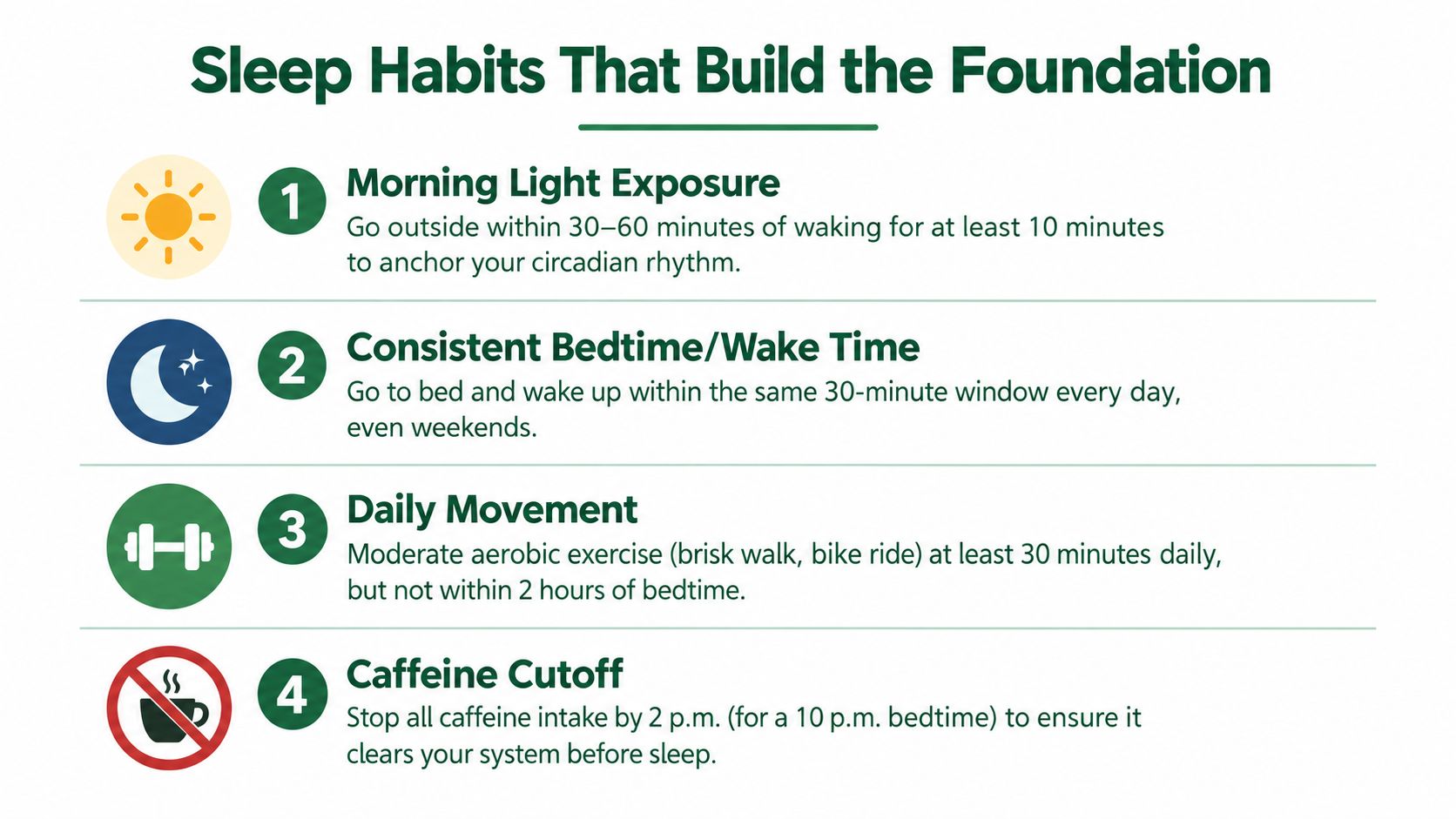
Start with light. Get outside within 30 to 60 minutes of waking and stay there for at least 10 minutes. Morning light helps anchor the body clock so the evening rise in natural sleepiness arrives at the right time instead of drifting later.
A regular wake time matters even more than a perfect bedtime. If you wake at wildly different hours across the week, your evening cues lose strength. The body likes repetition.
For readers who want another perspective on behavior-first strategies, this roundup of psychiatrist-approved sleep remedies is worth scanning because it keeps the focus on practical routines instead of miracle claims.
Caffeine is often the hidden saboteur. A useful general rule is to stop it by 2 p.m. if your target bedtime is around 10 p.m.. That gives your system more room to clear stimulation before night.
Screen wind-down is less about perfection and more about signal. Give yourself 60 minutes before bed with dimmer, warmer light and fewer mentally activating inputs. If you keep your phone, laptop, and overhead lighting on until the minute your head hits the pillow, don't be surprised when your brain stays in task mode.
A short ritual helps because the body responds to repeated cues. A warm shower, slow exhale breathing, a few minutes of stretching, or reading a paper book all work better than scrolling.
Here's a quick visual walkthrough to reinforce the habits that usually matter most before bed.
Your room should help the nervous system let go.
If you want a complementary read focused on practical home habits, AloeCure's guide on how to improve sleep quality naturally adds a few simple ways to tighten the evening routine.
Once the foundation is in place, ingredients can be useful. The important part is expectation. Most natural products don't knock people out. The better ones support timing, calm, muscle relaxation, or overall sleep quality in a narrower way.
Melatonin has one of the strongest evidence bases among natural options. A 2023 systematic review and meta-analysis found that prolonged-release melatonin improved subjective sleep-onset latency by 6.30 minutes, objective sleep-onset latency by 5.05 minutes, and objective sleep efficiency by 1.91% versus placebo (melatonin meta-analysis). That is measurable, but modest. It's best framed as support for sleep timing, not a heavy sedative effect.
A broader clinical review also notes that melatonin's evidence is most relevant when delayed sleep onset is the main issue, with average reductions in time to fall asleep of about 7 minutes and increases in total sleep time of about 8 minutes in broader reviews, while cautioning that fast-release melatonin isn't broadly recommended for insomnia management (clinical melatonin review).
| Ingredient | Dose Range | Best For | Evidence Strength |
|---|---|---|---|
| Melatonin | Adult study doses have ranged from 0.1 mg to 10 mg, typically taken up to 2 hours before bedtime | Delayed sleep onset and schedule shifts | Strongest among common natural options |
| Magnesium | Often used in evening routines for relaxation support | Tension-heavy evenings, muscle relaxation, general wind-down | Lower certainty overall |
| L-theanine | Often used in modest evening amounts | Mental overactivation and smoother wind-down | Signal of benefit, not one-size-fits-all |
| Valerian | Often used consistently rather than sporadically | Sleep onset support for some adults | Among the stronger non-melatonin ingredients in recent summaries |
| Ashwagandha | Commonly used for stress adaptation support | Stress-driven wakefulness | Signal of benefit, still limited |
| Saffron | Used in small amounts in supplement formulas | Sleep quality and mood-linked nighttime tension | Emerging support |
Use ingredients like tools, not trophies.
A scent-based bedtime ritual can also help some people settle into a calmer pre-sleep state. If that appeals to you, this guide on sweet dreams with aroma oil offers practical ideas for using fragrance as part of a wind-down cue rather than as a standalone fix.
Most disappointment with natural sleep products comes from using the wrong ingredient for the wrong pattern, then assuming nothing works.
For readers who want to avoid melatonin altogether, AloeCure's article on natural sleep aids without melatonin is a useful next step because it focuses on non-melatonin options and how they fit different nighttime patterns.
Aloe vera doesn't belong in the same category as melatonin. It isn't a direct sleep-timing ingredient, and it doesn't need to be sold as one. Its more realistic role is in an evening routine built around comfort and settling, especially for adults whose nights get disrupted when the body feels physically unsettled.
Some people don't stay awake because they lack sleepiness. They stay awake because the body feels “on.” That can mean tension, post-meal heaviness, abdominal discomfort, or a general sense that the system hasn't downshifted. In that setting, a gentle evening routine can work better when it supports comfort first.
A well-made inner-leaf aloe product can fit there. The key is quality and processing. Look for decolorized, aloin-free inner-leaf aloe, not poorly processed material. Whole-leaf products can be harsher, while cleaner inner-leaf preparations are better suited to regular wellness use.
This category has big differences in manufacturing.
A practical serving often discussed by wellness practitioners is a small evening portion taken about 30 minutes before bed, then adjusted based on personal tolerance and product directions. If someone is building a pattern-specific routine, aloe can pair well with a calming evening setup and, when appropriate, a separate ingredient chosen for timing or relaxation.
AloeCure's how to use aloe vera article gives a straightforward overview of ways people incorporate aloe into daily routines.
The sleep-specific evidence for aloe is thinner than the evidence for melatonin. That's fine. Not every useful evening tool needs to act directly on sleep timing. Some support a calmer physical baseline, and that can matter when bedtime gets derailed by discomfort instead of pure alertness. Among product options in this space, AloeCure also offers a Melatonin + Collagen Sleep Support Capsules formula positioned to support the body's natural sleep-wake cycle and restful sleep.
“Natural” doesn't mean risk-free. That assumption causes more problems than many realize. The better mindset is simple: if an ingredient is active enough to help, it's active enough to deserve respect.
A 2025 workshop summary from the U.S. Office of Dietary Supplements and the National Center on Sleep Disorders Research highlighted major evidence gaps for non-prescription nighttime interventions, including limited long-term data, too few rigorous trials for commonly used products, and too little dose-response work (ODS workshop digest). That's the core issue with many popular products. Not that they're automatically dangerous, but that the long arc of use is often less studied than people assume.
The same summary also noted a 2026 report on melatonin that raised concern that long-term use in adults with chronic insomnia was associated with roughly 90% higher heart failure risk over five years, while a 2025 scoping review found adverse events across OTC sleep-product trials were mostly mild and transient with no serious adverse events reported. That tension is exactly why blanket reassurance isn't good practice.
Use extra care if any of these apply:
A short successful trial tells you a product may fit your pattern. It does not prove that indefinite use is the right plan.
With aloe, the distinction between inner-leaf and latex-containing material matters. Poorly processed aloe latex can be too stimulating for regular evening use and may lead to cramping or bowel urgency. That's the opposite of what you want before bed. Choose products that clearly explain sourcing and processing.
FDA also draws a firm line around supplement language. Structure/function claims may describe support for normal body function, but they must be truthful, not misleading, and include the required disclaimer that the statements haven't been evaluated by FDA and aren't intended to diagnose, treat, cure, or prevent disease (FDA structure/function guidance). FDA also requires firms marketing a supplement with this kind of claim to notify the agency within 30 days after first marketing the product with that claim (FDA notification requirement).
The best routine is one you'll actually repeat. Keep it simple enough that it survives a busy weekday.
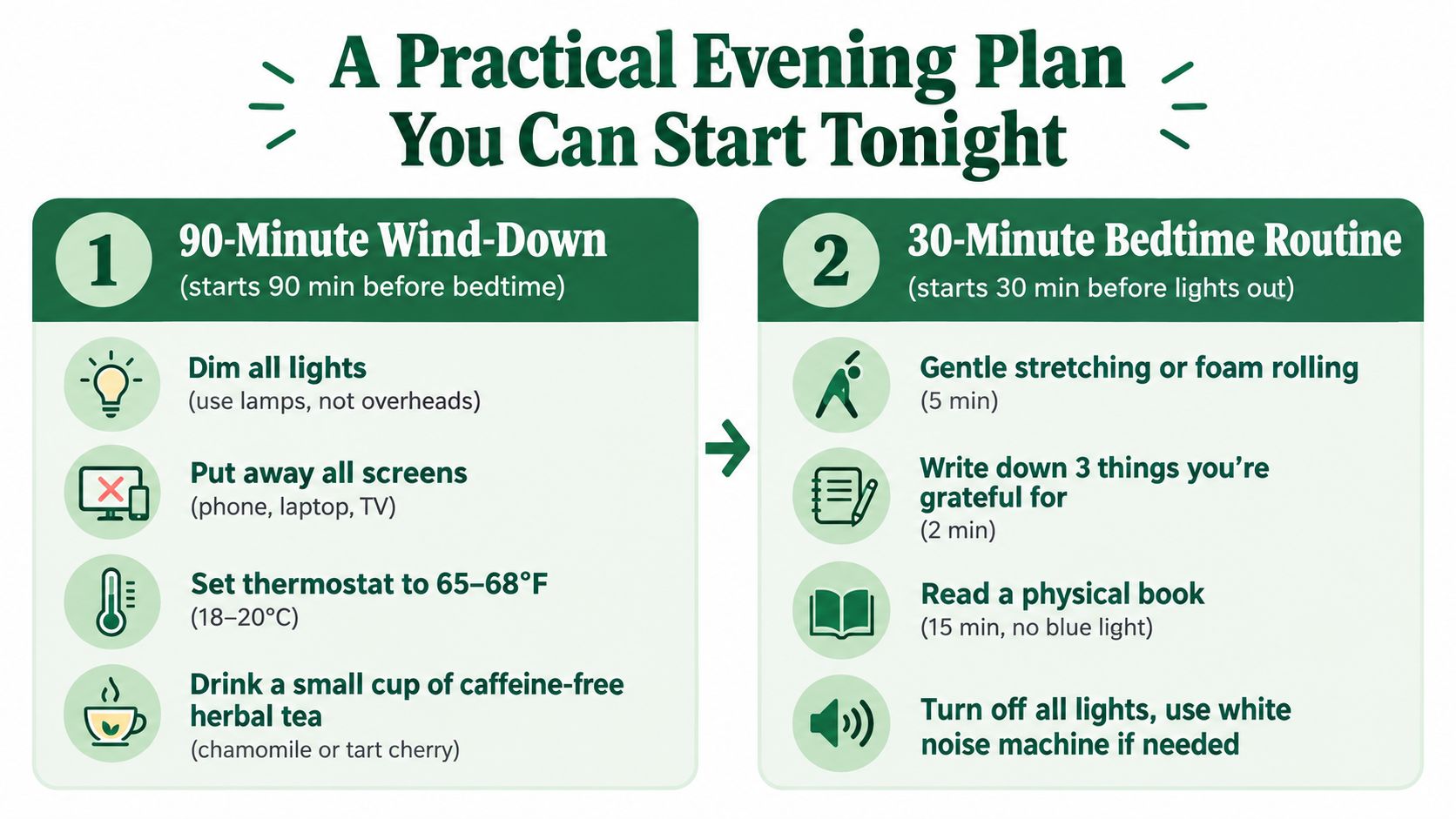
Start 90 minutes before bed.
The physical environment matters more than people think. If you're upgrading the sleep space itself, this guide to the best luxury bedding for sleep gives practical ideas on making the bed feel cooler, calmer, and more supportive without overcomplicating the process.
Make the final stretch repetitive. Repetition is the cue.
Try a sequence like this:
If you travel, shift workers' routines need more flexibility. Keep the order of cues the same even if the clock time changes. If you share a room, prioritize what you can control first: eye mask, earplugs, fan noise, and pre-sleep light discipline.
For the first few nights, work only on light, caffeine timing, and room setup. Then add one ingredient if needed, not three. Track three things in a simple log: how long it took to fall asleep, whether you woke in the night, and how alert you felt the next morning.
Commit to one small action tonight. Step outside tomorrow morning, or set a caffeine cutoff alarm now.
Some sleep problems are reasonable to work on at home. Others deserve skilled input sooner. If your pattern has lasted for months, if your daytime function is slipping, or if someone notices disrupted breathing during the night, don't keep self-experimenting indefinitely.
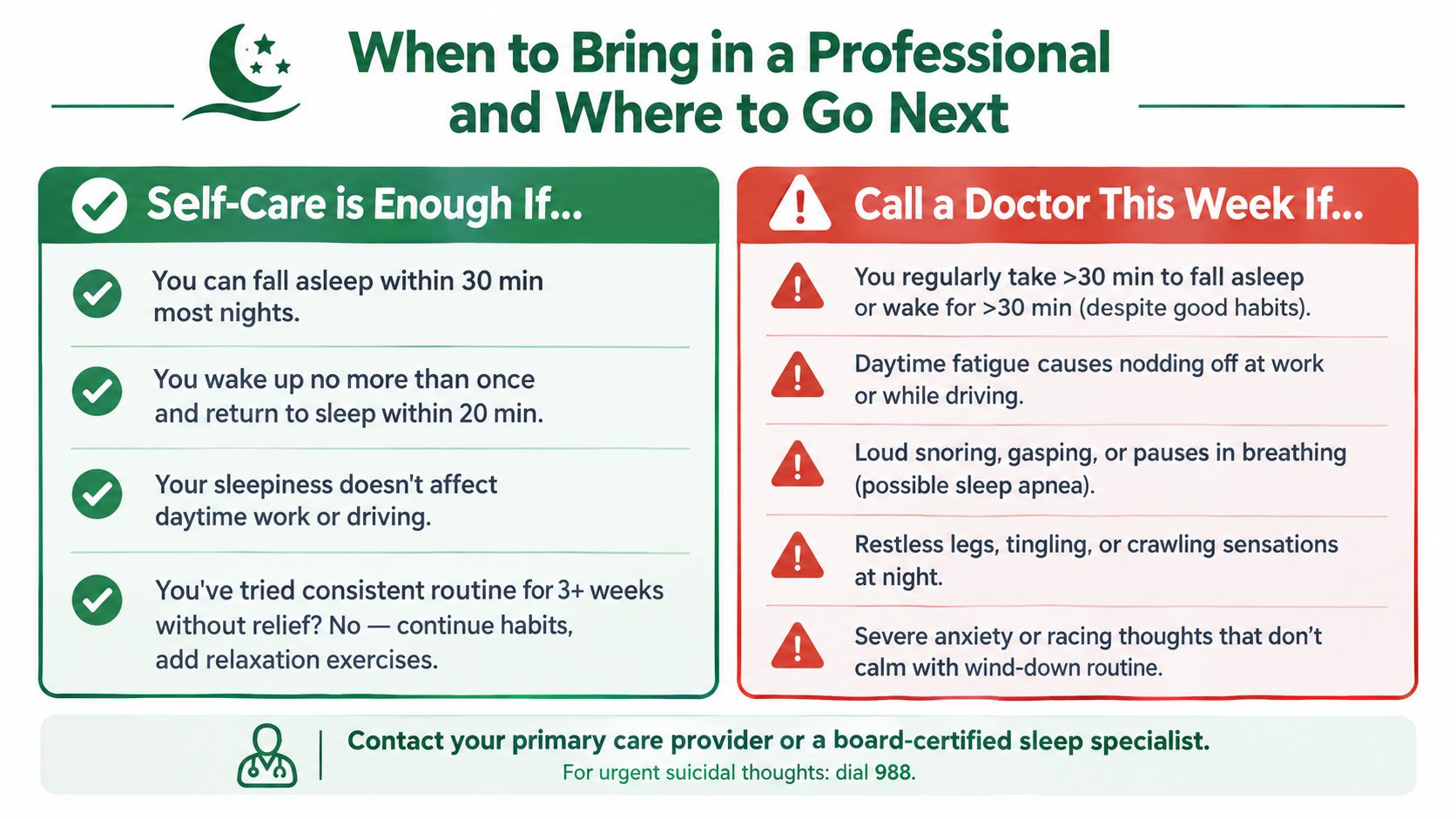
The right next step depends on the pattern. A primary care clinician can help rule out common contributors. A behavioral sleep specialist is often the best fit when the issue is conditioned wakefulness and a spiraling relationship with bedtime itself.
Keep the framework simple. If you can't fall asleep, think timing and downshifting. If you wake in the middle of the night, look harder at stress carryover, environment, and physical comfort. If you get enough hours but still wake flat, review sleep quality, schedule consistency, and the overall evening setup.
These statements have not been evaluated by the Food and Drug Administration. This product is not intended to diagnose, treat, cure, or prevent any disease.
If you want aloe-based options that fit a calmer evening routine, AloeCure offers pure organic aloe vera juices, targeted capsules, and a bedtime formula designed to support the body's natural sleep-wake cycle. You can explore the full collection, compare formats, and sign up for ongoing savings at AloeCure.
Les commentaires sont approuvés avant leur publication.