Votre panier est vide


Can two aloe powders look nearly identical while offering very different value in a capsule, smoothie, or skincare formula? The answer usually isn't the color on the label. It's the chain of decisions made after harvest, including which part of the leaf is used, how quickly it's cooled, how water is removed, and whether the finished powder is tested and traceable.
Freeze dried aloe vera is best understood as a processing method, not a guarantee by itself. Freeze drying can protect delicate aloe constituents, but the result still depends on harvest timing, temperature control, formulation choices, and ingredient transparency. This guide follows that path from inner-leaf gel to finished product, then turns the technical details into a practical shopping checklist.
Why can two green aloe powders on a shelf look alike yet behave so differently in a wellness routine? A powder is the final snapshot of a much longer story. The plant's maturity, the separation of inner gel from rind, the time between harvest and freezing, the drying cycle, and the use of carriers can all influence the finished ingredient.
That matters because aloe's characteristic polysaccharide fraction, including acemannan, is naturally associated with the gel. Processing can affect the structure, concentration, texture, color, and reconstitution behavior of that fraction. A front label may say “aloe vera powder,” but that phrase doesn't tell you whether the product uses inner-leaf gel, whole leaf, a concentrate, or a formulated powder.
Think of the ingredient as a relay race. The farm starts the race, harvesting supplies the raw material, processing determines how much of the original profile survives, testing checks what arrived at the finish, and packaging protects the result. If one handoff is poorly managed, a polished label can't restore what was lost earlier.
Freeze drying is a strong quality signal when it's paired with fast post-harvest handling and clear specifications. Technical literature describes freeze drying as a way to achieve low moisture while protecting functional compounds, but the method still needs disciplined execution. The comparison of whole-leaf and inner-leaf aloe is useful background because the plant part is just as important as the drying method.
Practical rule: Judge the process, not just the powder's appearance. Ask what part of the leaf was used, how it was dried, and how the finished lot was verified.
The most useful questions are simple. Is the material inner-leaf gel? Does the label identify a polysaccharide or acemannan marker? Does the supplier explain its testing and traceability? Those answers reveal more than a bright color or a bold front-panel phrase.
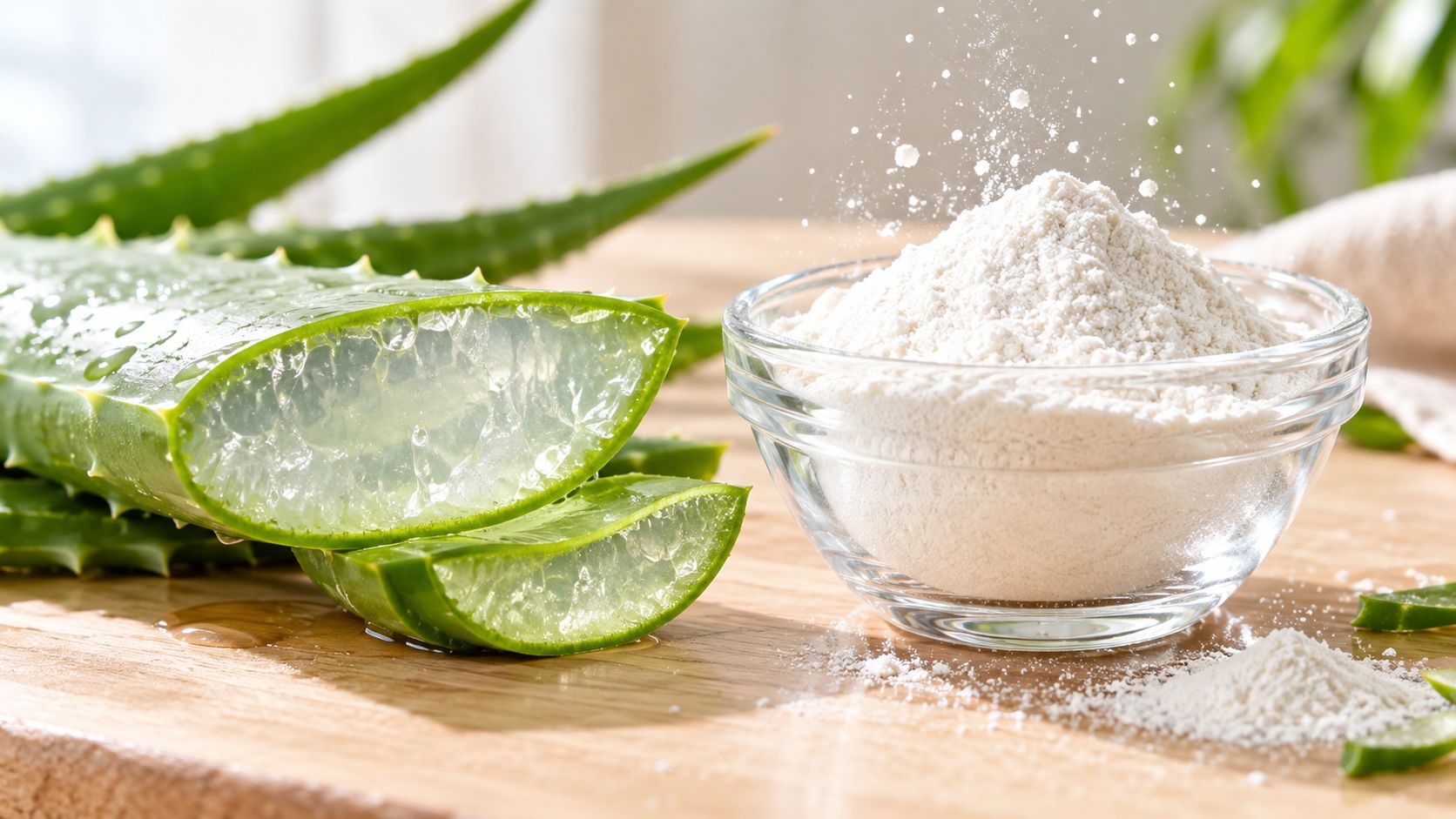
Freeze dried aloe vera is aloe gel with most of its water removed through freezing and vacuum dehydration. A helpful analogy is a time capsule. Fresh gel is placed into a frozen state, then the ice is encouraged to leave as vapor, allowing the solid components to remain in a dry, lightweight form.
The technical term for that direct change from ice to vapor is sublimation. During primary drying, the frozen water doesn't first become liquid. That distinction matters because the process can operate at low temperatures rather than relying on prolonged hot-air exposure.
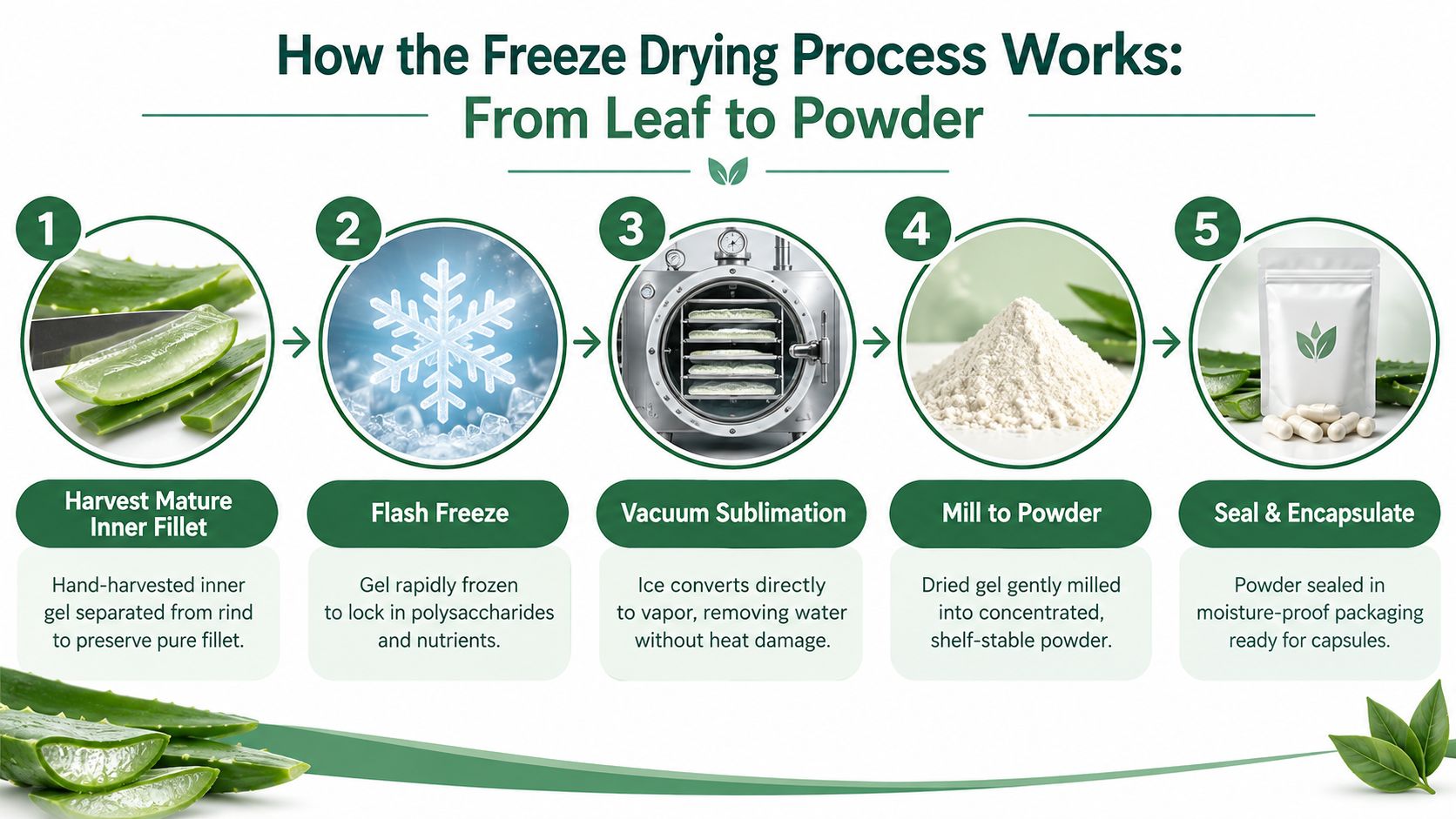
A typical process begins with inner-leaf gel. The gel is frozen, placed under vacuum, and dried until the desired moisture level is reached. It's then milled and protected from ambient moisture in sealed packaging.
The goal is to preserve the gel's composition as faithfully as practical. Acemannan and other aloe polysaccharides are central markers of interest, while enzymes, phenolics, and trace nutrients may also be affected by processing choices. Freeze drying is valued because it avoids the intense thermal conditions associated with conventional drying, although the exact result still depends on the raw material and cycle design.
Spray drying and drum drying use different approaches. They expose liquid or semi-liquid material to warmer drying conditions, which can be efficient for manufacturing but may place more stress on heat-sensitive constituents. That's why freeze dried aloe vera is often positioned as a premium ingredient for capsules, powders, functional foods, and topical formulas.
The label alone still isn't enough. A product can say “freeze dried” while differing in gel source, filtration, carrier content, milling conditions, and storage protection. Temperature history and ingredient identity determine whether the method delivers its intended advantage.
Freeze drying looks simple from the outside, but each phase controls a different quality risk. The process starts with prepared inner-leaf gel and ends with a dry powder that must be protected from humidity.
First comes pre-freezing. The gel is cooled below the point at which its water can be removed efficiently as ice. A FAO AGRIS-indexed aloe powder study reported complete freezing at -36, -38, and -40 degrees C in 90, 90, and 120 minutes, respectively, with resulting powder moisture contents of 6.71%, 6.31%, and 8.83% in the reported study. Those findings show why freezing conditions and endpoint control matter.
Primary drying follows. Vacuum pressure lowers the environment around the frozen gel, allowing ice to sublime. The condenser captures the vapor, while the product remains cold enough to reduce unnecessary thermal stress.
Secondary drying removes more tightly held moisture. This phase brings the powder to its target water activity and helps make it suitable for storage and encapsulation. The exact endpoint depends on the formulation and equipment, so a fixed moisture target shouldn't be assumed for every product.
Milling and packaging complete the cycle. The dry cake is gently milled in controlled humidity, then sealed quickly. Powder absorbs moisture readily, so packaging is part of preservation rather than an afterthought.
Heat drying removes water by warming the material until liquid water evaporates. That can alter sugars, color, flavor, viscosity, and heat-sensitive compounds. Freeze drying takes a different route, so the aloe structure experiences less direct thermal exposure.
A comparative study on aloe vera rind powders reported the highest extraction yield for freeze drying at 13.34 ± 0.50%, along with measured phenolic content of 38.75 ± 0.11 mg GAE/g and antioxidant activity in DPPH and FRAP testing in that study. These results support the technical case for low-temperature dehydration, but they don't mean every freeze-dried product will have identical composition.
Quality depends on the cycle: vacuum pressure, condenser temperature, product temperature, and drying time all influence the finished powder.
A short delay before freezing can also matter because fresh plant material continues changing after harvest. That's why an integrated operation that controls harvesting, cooling, drying, testing, and packaging can reduce unknowns that a bulk ingredient label won't reveal.
Choosing an aloe format is a trade-off between convenience, water content, handling, and composition. Fresh gel offers the closest experience to the leaf, while powder offers portability and easier storage. Juice and concentrate sit between those options, with their own processing requirements.
| Form | Moisture | Shelf Life | Bioactive Retention | Reconstitution |
|---|---|---|---|---|
| Fresh gel | Very high water content | Short and refrigeration dependent | Closest to the freshly opened leaf when handled promptly | Already hydrated |
| Juice | Liquid and water-based | Depends on filtration, heat processing, packaging, and preservation | May change during processing and storage | Ready to drink |
| Concentrate | Less water than juice | More stable than fresh gel in suitable packaging | Heat exposure can affect sensitive constituents | Diluted before use |
| Freeze dried aloe vera | Low moisture when properly processed | Shelf-stable when sealed and stored correctly | Designed to protect sensitive constituents through low-temperature dehydration | Rehydrates into a gel or liquid form |
A scientific review noted that freeze-dried aloe powder can have lower viscosity and different reconstitution behavior than fresh juice, even when pH and sensory scores remain similar in the reviewed research. That's an important distinction. “Rehydrates” doesn't mean “becomes identical to fresh gel.”
Fresh gel suits immediate use, but it's perishable and harder to standardize. Juice is convenient for people who prefer a ready-to-drink format, although its water-based nature means the processing and storage history deserve attention. Concentrate can reduce volume, but heat evaporation may place more pressure on sensitive compounds.
Powder removes water through sublimation and can be used in capsules, drink mixes, and topical formulations. Its practical advantages include lighter shipping, compact storage, and consistent portioning when the manufacturer provides a clear serving specification.
For a plain-language look at liquid and gel formats, see this guide to aloe vera juice compared with aloe gel. The right choice isn't universal. It depends on whether you value immediate hydration, portability, measured servings, or flexibility in formulation.
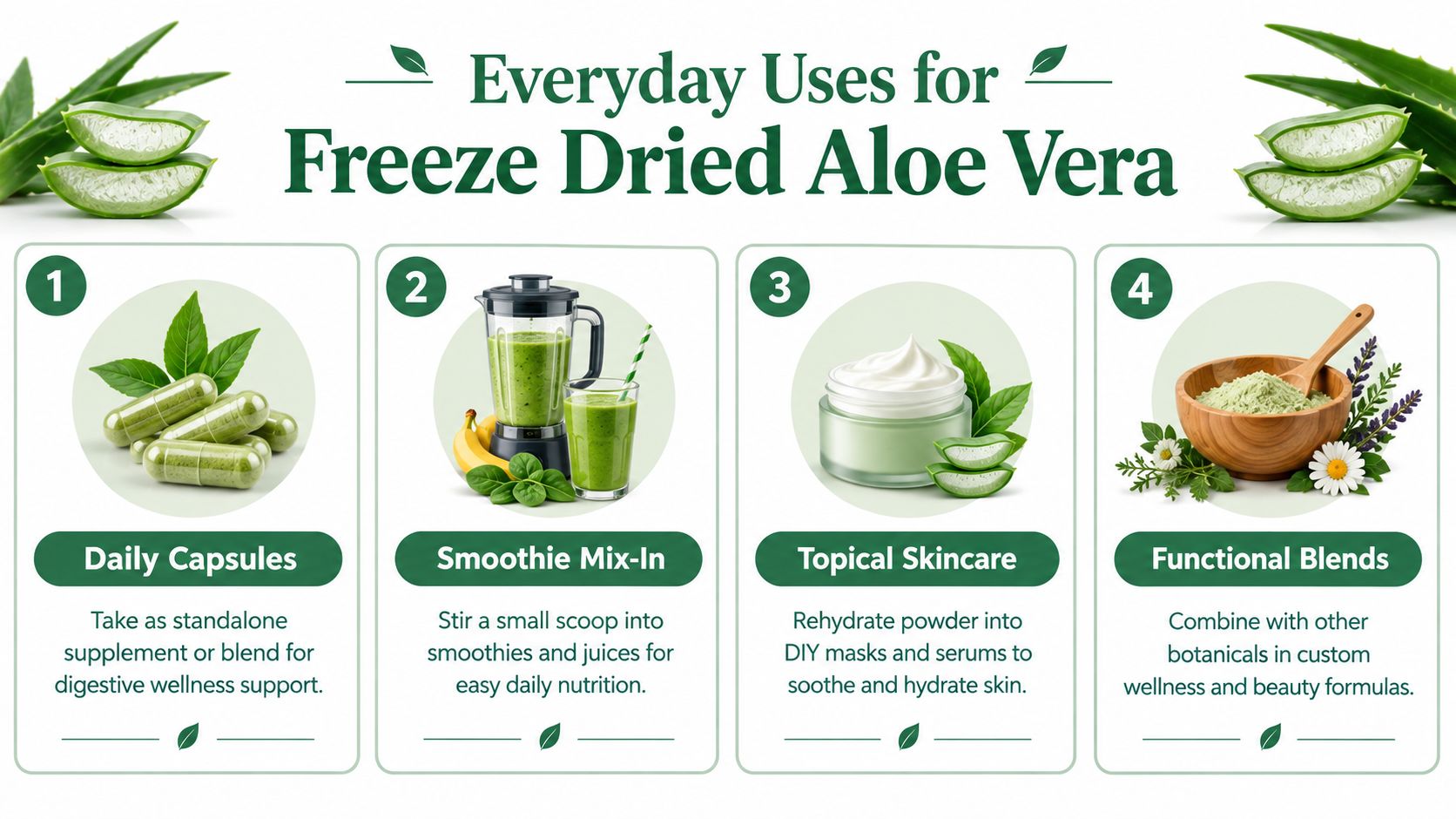
Freeze dried aloe vera fits several routines because it starts as a dry, concentrated ingredient and can be used in different forms. Capsules offer convenience and consistent handling. Powder can be mixed into a beverage or rehydrated for a topical formula, provided the product is intended for that use and the label gives appropriate directions.
Capsules are practical for travel, workdays, and shoppers who prefer a measured serving without refrigeration. A freeze-dried inner-leaf powder can stand alone or appear in a broader wellness formula. Look for the actual ingredient amount and any stated polysaccharide specification rather than relying only on a large concentration phrase.
Smoothie and drink mixes offer flexibility. A small amount can be stirred into water, juice, or a smoothie, but taste and texture depend on the powder's particle size, carriers, and reconstitution properties. Start with the product's directions, because powders aren't interchangeable.
Topical formulas may use aloe powder that's rehydrated into a gel, serum, mask, or cream base. Cosmetic use requires attention to preservation, pH, sanitation, and compatibility with the rest of the formula. A powder intended for capsules isn't automatically suitable for a homemade skin product.
The same powder format can represent very different supply chains. A vertically integrated supplier grows its own aloe, processes the plant, and produces finished products instead of purchasing an unknown bulk powder through multiple intermediaries. That control can make it easier to connect a lot number with the field, harvest, processing cycle, test results, and final packaging.
AloeCure offers aloe products made with aloe grown and processed through its own farm-to-capsule operation. For shoppers, the useful question isn't whether a brand uses attractive language. It's whether the company can explain what it makes, where the ingredient comes from, and how it verifies the finished product.
Use the format that fits your life. Capsules prioritize simplicity, powders support customization, and topical preparations suit a skincare routine. Convenience works best when it's paired with a clearly defined ingredient.
Vertical integration means one company controls more of the route from cultivation to finished product. In the freeze dried aloe market, that can be a meaningful quality signal because the buyer often can't see what happens before a bulk powder reaches a contract manufacturer.
A brand that buys finished powder may know the supplier's specification, but it may not control harvest maturity, transport conditions, time before processing, or changes between lots. A farm-to-capsule operation can document those handoffs directly and adjust the process when the raw material changes.
A vertically integrated model typically connects four activities:
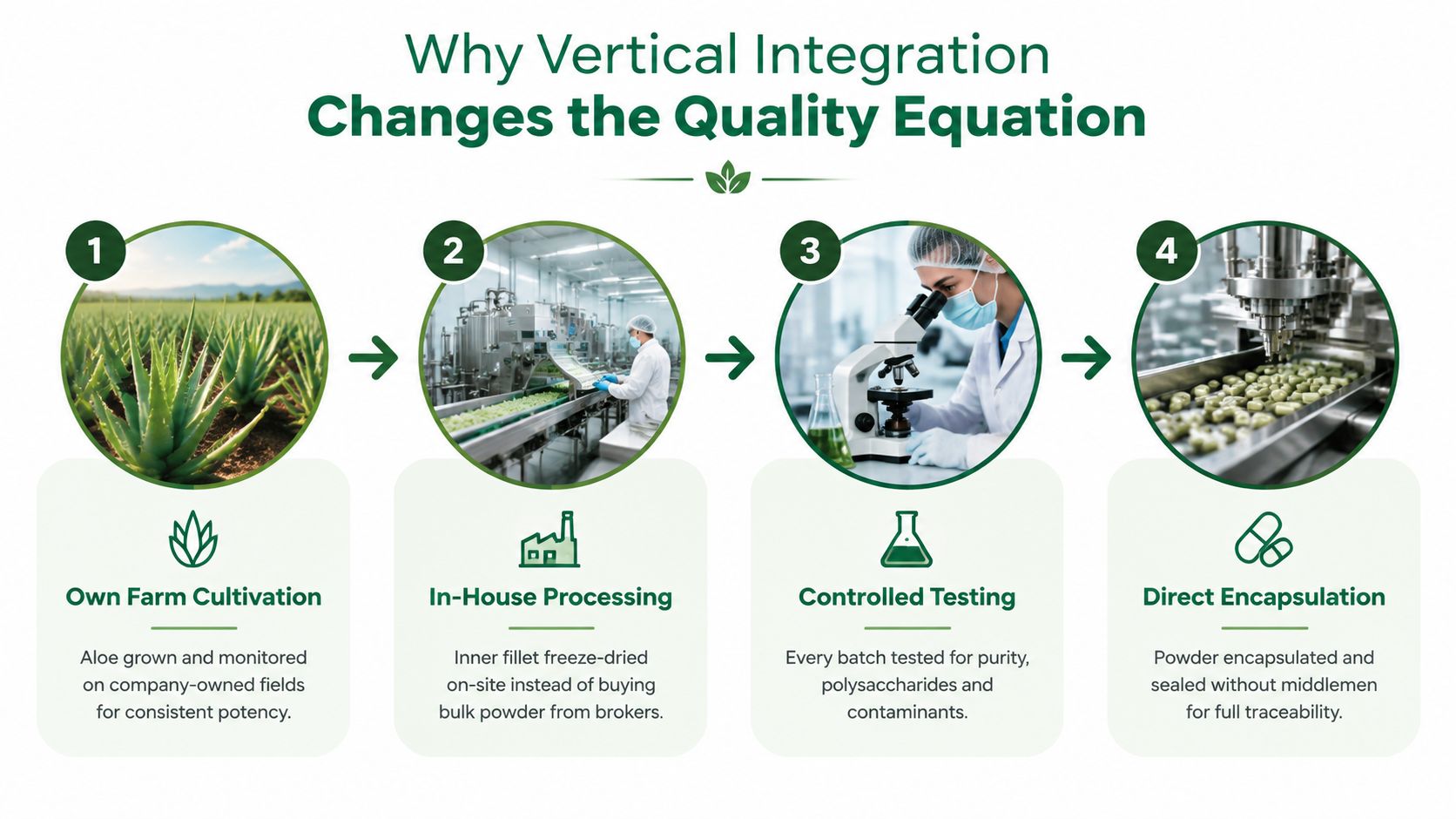
The advantage isn't that integration automatically makes every product identical. It's that the manufacturer has more opportunities to identify variation before the product reaches the customer. That may support more consistent specifications, clearer lot documentation, and better accountability.
For raw-material quality, the International Aloe Science Council quality standard describes requirements involving total aloe solids, marker constituents, organoleptic properties, and contaminants. The standard lists a minimum of 1.0% total aloe solids for aloe vera leaf juice and 0.5% for inner leaf juice. Those figures apply to the covered juice raw materials, so they shouldn't be transferred automatically to every freeze-dried powder.
Ask for traceability: A serious supplier should be able to explain how it connects the crop, processing record, laboratory results, and finished lot.
This is why vertical integration deserves more attention than polished packaging. When a company farms its aloe, processes it, and makes its own products, the buyer has a clearer path for evaluating the ingredient. A practical overview of what to consider when buying aloe vera can help turn that idea into label questions.
A product page should answer basic identity questions without forcing you to decode vague marketing. Start with the ingredient itself, then examine the processing, testing, and claims.
Look for:
The IASC quality standard framework is relevant because it applies to aloe raw materials used in products and addresses consistency, marker constituents, organoleptic properties, and contaminants. It gives brands a useful reference point for specifications without turning a composition standard into a wellness promise.
A credible product page should make it reasonably clear whether the manufacturer uses a GMP facility, third-party testing, organic certification, non-GMO verification, and testing for contaminants such as heavy metals and microbiological hazards. It should also identify the country of origin and provide directions that match the product form.
Be cautious with impressive ratios unless the company explains them. A concentration ratio describes the amount of starting material used to produce a smaller amount of dried material, but it doesn't automatically tell you how much acemannan remains or whether the ingredient includes carriers.
FDA defines structure/function claims as statements about how a nutrient or dietary ingredient affects the normal structure or function of the body, or describes a documented mechanism related to maintaining that function according to FDA's labeling guidance. Examples of compliant phrasing include “supports healthy digestive function,” “promotes skin hydration,” and “helps maintain normal body function.”
FDA states that these claims must be truthful, not misleading, and substantiated, and that the required disclaimer must accompany them. The claim also needs notification to FDA no later than 30 days after first marketing the product with that claim under FDA's structure/function claim rules.
The best format depends on how you'll use it. Capsules suit people who want a compact product and a defined serving. Powder works well for smoothies, drink mixes, or compatible formulation projects. A topical aloe product belongs in a skincare routine, while an ingestible product should be selected and used according to its own label.
Three quality pillars deserve priority:
Aloe products vary, so don't assume that a larger ratio, darker color, or “natural” wording means greater value. Compare the plant part, marker information, carrier ingredients, certifications, testing disclosures, lot traceability, and directions. If you take prescription or over-the-counter products, or if you're pregnant or nursing, consult a qualified healthcare professional before adding a dietary supplement. Starting with one format also makes it easier to understand how it fits your routine before layering additional products.
FDA-compliant structure/function language keeps the focus on normal wellness support. A responsible product may say it supports healthy body function, promotes wellness, or helps maintain normal physiological processes. It shouldn't promise outcomes outside that framework.
These statements have not been evaluated by the Food and Drug Administration. This product is not intended to diagnose, treat, cure, or prevent any disease.
AloeCure offers aloe products made from aloe grown and processed through its own vertically integrated farm-to-capsule system, including inner-leaf formulations designed for everyday wellness routines. Visit AloeCure to review the available products and choose Subscribe & Save for 20% off eligible subscription orders.
Les commentaires sont approuvés avant leur publication.