Votre panier est vide


Most buying guides settle the cold processing question in a single line. No heat means more of the plant survives, so cold processed aloe vera juice wins. That story survives right up until you look at what processors measure, and then it gets complicated in ways that matter at the checkout.
Heat does degrade some of what sits in the gel. But a producer who avoids heat inherits a different set of obligations: faster handling after cutting, cleaner separation of the gel from the leaf, a cold chain that doesn't break, and testing dense enough to prove the batch is safe without a thermal kill step. Cold is one control among several. It isn't a verdict.
The question worth asking about a bottle isn't whether it's cold processed. It's what the producer can document around that step, and whether anyone outside the company has seen the results.
Cold processed aloe vera juice is made from freshly harvested inner-leaf gel that's handled without added heat, chemicals, enzymes or charcoal filtration, so the plant's own compounds stay closer to their natural state. That's the whole definition. It describes a temperature path through the plant. It says nothing about how long the leaves sat in a crate, how clean the line was, or what the finished batch measured.
The category is crowded enough that the vocabulary blends together. Grand View Research valued the global aloe vera drinks market at USD 131.7 million in 2024, and processing terminology isn't standardized across markets, so five different methods all end up sounding like quality on a shelf.
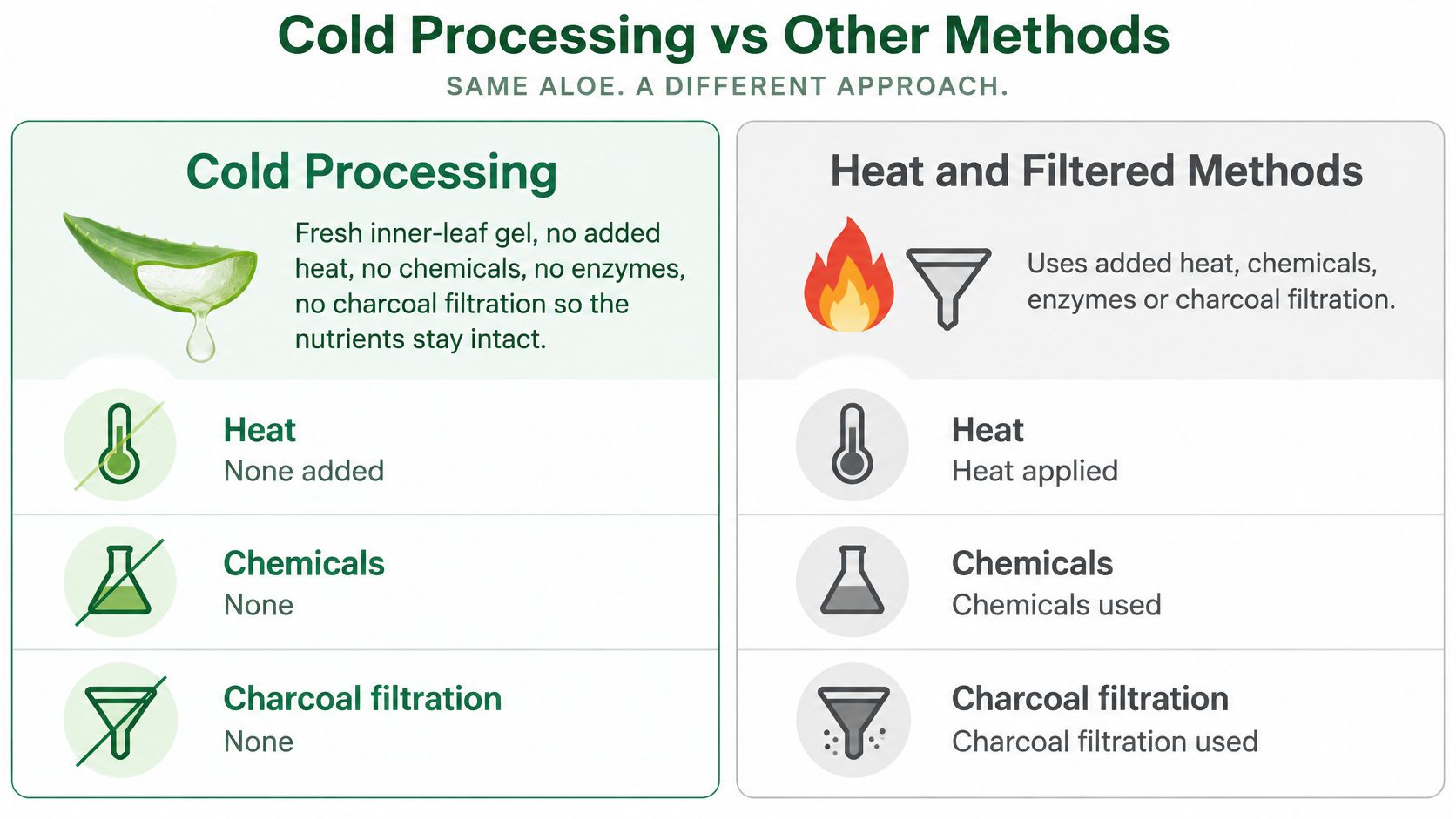
Laid side by side, each route makes a specific bargain with the plant.
| Method | How the Juice Is Handled | Main Trade-off |
|---|---|---|
| Cold processing | Inner-leaf gel is extracted without added heat, chemicals, enzymes or charcoal | Needs fast post-harvest handling and strict microbial controls |
| Chemical processing | Chemical agents are used during processing | Residues must be verified by independent testing |
| Charcoal filtration | Charcoal is used to filter the juice | Removes color and some compounds along with impurities |
| Enzyme use | Enzymes are used to break down parts of the gel | Changes the native polysaccharide profile |
| Heat pasteurization | Heat is applied to reduce microbes | Lowers heat-sensitive vitamin C and antioxidant activity |
Read that table as a set of substitutions, not a ranking. A chemical route trades a clean ingredient list for a residue question, and the only answer is a lab report on the finished lot. Charcoal filtration pulls color and bitterness out of whole-leaf juice, and it pulls other compounds out with them, which is why a decolorized whole-leaf product and a filleted inner-leaf product aren't interchangeable. Enzyme treatment breaks the gel down deliberately, so the polysaccharide profile you end up measuring isn't the one the leaf started with. Heat buys microbial assurance and pays for it in heat-sensitive nutrients.
Cold processing, meanwhile, shifts the burden onto speed and hygiene. The gel has to move from leaf to bottle before the plant's own enzymes and oxygen do the work that heat would otherwise interrupt.
Practical rule: "Cold processed" answers one question, about temperature. Ask the producer what keeps the juice stable and safe instead of heat, and whether the batch records show it.
Aloe's other use runs on the same logic. Anyone interested in using aloe vera juice in skincare is relying on how the gel was stabilized before it reached the bottle, not on a front-label adjective. The drying step matters as much as the pressing step, which is why freeze-dried aloe vera gets judged on its process record rather than its name.
Aloe gel's bioactive fraction is usually tracked through acemannan, a polysaccharide used as a marker of how much of the interesting material survived. What acemannan is and why labs report it in milligrams per cubic decimeter is worth understanding before you compare two bottles, because the units are unglamorous and the differences are real.
One processing comparison held aloe gel at a ladder of temperatures, from warm through just below boiling, each for the same fixed stretch, then tested two pasteurization regimes as well. The National Toxicology Program's exposure-data review makes the timing argument behind this kind of testing: aloe leaves should ideally be processed within a few hours of harvest, because temperature, light, air and humidity all act on plant constituents. That single line justifies treating harvest-to-processing time as a quality metric rather than a marketing phrase.
| Condition | Measured Result | What It Shows |
|---|---|---|
| 85–95°C for 1–2 minutes | Acemannan 11,304 ± 60 mg/dm³ | Higher acemannan than the longer low-temperature regime in this study |
| 65°C for 15 minutes | Acemannan 7,468 ± 3,223 mg/dm³ | Longer low-temperature exposure with wide variation |
| Brief high-heat pass on juice | Vitamin C and DPPH-measured antioxidant activity both declined | Heat reduces heat-sensitive antioxidants |
| Refrigerated storage | Glucomannan declined | Polysaccharides keep degrading after processing |
| Room-temperature storage | Larger glucomannan decline and more browning | Warmer storage accelerates the loss |
The acemannan rows are the ones that scramble the usual story. The short, hot regime produced 11,304 ± 60 mg/dm³, a tight result. The longer, cooler regime produced 7,468 ± 3,223 mg/dm³, a mean that is lower and a spread that is enormous. Anyone who assumed cooler always preserves more has to reckon with that. Time and temperature interact. A gentle temperature held for fifteen minutes can do more damage than a hard temperature held for ninety seconds.
The juice rows cut the other way, which is why no single rule covers the category. A brief high-heat pass cost the juice vitamin C and a share of its DPPH-measured antioxidant activity, and the antioxidant marker fell harder than the vitamin did. Then storage took its own share: glucomannan declined in both refrigerated and room-temperature storage, with the greater loss and more browning at room temperature.
Every one of those declines happened without any processing decision at all. Storage is part of the record.
There's a limit the labels tend to skip. A 2025 review of aloe processing notes that cold processing may itself involve preservatives, ultraviolet treatment and microfiltration, so a cold claim can sit alongside other hurdles rather than meaning heat avoidance alone. The same review notes that heating at 65°C for 15 minutes did not necessarily eliminate the gel's biological activity. Read the two acemannan figures again with that in mind. The wide spread between them is precisely why nobody can rank every heated juice as weaker.
Juice A lists a harvest-to-bottle window, mechanical filtration, any preservative or ultraviolet step, and a lot result for the polysaccharide marker and microbes. Juice B says only cold processed. Only Juice A can be checked. Ask any producer for its time-temperature record and compositional data, and notice what happens to the conversation.
A documented cold process has a sequence, and each step exists to solve a specific failure mode. Skip one and the temperature claim stops meaning much.
1. Harvest mature leaves by hand. The gel and the latex layer have to be separated from the leaf stage onward, so how the leaf is cut and handled sets up everything after it. The slip here is machine handling that bruises the leaf and mixes rind into the batch.
2. Move the leaves into processing within 12 hours of harvest. That's the window AloeCure works to, and it matches the reason the timing matters: gel quality declines as temperature, light, air and humidity act on it. The slip is a crate sitting in the sun while a line finishes a previous run.
3. Fillet the leaf and separate the inner gel from the yellow latex layer under the rind. This is the step that keeps aloin out of the finished juice, and it's the one most often rushed. A wide blade that takes gel with the rind wastes yield; a shallow one leaves latex behind.
Here's the visual version of the sequence, from harvest to sealed bottle.
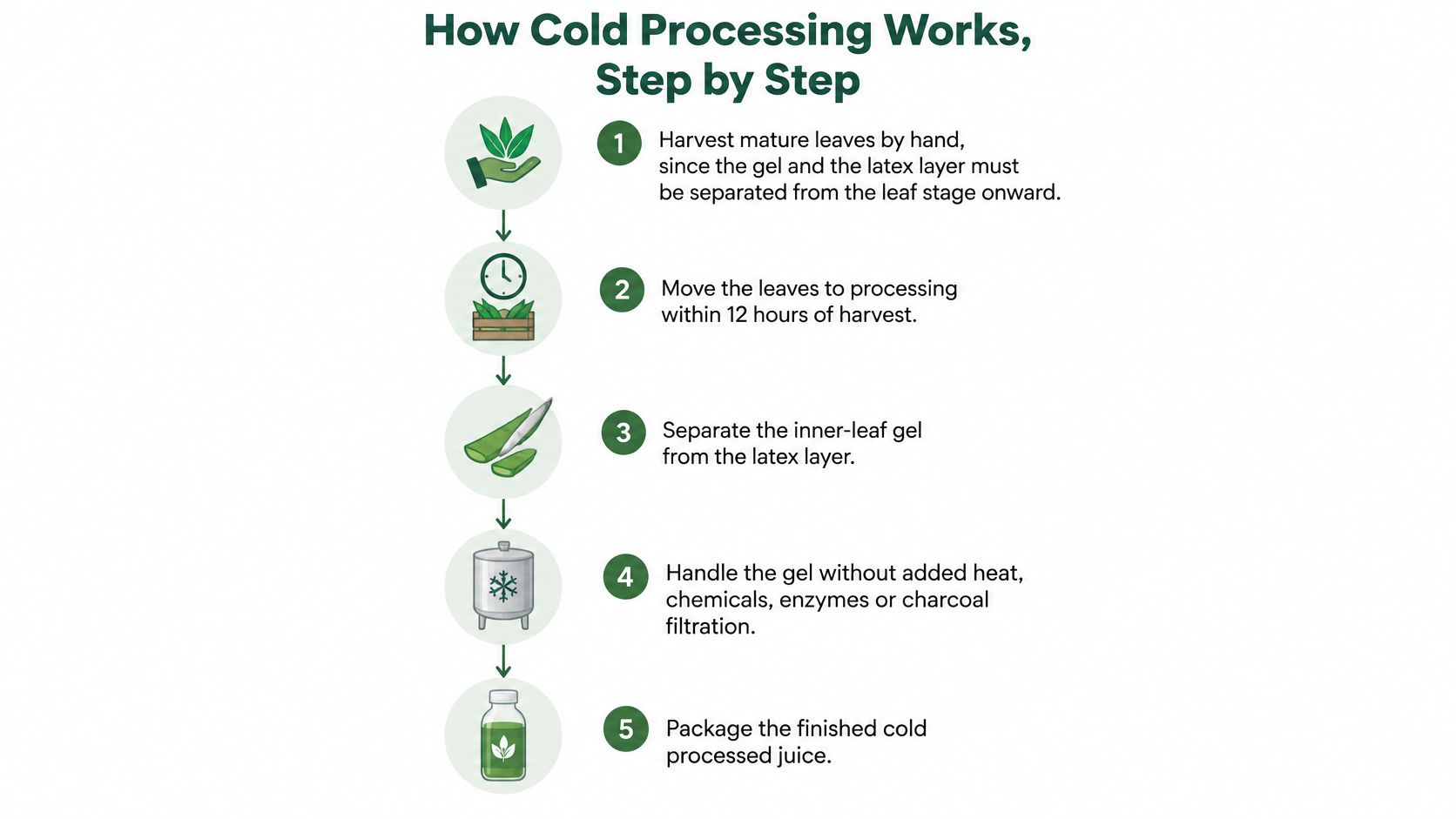
4. Extract the gel using physical methods only, with no added heat. Cold processing means no chemicals, enzymes or charcoal filtration either, which is how AloeCure handles its harvest and processing. The slip is adding an enzyme to improve yield and calling the result cold.
5. Clarify the juice by mechanical filtration. Filtration removes pulp and particulate without stripping color compounds the way charcoal does. The slip is filtration so aggressive it takes polysaccharides with the solids.
6. Bottle and hold the juice cold through storage. Storage is where measured polysaccharide levels drift, so the cold chain is part of production, not logistics. The slip is a warm truck between two cold rooms.
7. Test each batch before release. Every lot needs a result, not a specification sheet.
A short walk through what those checks look like in practice makes the rest of the sequence concrete.
What to look for on a label: a stated harvest-to-processing window, a batch or lot number you can quote, and a test result the company will send you. If a producer can't name the window, the temperature claim has nothing behind it.
Three defensible benefits come with cold processing, and each one carries a condition that belongs in the same sentence.
That last point is where the marketing usually goes quiet. Because heat isn't the primary preservation hurdle in a cold process, refrigerated storage, validated pathogen testing and a defined shelf-life study carry the weight. A defensible specification measures the polysaccharide marker, color, pH, microbial counts and antioxidant markers over the shelf life. Anything less is an assumption.
Wording has its own rules. A structure/function line such as "supports healthy digestive function" or "promotes everyday wellness" is usable only with substantiation behind it, which the FDA's structure/function claim guidance requires a manufacturer to hold before the claim appears. The FDA doesn't pre-approve the language, so compliance rests on the company's evidence and wording.
The limit in one line: cold processing may retain more of what's heat-sensitive, but it does not remove the need for microbial controls or shorten the evidence required for a claim.
Consider two bottles labelled identically. One comes with batch aloin and microbial results, a harvest window and a shelf-life study. The other comes with the phrase alone. The first is verifiable. The second is a hope with a barcode.
The independent safety picture is worth carrying into that comparison. The National Center for Complementary and Integrative Health notes that research on oral aloe gel is limited and that short-term use of up to 42 days appears generally safe. Limited is the operative word. A clean processing method reduces unwanted constituents. It doesn't upgrade thin clinical evidence into something stronger.
Aloin is the compound that decides whether a bottle belongs in your kitchen. It sits in the yellow latex layer just under the rind, alongside related hydroxyanthracene derivatives that researchers have tied to potential toxic effects. An independent technical review of aloe quality reports an International Aloe Science Council recommendation of no more than 10 ppm aloin in ingestible aloe products. Ten parts per million is the number to hold in mind, and it's a batch number, not a brand promise.
| Check | Reference Point | What It Confirms |
|---|---|---|
| Aloin content | No more than 10 ppm (International Aloe Science Council recommendation) | Latex has been separated from the gel |
| Harvest-to-processing time | A short, documented window; AloeCure processes within 12 hours of harvest | Freshness and stability of the gel |
| Acemannan content | Measured per batch | Level of the gel's bioactive marker |
| Microbial testing | Validated per batch | Microbial safety without relying on heat |
| Organic certification | USDA organic handling rules and ECOCERT standards | Certified cultivation and handling |
Cold processing preserves native polysaccharide structure by limiting thermal degradation. It also removes the heat hurdle that would have suppressed oxidation and microbial growth, so control has to come from filleting discipline, filtration strategy and testing. That's why the review's recommendations read like a manufacturing audit rather than a marketing checklist: documented filleting, documented rind and latex removal, a stated clarification method, and lot-level aloin verification. A trustworthy producer tests each lot for aloin, identity, microbial safety and polysaccharide content, and keeps a documented chain of custody from harvest through filling.
For our part, AloeCure produces its pure aloe vera extract using ECOCERT's strict organic cultivation and processing techniques, and tests its aloe for peak bioactivity rather than assuming it.
Ask any producer for four things: the batch or lot number, a certificate of analysis showing aloin and microbial results, the harvest-to-processing window, and the name of the certification body.
The form of the product matters as much as the paperwork. Inner-leaf gel and whole-leaf juice are different drinks with different safety profiles, and the difference between whole-leaf aloe and inner aloe gel is the first thing to establish before comparing test results. A whole-leaf product that isn't properly decolorized carries the latex fraction. A filleted inner-leaf product starts from a better position, then has to prove it held.
Vertical integration sounds like a corporate slogan until you try to audit a supply chain that has four owners. One company growing the aloe, processing it and packaging the product can keep a single chain-of-custody record from planting to filling. Four suppliers mean four sets of records, four harvest windows and four testing regimes to reconcile.
The organic claim is where this becomes checkable rather than philosophical. Under USDA organic handling rules, an operation that handles unpackaged organic products, other than transportation, generally must be certified unless it qualifies for a specific exemption or exclusion. Organic status isn't established by growing the crop. The operation that handles and converts the material has to meet the certification requirement too.
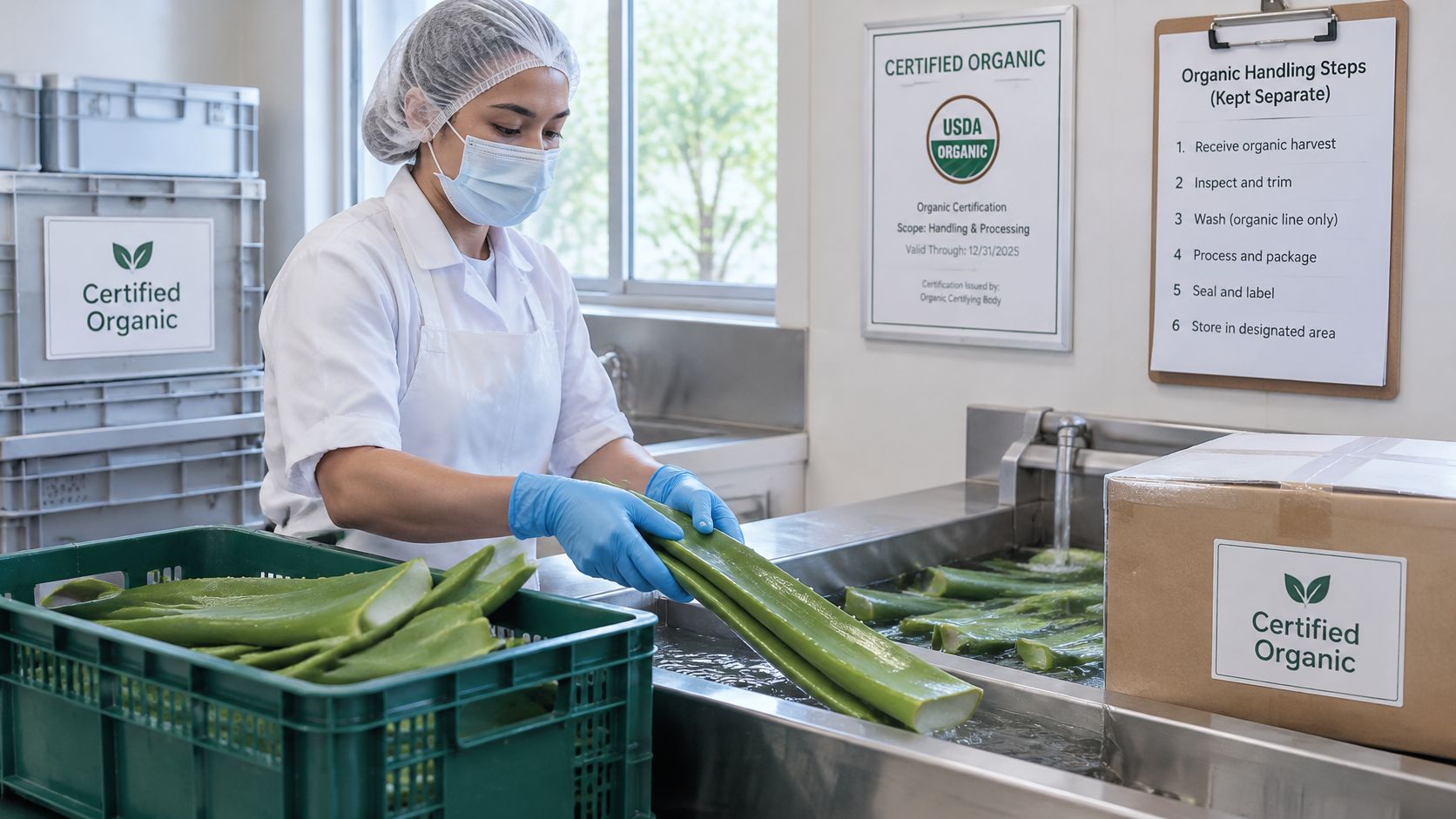
That distinction separates certified cultivation from certified processing and packaging, and it's why a farm-to-product narrative needs both halves. A company that owns only the field can describe how the plant was grown. It can't describe what happened in the four hours after cutting unless it also runs the line.
AloeCure owns its organic aloe farms and processes the aloe on site, controlling every step from planting through harvest. AGHG, the parent company, has a patented and proprietary harvesting and manufacturing process that converts fresh aloe leaves into finished products within 12 hours of harvest, and describes itself as one of the largest vertically integrated producers of pure aloe vera and certified organic aloe vera products in the world. Those are the company's own descriptions, and they're the kind of claim a buyer can test with a batch record.
Contrast that with a brand buying raw leaves on the open market. Nothing is necessarily wrong with the juice. But the reader who wants to verify a harvest window, an aloin figure and a microbial result has to request three documents from three businesses and hope the lot numbers line up.
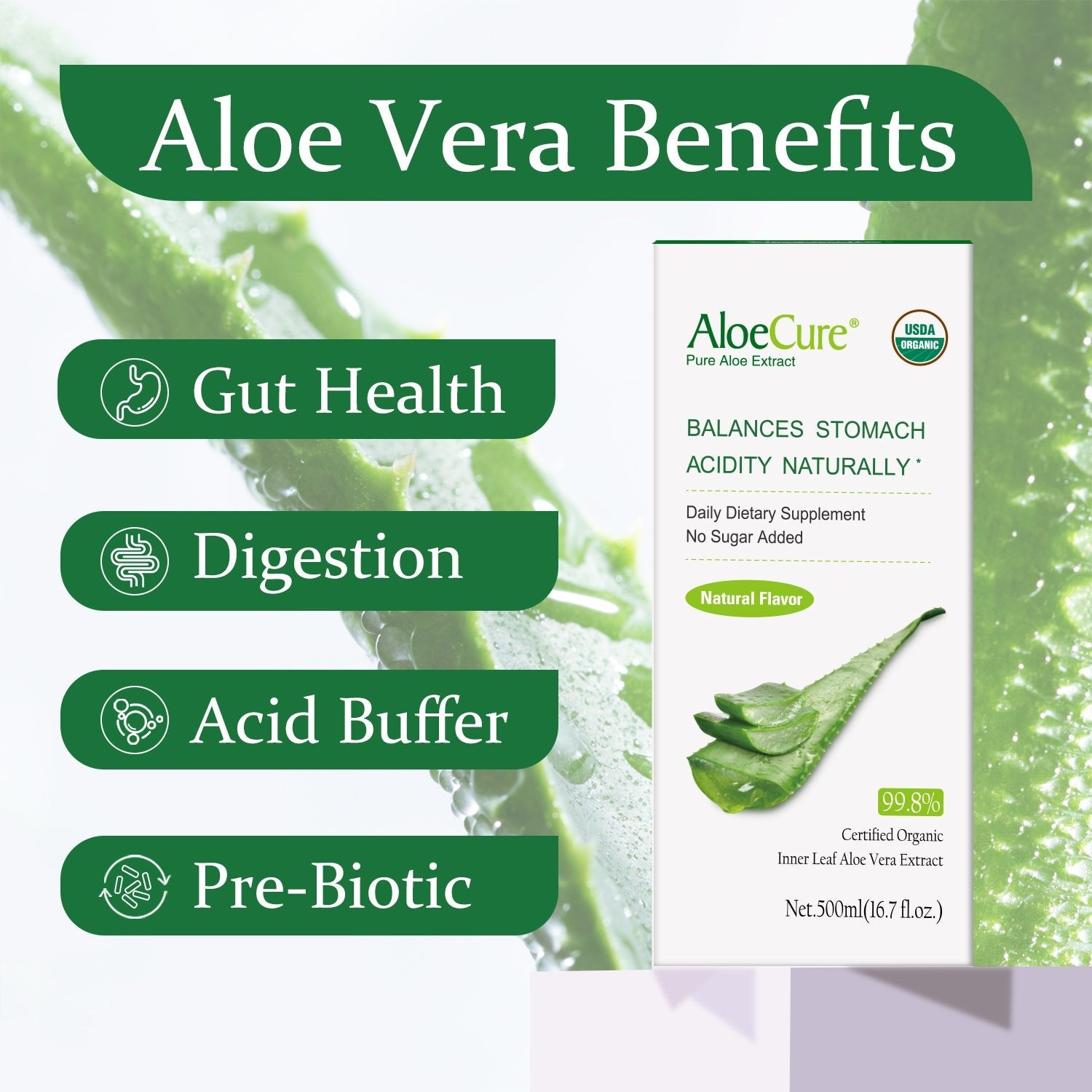
Once the harvest window, the inner-leaf filleting and the batch records exist, the next step is a product page rather than another checklist. AloeCure Pure Aloe Vera Juice comes in Natural, Grape and Lemon, each flavor USDA Certified Organic and priced at $19.95. Orders ship with 1–2 day priority processing, free shipping on qualifying orders and a 90-day money-back guarantee, and Subscribe and Save takes 20% off with a flexible delivery schedule. The same company farms the aloe, controls planting through harvest and runs its patented on-site process to turn fresh leaves into finished juice within 12 hours, so cultivation, handling and bottling stay on one chain of custody.
If a page carries a structure/function line such as "supports healthy digestive function," the FDA's notification requirements for supplement claims require the disclaimer beside it, in bold, at a minimum of one-sixteenth of an inch, with notification to the agency no later than 30 days after first marketing. That's what the bold line under the claim is doing.
These statements have not been evaluated by the Food and Drug Administration. This product is not intended to diagnose, treat, cure, or prevent any disease.
AloeCure grows, harvests, processes and bottles its own certified organic aloe within 12 hours of harvest, with no chemicals, enzymes or charcoal filtration, so the record behind the bottle stays in one company's hands. If this breakdown changed how you read a processing claim, the next step is to look at a product that publishes its own. Visit AloeCure to compare the Natural, Grape and Lemon juices, start a Subscribe and Save order at 20% off, or place a one-time order with 1–2 day priority processing.
Les commentaires sont approuvés avant leur publication.