Tu carrito está vacío
Envío y manipulación gratuitos con todos los pedidos superiores a $25
Envío y manipulación gratuitos con todos los pedidos superiores a $25

Which one does your body need, a prebiotic or a postbiotic? Most shoppers answer by picking the category they've seen more often, which usually means the one printed in larger type on the front of the bottle.
That choice skips the part that matters. Neither word names an ingredient. Each names a relationship between an ingredient and evidence. A prebiotic is a substrate that the microbes already living in your body use selectively, and that use has to produce a measured health benefit. A postbiotic is a preparation of inactivated microorganisms or their components that has itself been shown to benefit the host. One is fuel for a community you already carry. The other is a finished, non-living input.
So the useful question at the shelf isn't which category sounds stronger. It's whether the product can show you the substrate or the strain, the dose, and an outcome that someone measured.
Six factors make the prebiotic vs postbiotic split concrete. The category name on the front of the bottle does not.
| Factor | Prebiotic | Postbiotic |
|---|---|---|
| Definition | Substrate selectively used by host microorganisms that confers a health benefit | Preparation of inanimate microorganisms and/or their components that confers a health benefit |
| Biological input | Food for microbes already present in the digestive system | The inactivated preparation itself |
| Typical examples | Inulin, FOS, GOS, lactulose, resistant starch, human milk oligosaccharides | Heat-inactivated cells and retained components, with or without metabolites |
| Needs live microbes | Yes, resident microbes must use the substrate | No, the defined preparation is the input |
| Main variable | Reader's microbial community, dose and transit time | Strain identity and documented inactivation process |
| Evidence to look for | Selective utilization linked to a measured host benefit | Strain-level identity, inactivation confirmation and controlled human evidence |
Two rows do most of the work. Biological input says where the activity sits: food for microbes you already carry, or a finished preparation you swallow. Evidence to look for says what the label should show before the price matters.
The other rows follow from those two. A prebiotic has to be used by resident microbes, so the same dose can land differently from person to person. Transit time is part of that result, not a footnote. A postbiotic is defined by the preparation, so the questions point at the maker: which strain, inactivated how, and tested in whom.
A prebiotic works like groceries left for a kitchen you do not run. Whether anything useful comes out depends on the cooks already there. A postbiotic works like a sealed dish: the value is whatever the maker put in the container, and the label is how you check that claim.
The split in one line: a prebiotic asks something of your microbes, and a postbiotic asks something of the company that made it.
A probiotic is a live microorganism. Neither row above describes that live input. Shoppers often mix the three words, and a general three-way comparison such as how postbiotics survive stomach acid does not replace the evidence row. If the live category is the one you are weighing, the difference between probiotics and prebiotics separates those two terms.
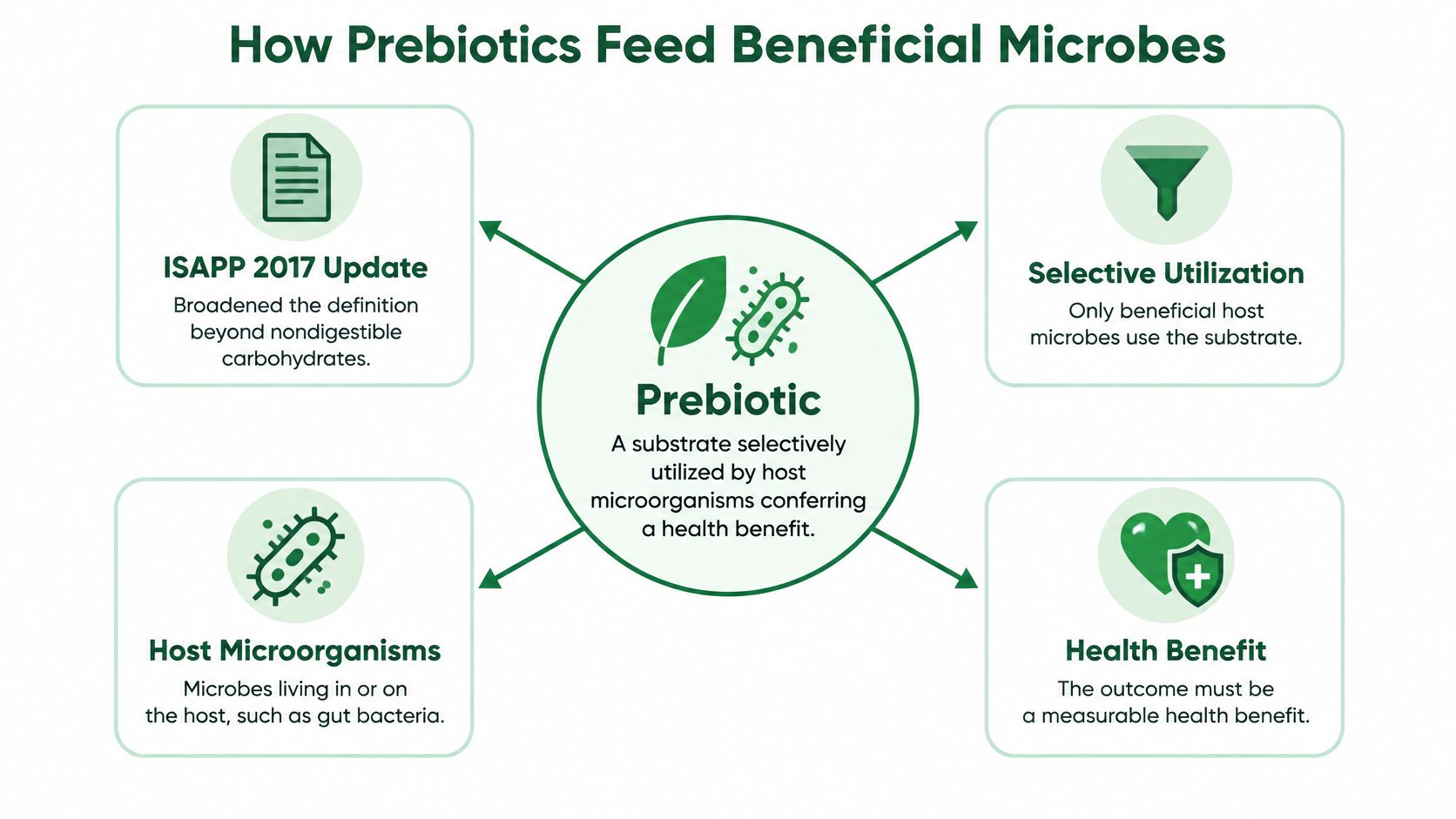
In 2017, the International Scientific Association for Probiotics and Prebiotics (ISAPP) refreshed the definition to "a substrate that is selectively utilized by host microorganisms conferring a health benefit," as recorded in the ISAPP prebiotic definition update, which lists inulin, fructooligosaccharides, galactooligosaccharides, lactulose, certain resistant starches and human milk oligosaccharides among the qualifying substrates.
That wording did two jobs at once. It moved the category past the older assumption that a prebiotic must be a nondigestible carbohydrate, and it packed two requirements into a single sentence: selective use by host microorganisms, plus a health benefit someone measured. Both, not either.
The mechanism runs as a chain, and each link matters.
Those downstream compounds are one reason researchers keep studying what the gut community does beyond digestion. How the microbiome affects mood surveys that emerging evidence, with the caveats the topic deserves.
Here's the confusion the definition is meant to stop. A fiber is not automatically a prebiotic. Plenty of ingredients resist human digestion and still fail the test, because no specific group of host microbes uses them selectively, or because nobody demonstrated a benefit. Plant-derived on a label proves nothing on its own.
Picture two readers adding the same thing to breakfast. One stirs chicory-root inulin into her coffee; the other, with a different microbial profile and a slower transit time, does the same. Same substrate, different community, different fermentation capacity, so the effect on each person can differ in both size and comfort.
If the goal is more fermentable material from food rather than a capsule, best ways to increase fiber intake covers the kitchen side of the same project.
Three questions will sort any prebiotic label quickly.
Label check: a prebiotic claim with no substrate, no dose and no measured outcome is a fiber claim wearing better clothes.
Postbiotics were standardized later. ISAPP convened an expert panel in 2019 drawing on nutrition, microbial physiology, gastroenterology, pediatrics, food science and microbiology, and the consensus statement appeared in Nature Reviews Gastroenterology & Hepatology on May 4, 2021. It defines a postbiotic as "a preparation of inanimate microorganisms and/or their components that confers a health benefit on the host."
Read the boundaries carefully, because most mislabeled products fail on one of them.

A prebiotic is a substrate that feeds microorganisms already resident; a postbiotic is a non-living preparation delivered after the organisms were grown and then inactivated. The first depends on an ecosystem. The second is the input itself.
That difference creates a manufacturing benefit worth understanding. Inactivation reduces dependence on keeping organisms alive through storage and shipping, so stability is easier to hold across a shelf life. For a global supply chain, that's a real advantage, and it's the reason the category grew commercially.
Stability isn't evidence. A preparation can sit perfectly stable on a shelf for two years and still lack any controlled study showing benefit in the people who take it.
Take a heat-treated fermented ingredient sold as a postbiotic. A credible version names the strain it started from, describes how the material was inactivated, and identifies the benefit that was tested. A weak version says only that bacteria were once present, which tells you nothing about what survived the process or what it did in a trial.
What a credible label owes you: the strain, the process and a description of the final matrix, not just the word postbiotic.
A postbiotic is a defined preparation. The category name on the front of a bottle does not specify that preparation. The lines underneath do.
The published consensus statement is blunt about the gap: "heat-killed" or "non-viable" is not an adequate performance specification by itself, per the consensus paper. Those phrases describe an absence of living cells. They do not name the strain, the process, or the material left behind.
A credible product needs a chain of documentation instead: strain-level identity, a documented inactivation process, confirmation that inactivation occurred, characterization of the final matrix and retained microbial components, and controlled human evidence in the target population. On a label, that chain is a series of checkable lines, not one adjective.
| Marker | What to look for | Red flag |
|---|---|---|
| Strain identity | Named originating strain | Only a generic phrase such as beneficial bacteria |
| Inactivation method | Documented process, such as a stated heat treatment | No process described |
| Inactivation confirmation | Evidence that the organisms are no longer viable | Non-viable claimed with no test |
| Matrix and components | Description of retained cell structures and metabolites | Only the word postbiotic on the label |
| Batch consistency | Activity measure reported across batches | No batch data available |
| Dose or activity measure | Clinically validated dose or activity value | No dose or measure given |
| Human evidence | Controlled study in the target population | Only in-vitro or animal results cited |
Work the table from the top. A named strain shows the manufacturer knows what it grew. A described process shows the inactivation was planned, not an accidental side effect of manufacturing. Batch data shows the jar in your hand resembles the material that was tested. For a biological preparation, that match matters more than it does for a single stable chemical, which stays the same molecule from batch to batch.
Isolated metabolites fall outside the definition. A label that lists only a metabolite name, however familiar that name sounds, is not selling a postbiotic under the consensus wording. The preparation has to retain microbial cells or components, and those materials have to be part of the demonstrated benefit.
A recipe works differently from a single spice. Naming one metabolite is like listing only the salt. A postbiotic claim needs the rest of the prepared mixture, the inactivated cells or their components, tied to the benefit that was tested.
Vague: "Contains beneficial microbial components from a proprietary fermentation process."
Specific: "Inactivated Lactobacillus strain identified by its strain code, heat-treated under a documented temperature and time, batch activity verified against a stated reference value, and tested in a controlled human study of adults taking a stated daily dose."
The second version invites verification. The first cannot be checked against a strain, a process, or a study.
Before you buy: request the certificate of analysis for the lot and the study behind the claim. A manufacturer who has both will send them.
The documentation is the product. The consensus definition pushes the conversation toward what was grown, how it was inactivated, and what evidence sits behind the dose, rather than toward the category name alone.
Start with your own situation rather than the category's reputation.
| Reader situation | Starting point | Watch for |
|---|---|---|
| Want to feed microbes already present | Prebiotic fiber or a prebiotic blend, started at a low dose | Results depend on the reader's own microbial community |
| Digestion sensitive to fermentation | Lower dose with a slower ramp over several weeks | Gas or bloating can signal too rapid an increase |
| Want a defined non-living input | Postbiotic with strain, process and batch data | Stability does not replace human evidence |
| Want both roles in one routine | Blend pairing prebiotic and probiotic components | Each component should be identified on the label |
| Reading any claim | Structure and function wording backed by substantiation | A disclaimer does not make an unsupported claim acceptable |
Your digestion handles fermentable fiber well. A prebiotic acts on an established community, so consistency does more than intensity. Daily intake at a modest dose, alongside foods that support the target microbes, is where the pattern builds.
You notice gas or bloating after a fast increase. That's usually a ramp problem, not a verdict on the ingredient. Drop to a lower dose, hold it two weeks, and step up only when the previous level settles. Rapid fermentation produces gas; slower introduction gives your community time to adjust.
You want a predictable non-living input. A defined postbiotic removes the survival and establishment variables entirely, because the preparation is the input. What remains is the evidence question: was this specific preparation tested, and did it help.
The trade-off is honest in both directions. Prebiotic results depend on what you already carry and how consistently you feed it. Postbiotic results depend on which preparation was tested and whether the label matches it.
Note four things daily, in a phone note or on paper: comfort after meals, afternoon energy, the dose you took, and any change in gas. Two weeks is enough to see a direction without overreacting to a single bad afternoon.
Take AloeCure's Pre+Probiotic & Digestive Enzyme Blend, priced at $19.95 USD. It combines aloe-based pre and probiotics with digestive enzymes, so it lands in the fourth row of the table above, both roles in one routine. Run the same discipline over it that you'd run over a postbiotic: is each component identified, is the prebiotic substrate named, is the dose printed, and does the wording stop at normal function rather than promising an outcome.
In the United States, a structure and function statement has to be supported by evidence showing it's truthful and not misleading before it's used, and the manufacturer must notify the FDA with the claim text no later than 30 days after first marketing the product with that claim, according to the FDA dietary supplement labeling guide. That's why phrasing such as "supports healthy digestive function" or "helps maintain normal intestinal function" is common and defensible.
The same framework has a boundary worth knowing. The claim isn't pre-approved by the FDA, so the responsibility for substantiation stays with the company making it. A disclaimer printed on a bottle doesn't convert an unsupported promise into a supported one.
The two approaches work better in one routine than in competition. Feed what you carry, add a defined preparation if the evidence supports it, track what changes, and keep a qualified healthcare professional in the loop about anything you already take.
Four steps, in order.
Sourcing deserves the same scrutiny as the ingredient list. We farm our own aloe, process it in-house and produce our own products, so each stage from field to bottle sits under one company's control. We also test our aloe for peak bioactivity before it goes into a formula.
Ask any manufacturer for the certificate of analysis and the batch data before you buy, and read the study if a claim rests on one. If your routine already includes other daily products, daily supplements for active adults is a useful cross-check for how a broader stack fits together without duplicating the same job twice.
If reading labels is the part you want to sharpen, how to read supplement labels walks through the panels in the order that answers the most questions fastest.
Here's the short video version of the comparison, useful if you're deciding before your next order arrives.
Recurring orders are where the math usually improves. Subscribe & Save gives 20% off every order, and the discount applies to first orders too, so it's worth checking the product page for current options before you commit to a one-time purchase.
Talk with a qualified healthcare professional before you change a routine you already follow, particularly if you take anything else regularly.
These statements have not been evaluated by the Food and Drug Administration. This product is not intended to diagnose, treat, cure, or prevent any disease.
If you want both roles handled in one place, AloeCure's Pre+Probiotic & Digestive Enzyme Blend combines aloe-based pre and probiotics with digestive enzymes at $19.95 USD, and it comes from aloe we farm, process and bottle ourselves. You can read the full ingredient list, compare formulas and set up recurring delivery at 20% off by visiting AloeCure. Start with one bottle at the lower dose, keep the two-week log, and let your own notes tell you whether it earns a place in your routine.
Los comentarios se aprobarán antes de mostrarse.