Your Cart is Empty


If two natural supplements sit on the same shelf, does that mean they're suited to the same kind of joint discomfort? Not necessarily. The ingredient, its exact form, the joint involved, and your reason for taking it all matter more than the word natural.
When you search for natural joint pain supplements, you'll find familiar ingredients alongside newer plant-based options. A useful comparison starts with what researchers tested, separates promising findings from established results, and gives you a clear point at which to stop experimenting.
Natural joint supplements by form, study amount and evidence
| Ingredient | Common form | Daily amount used in studies | Evidence signal |
|---|---|---|---|
| Glucosamine | Glucosamine sulfate or hydrochloride | A study-specific amount isn't established by the linked summaries | Mixed; findings differ by form |
| Chondroitin | Chondroitin sulfate, often from animal cartilage | A study-specific amount isn't established by the linked summaries | Mixed; often assessed alongside glucosamine |
| Curcumin (turmeric) | Standardized curcuminoid extract | Match the exact human-study formulation; no universal amount established | Encouraging short-term findings; small samples |
| Collagen | Hydrolyzed collagen peptides, bovine or marine | Confirm the amount against a study of the exact peptide preparation | Short-term comfort signals in a broader supplement review |
| Boswellia | Boswellia serrata resin extract | Use the extract-specific label after professional review | Short-term comfort signals in a broader supplement review |
| Aloe-based | Inner leaf gel or capsules | No joint-specific study amount established here | Insufficient joint-specific evidence for a firm conclusion |
Research amounts aren't personal prescriptions. The available summaries don't establish a daily amount for every ingredient, so this table deliberately avoids filling those gaps with customary doses. A familiar number on a retailer's page isn't proof that researchers tested that product.
The evidence labels describe the ingredients, not every bottle that contains them. A formula can share an ingredient name with a study product while using a different extract, concentration, or serving size.
Start with the ingredient panel. Look for glucosamine sulfate, a standardized curcuminoid extract, or hydrolyzed collagen peptides, rather than relying on broad front-label phrases such as joint complex or turmeric blend.
Then check how the manufacturer expresses the amount. The total weight of a blend doesn't tell you how much of each ingredient you'll receive. Likewise, turmeric powder and a concentrated curcuminoid extract are not interchangeable because both come from the same plant.
Shortlist no more than a couple of candidates, then choose just one to evaluate with professional guidance. Changing several products together makes it difficult to tell which one agrees with you or whether any change is connected to the supplement at all.
Practical rule: Choose a clearly identified ingredient before choosing an impressive-looking combination.
Healthy cartilage works like a shock-absorbing sponge that cushions every step, and joint comfort depends on how well that sponge keeps its water and structure. The analogy is useful, but a joint also includes bone, muscles, tendons, and other tissues. Not every uncomfortable step starts with the cartilage.
Say your knees feel uncomfortable after a long day of errands. One supplement might provide nutritional building blocks, while another contains plant compounds studied for their activity in normal cellular pathways. Neither explanation tells you, by itself, whether you'll notice a difference.
Glucosamine is a compound the body uses in cartilage-related structures. That makes it biologically relevant, but supplying a building block doesn't guarantee that the body will use extra amounts to improve a particular joint. Think of delivering materials to a building site: delivery alone doesn't determine what gets built.
Chondroitin is associated with cartilage's water-holding properties. In the sponge analogy, its role concerns the hydrated framework rather than adding more water. It's important to distinguish the normal role of chondroitin in the body from the demonstrated effects of taking a supplement.
Collagen peptides provide amino acids used throughout the body, including in connective tissue. They aren't shipped directly to a sore knee like a replacement part. Digestion and normal metabolism come between taking the product and any possible change in comfort.
Curcumin is a turmeric-derived compound studied for its influence on cellular signaling. Boswellia contains plant compounds investigated for related pathway activity. For both, the exact extract matters, and a description of laboratory activity shouldn't become a promise about everyday mobility.
Aloe inner leaf gel contains polysaccharides, including acemannan. That identifies something present in the plant, not a demonstrated human joint benefit. Without adequate joint-specific human evidence, aloe-based products belong in the least-established category of this comparison.
For a closer look at ingredient terminology, the guide to glucosamine and joint-health supplements offers additional context. Use educational explanations to understand the label, then ask whether the finished formula has evidence relevant to your goal.
A supplement can supply raw materials or influence pathways, but it can't rebuild worn cartilage on its own.
The concept map below illustrates the sponge analogy. Its branches describe broad support concepts, not benefits demonstrated for every ingredient pictured.
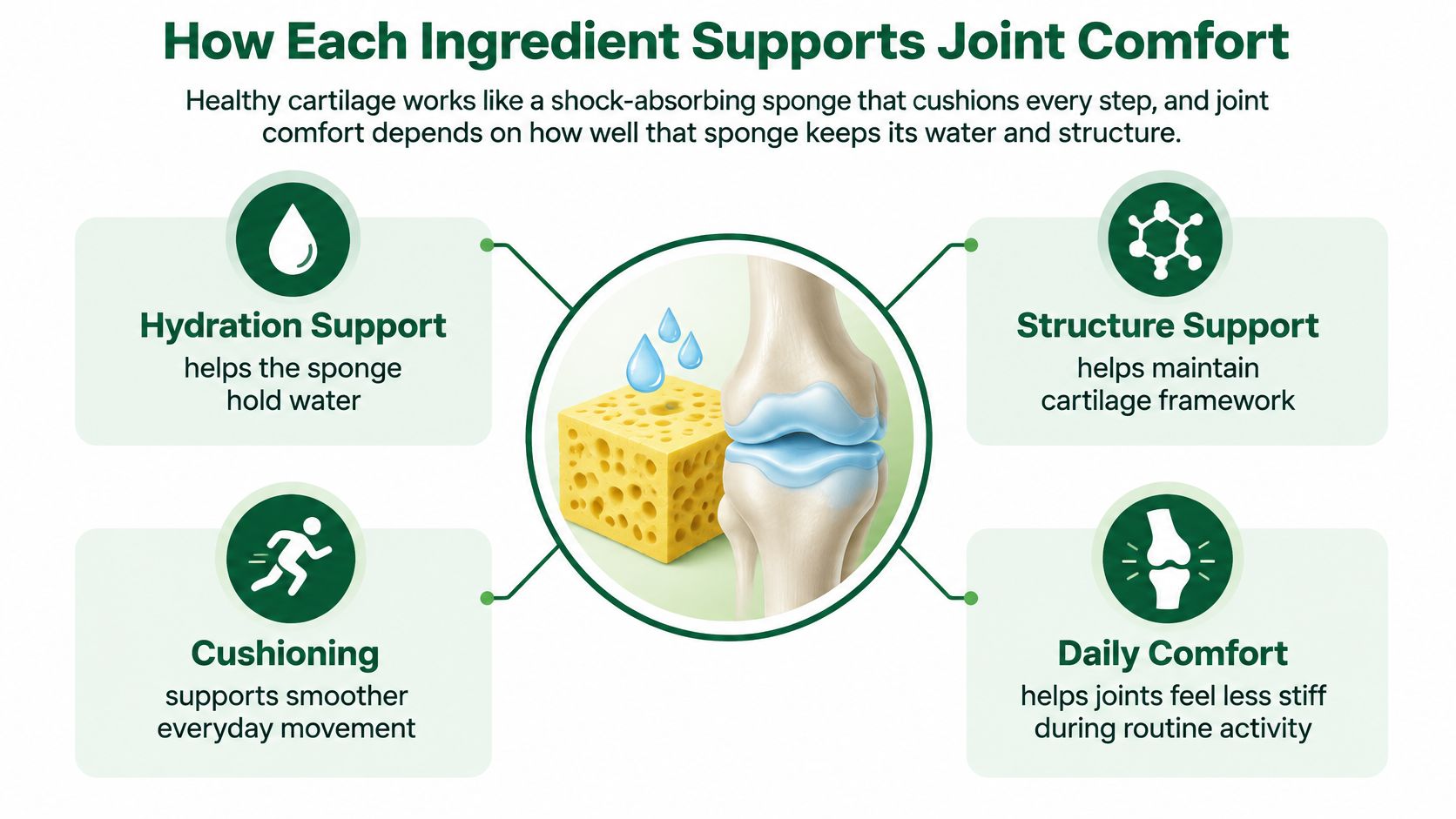
At the center is joint comfort. The building-block branches concern materials and structure; the plant-compound branches concern studied pathway activity. None should be read as proof of cartilage renewal or a guaranteed change in how a joint feels.
The evidence is mixed, not uniformly positive. A plausible ingredient story explains why someone ran a trial. Only comparisons between people can answer whether the ingredient changed an outcome.
Wording matters at this stage.
A group that feels better than it did at the start may owe part of that change to expectation, so the stronger question is whether the ingredient beat a placebo. A short-term comfort score also measures something different from lasting joint protection, much as a good week says little about a whole season.
Key studies behind joint-support ingredients
| Ingredient or study | Study size and design | Reported finding | Main limitation |
|---|---|---|---|
| Glucosamine or chondroitin, used alone | A 2018 analysis of 29 studies involving 6,120 people with knee joint wear, summarized by NCCIH | Used separately, either ingredient significantly reduced global pain | Individual studies were inconsistent |
| Glucosamine plus chondroitin, combined | The same analysis | The combination didn't produce a statistically significant pain reduction | Separate-ingredient findings don't establish a combined-product benefit |
| Glucosamine and chondroitin, long-term | The NCCIH summary also describes an Australian study lasting two years, with 605 participants, published in 2015 | Less joint-space narrowing occurred with the combination, not either ingredient alone | Structural findings disagreed across studies |
| Curcumin or turmeric extract | A placebo-controlled trial with 70 adults over 12 weeks, described in the BMJ-hosted evidence summary | Knee pain improved 9.11 millimeters more than placebo, with a 95% confidence interval of 0.44 to 17.79 millimeters | Small sample, short duration, and a wide range of plausible effects |
| Curcumin or turmeric, systematic review | A systematic review indexed in PubMed included 10 randomized trials | Every included study reported significant improvement from baseline; three direct comparisons with standard pain products found no significant difference in outcome scores | Small, heterogeneous studies; dose and formulation remain unresolved |
| Aloe-based joint products | No qualifying joint-specific human trial established in these summaries | No reliable joint-specific effect can be quantified here | Insufficient evidence for a firm conclusion |
For glucosamine and chondroitin, the practical lesson is that combining ingredients doesn't automatically strengthen the evidence. Two ingredients that each performed reasonably on their own behave like two capable cooks sharing one small kitchen: pairing them can help, or it can get in the way. A bottle containing both shouldn't inherit the favorable findings reported for either ingredient separately.
The structural finding needs particular care. Slower joint-space narrowing describes the joint's architecture on imaging. It says nothing directly about how climbing stairs feels tomorrow, and conflicting structural results across studies prevent a confident claim of long-term protection.
The turmeric result is encouraging, yet its confidence interval stretches from a barely noticeable difference to a much larger one. A single trial offers an estimate with a wide margin around it, more like a temperature range on a forecast than a precise prediction for the next person who buys a capsule.
Curcumin preparations differ in composition and absorption characteristics. The review's findings therefore can't confirm that any turmeric capsule will perform like the tested extracts, or that a larger amount works better.
The broader supplement review summarized on the BMJ page also identified short-term signals for collagen hydrolysate and Boswellia serrata extract. Those findings justify further investigation for the discomfort patterns studied. They fall short of a general recommendation for every joint.
Therapies delivered in a clinic sit outside this comparison entirely. Readers curious about that separate direction can find MSC insights from Dream Body Clinic, which describe a procedure-based approach rather than an oral supplement, so its results can't transfer to a capsule.
The useful conclusion is modest: some ingredients show promising short-term human findings for particular joints and particular patterns of discomfort. Those findings stop short of proving lasting protection, settling an ideal dose, or showing that all formulations behave alike.
Let the discomfort pattern lead the ingredient choice. The word natural on a label does not locate the joint, name the trigger, or predict a result. Start with three plain questions: where does it happen, when does it happen, and how long has it been happening?
A knee that complains on stairs is a different puzzle from a hand that looks swollen or a hip that suddenly makes walking hard. Choosing by pattern works like choosing a tool by the job in front of you: a hammer may be useful, but not because it is familiar, and not for every loose screw.
Discomfort pattern and the ingredient to research first
| Discomfort pattern | Ingredient to research first | Why it fits | Watch for |
|---|---|---|---|
| Knee discomfort that builds with walking or stairs | Discuss curcumin or glucosamine taken alone | More directly relevant knee research than many alternatives | Mixed findings don't make either a default recommendation |
| Hip discomfort | Ask a professional before choosing | Knee findings can't simply be transferred to the hip | Hip-specific results are less encouraging |
| Soreness after training or heavy days | Discuss hydrolyzed collagen peptides if considering a supplement | Broader reviews contain short-term comfort signals | Those findings don't establish a benefit for ordinary post-training soreness |
| Hand joint discomfort | Ask a professional before choosing | The hand should be assessed before any ingredient makes sense | Swelling or redness warrants prompt attention |
| Morning stiffness that lasts, swelling, redness, or heat | No supplement trial first | These features call for assessment | Don't postpone the assessment while trying a new product |
Say stairs have become uncomfortable, but flat walking is manageable. Write that down, including whether the feeling changes during the day and whether your activity has recently increased. A clinician or physical therapist can use those details more effectively than a description such as bad joints.
For hip or hand discomfort, avoid copying a friend's knee-supplement routine. The joint matters, and a successful personal story doesn't identify the cause of your symptoms or establish a likely result for you.
The Arthritis UK guide to diet and nutritional supplements is useful background for one idea: supplement suitability varies by joint problem. Familiarity with an ingredient isn't enough to make it an appropriate match.
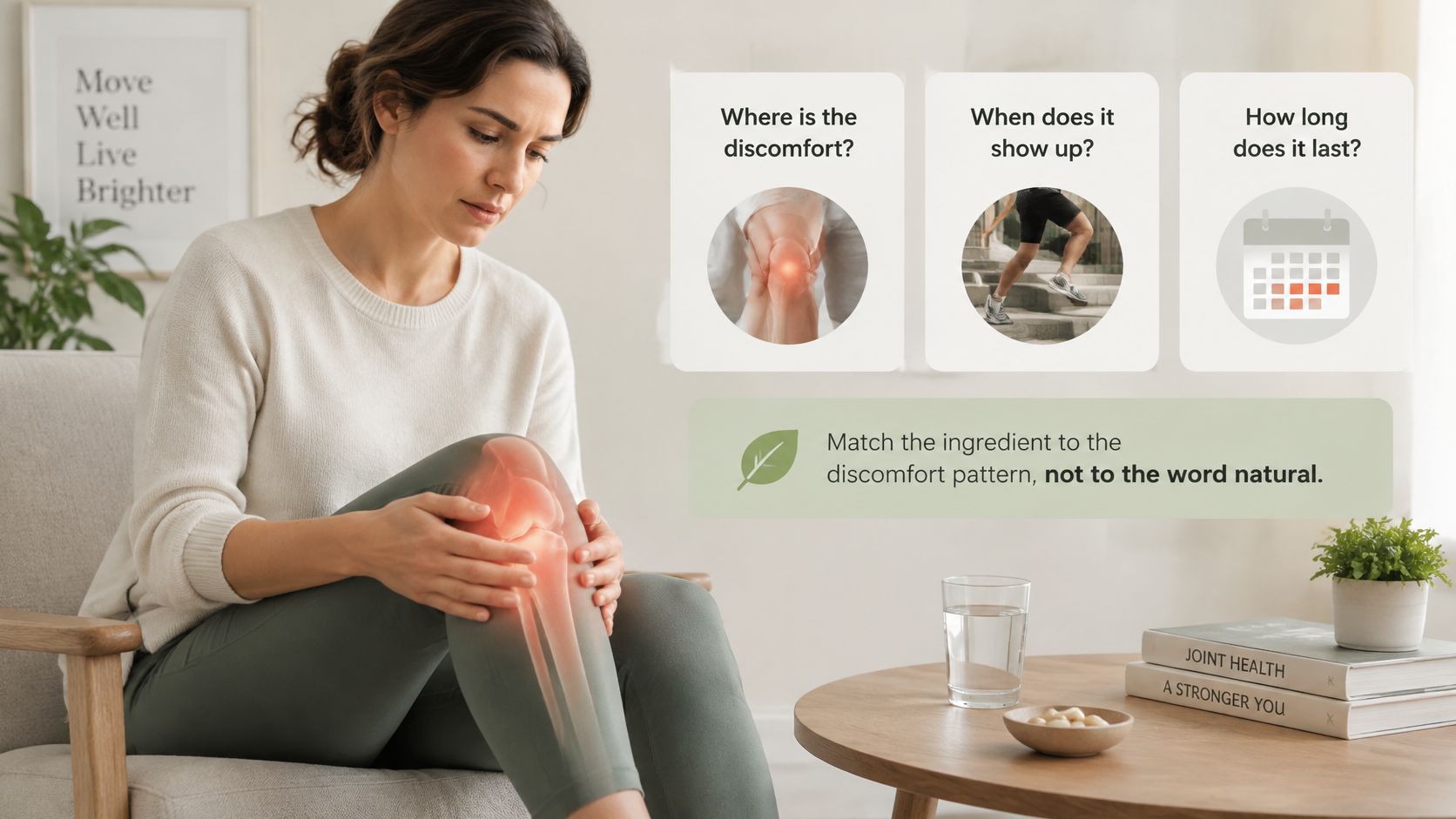
Choose something you can describe consistently, such as how stairs feel, whether a routine walk feels manageable, or how easily you rise from a chair. Record activity alongside comfort so a quieter week doesn't look like a supplement effect.
Keep expectations especially cautious for post-training soreness. Recovery habits deserve attention first, and a review of joint supplements doesn't automatically answer a sports-recovery question.
If your discomfort changes location, duration, or character, reconsider the plan. A changing pattern is a reason to reassess, not automatically increase the serving.
Photograph the complete label, including the ingredient panel and other ingredients. A product name alone may not identify the formula accurately, especially when manufacturers sell several versions.
The NIH Office of Dietary Supplements consumer guide explains that supplements can have unwanted effects and interactions. It also recommends discussing supplement use with health professionals, particularly around pregnancy and procedures.
Quality concerns go beyond whether an ingredient suits you. The FDA's pain-product safety notifications document products marketed for discomfort that contain hidden pharmaceutical ingredients. Avoid exaggerated promises and products that don't clearly disclose their contents.
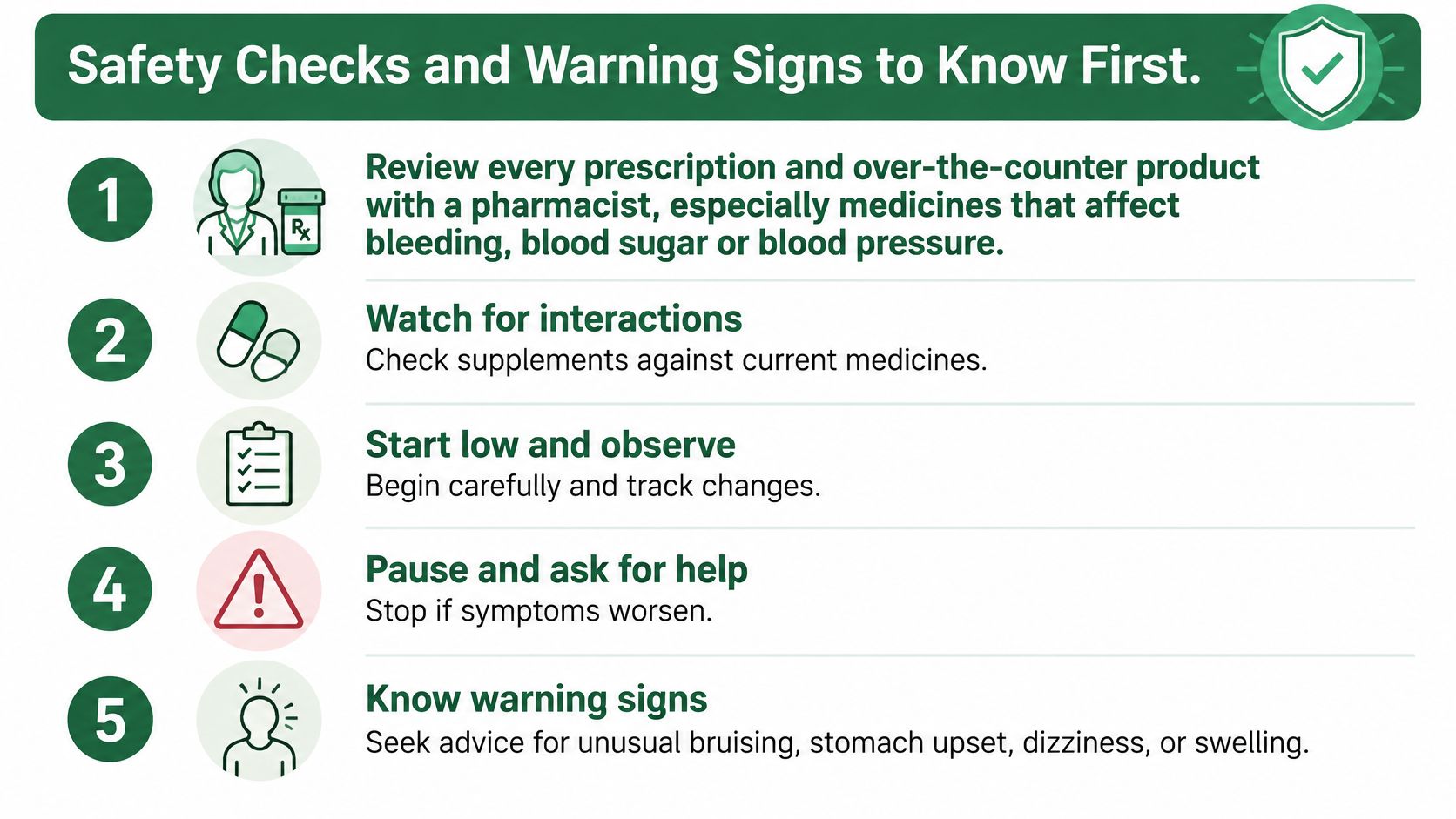
Seek medical assessment for these changes rather than starting another supplement:
When a joint changes suddenly, the next step is an assessment, not another bottle.
You don't need to finish a planned trial before asking for help. Safety takes priority over completing a bottle or keeping an experiment consistent.
Quality starts with knowing what's in the bottle. Identity means the ingredient is what the label says. Purity concerns unwanted material, strength concerns the amount present, and composition concerns the complete formula.
The FDA's manufacturing-practices backgrounder explains that manufacturing controls address inaccurate labeling and contaminants such as pesticides, heavy metals, and other impurities. Those controls are important, but they don't establish that a supplement will improve your joint comfort.
| Check | What to look for | What it doesn't establish |
|---|---|---|
| Ingredient identity | Exact form, plant part, or animal source | That every form has equivalent evidence |
| Serving information | Amount of each active ingredient per serving | That a larger serving is more useful |
| Extract standardization | Curcuminoid content or other relevant marker | That the finished formula matches a human trial |
| Batch traceability | A readable lot number and manufacturer contact | That every batch has been independently checked |
| Testing documentation | Named laboratory, relevant test scope, and batch connection | A guaranteed personal result |
| Independent seal | A verifiable certification with a clear scope | Universal safety or effectiveness |
Ask the manufacturer for documentation when an important detail is missing. A useful answer identifies what was tested, how the tested sample relates to your bottle, and which specifications it met.
The FDA's small-entity manufacturing guide describes requirements for scientifically valid testing and specifications covering identity, purity, strength, composition, and contamination limits. A general statement about rigorous quality is less informative than documentation connected to those checks.
For aloe-based options, vertical integration means the company controls farming, processing, and production. That can make the supply chain easier to explain, but ownership alone doesn't prove superior composition or a joint benefit.
Look for evidence supporting farm ownership, organic certification scope, processing methods, and traceability. If a company says it avoids chemicals, enzymes, concentrates, or charcoal filtration, ask how it defines those claims and how it verifies the resulting composition.
The guide to third-party testing offers a practical starting point for understanding independent checks. A seal is useful only when you can verify who issued it and what it covers.
Finally, separate a general support statement from a demonstrated outcome. The FDA's structure/function claims guidance requires marketers to substantiate such statements. Wording such as supports healthy joint function isn't a substitute for evidence about the exact product.
Build your routine around activities you can sustain: comfortable walking, cycling, or swimming, plus suitable strength work for the muscles around the joint. Step-ups, wall-supported squats, and resistance-band exercises are options to discuss with a physical therapist if movement is uncomfortable.
Warm up before harder activity, allow recovery after demanding days, and wear supportive footwear. Where appropriate, discuss body-weight goals with a clinician rather than using a supplement as a substitute for broader support.
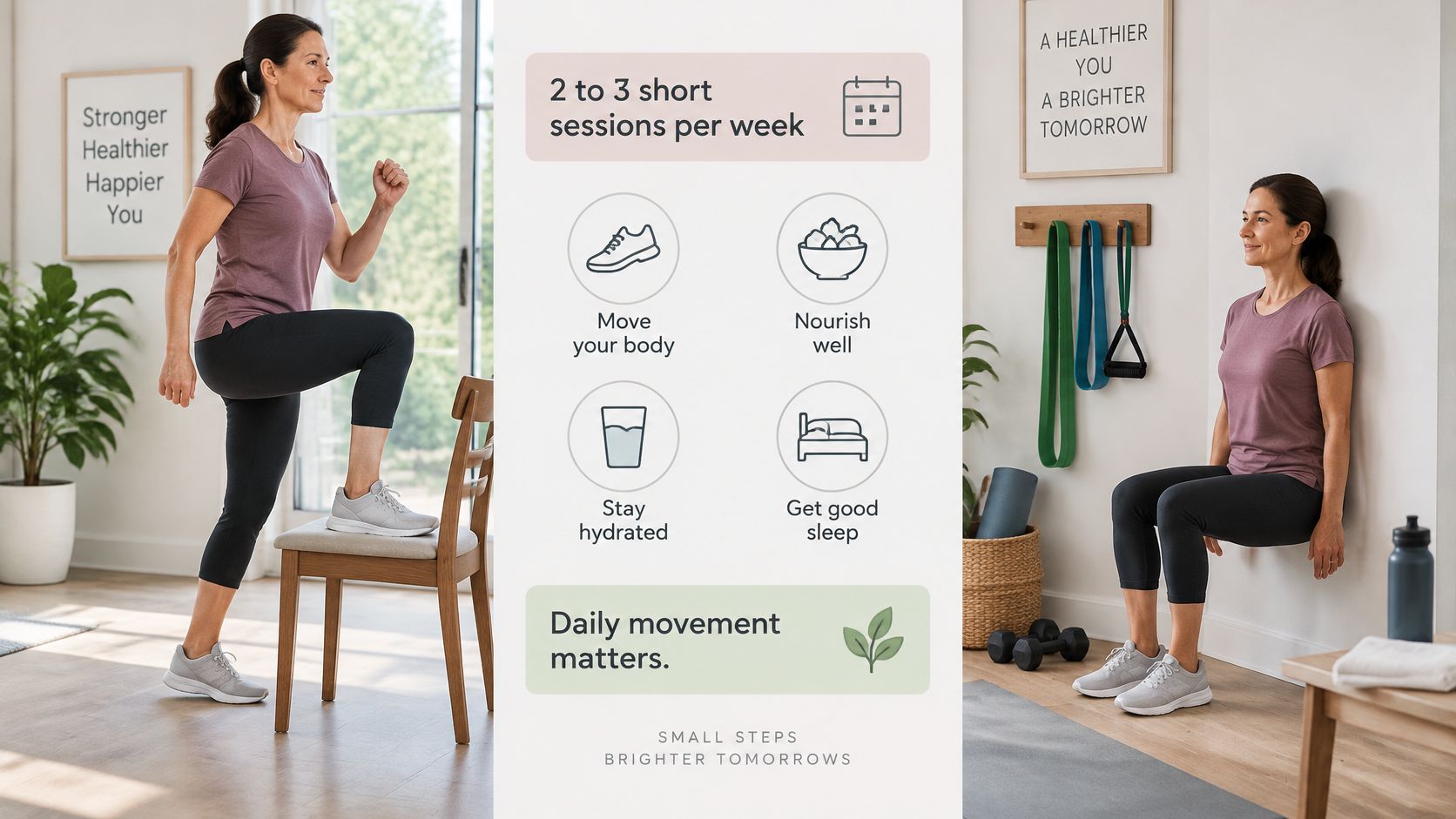
Choose one ingredient, complete the safety review, and write down your starting pattern. The comparison of exercise and supplements can help you keep movement at the center of the plan.
Set a defined review date with your clinician rather than continuing indefinitely. Track the same everyday task, note any unwanted effects, and stop sooner if the pattern changes or the product doesn't agree with you.
For readers considering a plant-based capsule, VeraFlex Joint Support Capsules are one option to evaluate alongside other clearly labeled formulas. Check the current ingredient panel, purchasing terms, and suitability with your pharmacist before ordering; don't assume an aloe-based formula has the same evidence as a studied curcumin or glucosamine preparation.
These statements have not been evaluated by the Food and Drug Administration. This product is not intended to diagnose, treat, cure, or prevent any disease.
Keep the decision simple: one pattern, one ingredient, one planned check-in. Continuing should be a deliberate choice based on tolerability and a meaningful change, not merely an automatic reorder.
AloeCure offers aloe-based wellness products, including VeraFlex Joint Support Capsules, for readers comparing plant-based joint-support options. Visit AloeCure to review the current formula, quality information, and purchase or subscription terms, then choose only after checking that the product fits your needs.
Comments will be approved before showing up.