Your Cart is Empty


You're rereading the same message, your coffee has gone cold, and you can't remember whether you set tomorrow's alarm. You've been getting by on short nights, but you don't feel exhausted all the time. Does that mean you're getting enough sleep?
Learning how to tell if you are sleep deprived starts with more than a tired morning or a watch notification. A useful home check brings together your actual sleep hours, your tendency to doze, and the small attention slips that show up during ordinary days. You don't need perfect records. You need an honest picture of your week.
You're probably sleep deprived when short nights repeat and daytime slips show up in the same week. That's a reason to investigate, not a diagnosis you can make from a checklist.
Start with the target for your age. The CDC's adult sleep guidance recommends at least 7 hours for adults ages 18–60, 7–9 hours for ages 61–64, and 7–8 hours for adults 65 and older.
Adult sleep targets and home warning signs
The age targets below follow that CDC guidance. Match your recent nights and daytime signs to a row, then use the last column to choose a practical next step.
| Age group | Nightly target | Warning pattern | What to do today |
|---|---|---|---|
| Adults 18–60 | At least 7 hours | Most nights under 7 hours | Start a 7–14 day sleep log |
| Adults 61–64 | 7–9 hours | Repeatedly under 7 hours or long weekend catch-up | Log bedtime, wake time, and naps |
| Adults 65 and older | 7–8 hours | Short nights plus unrefreshing mornings | Track awakenings and daytime alertness |
| Any adult, one short night | Still within the weekly target | A single late night only | Don't call it a pattern yet |
| Any adult, daytime slips | Hours may look adequate | Rereading, mistakes, or dozing while reading, watching television, or riding | Pair the hours with a dozing score |
The weekly view helps you separate an unusual evening from your usual routine. A late flight or deadline doesn't tell you much by itself. Repeatedly cutting sleep short, sleeping much later whenever you can, or waking unrefreshed deserves closer attention.
Use these signs as prompts for observation, rather than labels.
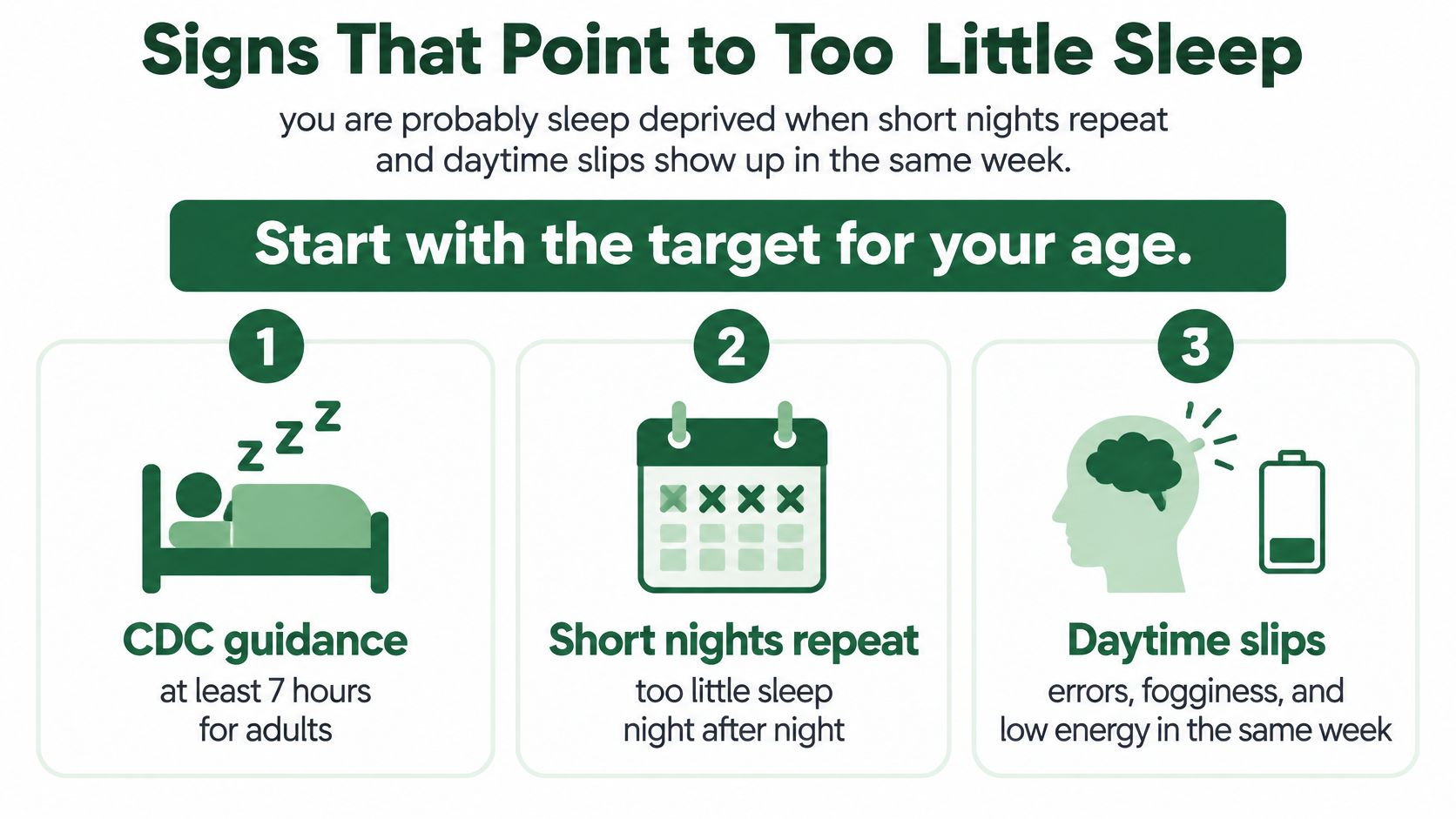
Short sleep is common: ABC30's report of CDC figures states that 30.5% of U.S. adults slept fewer than seven hours per night on average in 2024. Common doesn't mean it's the right amount for you.
The National Heart, Lung, and Blood Institute explains that inadequate sleep can affect focus, memory, reaction speed, decision-making, and emotional control. At home, that might mean losing your place in a recipe, missing a familiar turn, or snapping during a routine conversation.
Look for changes from your normal functioning, not whether you ever make a mistake. A demanding workday can also leave you scattered, so pair those observations with your sleep record.
Practical rule: Count a difficult morning as an observation. Look for repetition before calling it your usual pattern.
If evening alertness and morning grogginess seem mismatched, OneTwenty's resource on understanding the cortisol and sleep cycle offers useful background on daily timing. For practical adjustments to your evening environment, our guide to improving sleep quality naturally can help you choose a manageable starting point.
Turn the warning row into a record you can trust. A notebook beside the bed works well, especially if opening your phone tends to turn into checking messages.
The process is simple enough to follow when you're tired.
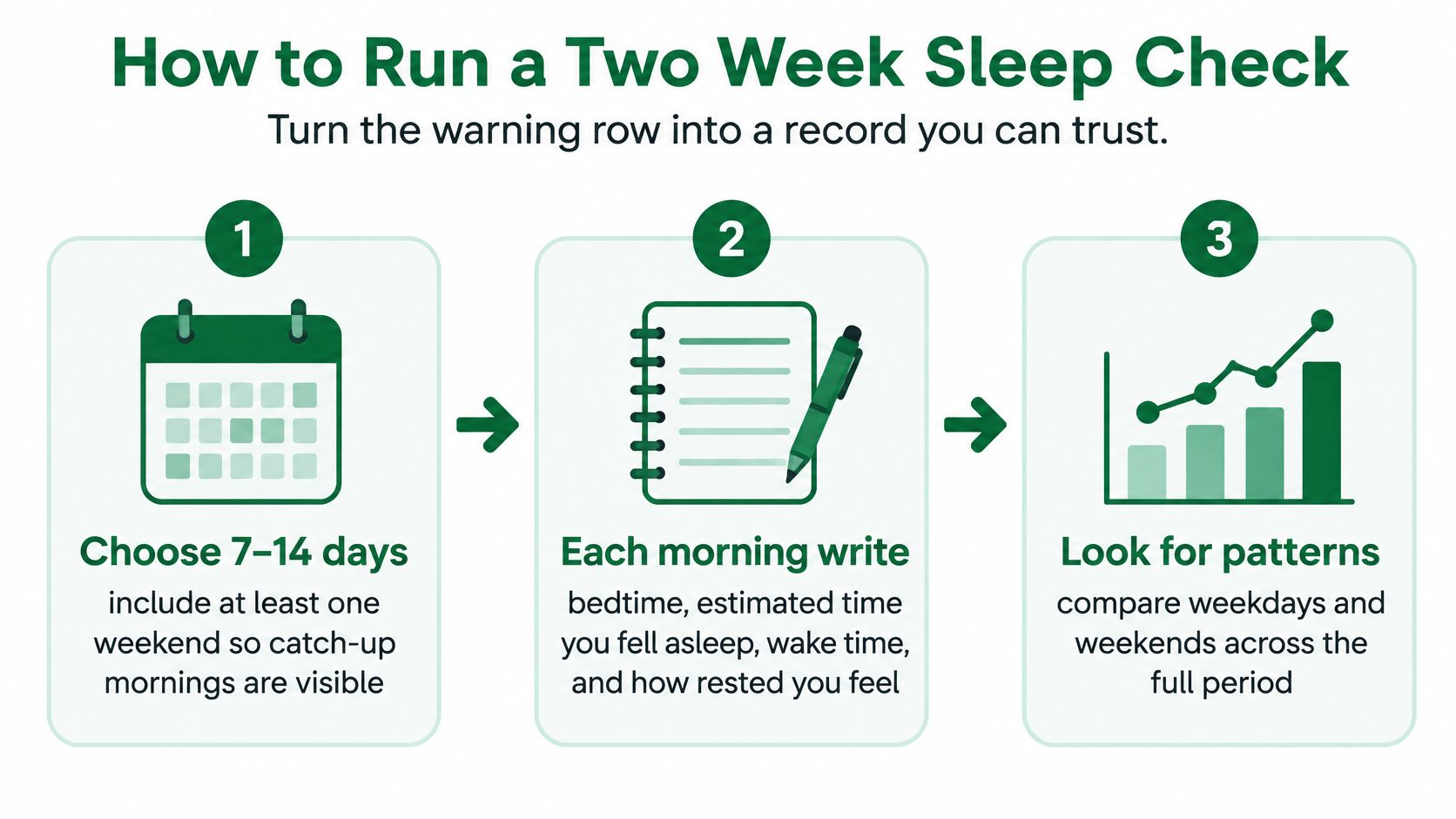
You don't need an attention test to complete this check. Distraction, worry, unfamiliar equipment, and testing at different times can all muddy the result. One poor performance doesn't settle anything.
For a broader look at comfort and the bedroom environment, Gates Home Furnishings' guide can help you understand sleep quality beyond eight hours. Use environmental observations alongside your diary, not instead of it.
If you prefer a video alongside your written notes, you can watch this:
Finish with a plain-language summary you could say aloud: short sleep, daytime slips, both, or neither. “Both” gives you stronger evidence that your current routine isn't providing enough rest. “Neither” is reassuring, but it doesn't cancel a persistent concern you should discuss with a professional.
Sleep hours tell you how much opportunity you had. A dozing questionnaire asks something different: how likely are you to fall asleep during ordinary situations?
The NIOSH version of the Epworth Sleepiness Scale uses eight situations, each scored 0–3, for a total of 0–24; NIOSH says 10 or greater raises concern. Rate your usual likelihood of dozing, not how you felt on your most exhausting day.
Daytime dozing score you can total at home
For each situation, choose one score. The final rows explain how to read the total; they aren't additional questions.
| Situation | 0 | 1 | 2 | 3 |
|---|---|---|---|---|
| Sitting and reading | No chance of dozing | Slight chance | Moderate chance | High chance |
| Watching television | No chance of dozing | Slight chance | Moderate chance | High chance |
| Sitting inactive in a public place | No chance of dozing | Slight chance | Moderate chance | High chance |
| Riding as a passenger for an hour | No chance of dozing | Slight chance | Moderate chance | High chance |
| Lying down to rest in the afternoon | No chance of dozing | Slight chance | Moderate chance | High chance |
| Sitting and talking with someone | No chance of dozing | Slight chance | Moderate chance | High chance |
| Sitting quietly after a meal without alcohol | No chance of dozing | Slight chance | Moderate chance | High chance |
| Sitting in a car stopped in traffic | No chance of dozing | Slight chance | Moderate chance | High chance |
| Total 0–9 | Lower usual dozing tendency | Keep the log | Stay with daily habits | Recheck after more consistent nights |
| Total 10–24 | Higher usual chance of dozing | Review sleep opportunity | Get more regular sleep | Ask a professional if it persists |
There's a useful distinction between feeling drained and being likely to fall asleep. You might feel worn out after a difficult conversation but have no tendency to doze. Answer the questionnaire about falling asleep, rather than general low energy.
Don't put yourself in any of these situations to test your response. In particular, the traffic item asks about your usual experience. It is never an invitation to assess yourself behind the wheel.
Consider a hypothetical example using the scoring system above. You choose a slight chance while reading (1), a moderate chance as a passenger (2), and a high chance while lying down to rest (3). With zeros elsewhere, your total is 6.
Now change the passenger score to 3 and the stopped-in-traffic score to 3. Keeping the other answers unchanged gives 1 + 3 + 3 + 3 = 10, reaching the questionnaire's concern threshold.
That difference should prompt attention, not panic. It helps you put a familiar feeling into words and makes a conversation about sleep more concrete.
A low dozing score doesn't erase repeated mistakes or unsafe lapses. A high score doesn't tell you why you're sleepy.
Keep the completed questionnaire with your diary. Read it alongside actual sleep time, nighttime awakenings, and what happens at work or during travel. If your answers feel difficult to judge, describe those uncertainties when you seek professional advice rather than choosing the most reassuring response.
Your watch gives last night a reassuring score, but you're fighting to stay awake on the train. The score doesn't overrule your experience. A watch can show a pattern, but it can't settle the question alone.
A 2025 study of 188 healthy young adults found moderate relationships between wearable-estimated total sleep time or time in bed and questionnaire-based sleep measures, but no significant relationship between wearable sleep efficiency and those scores. The same source describes emerging home-sensor work that improved daytime-sleep detection by 43.4% in night-shift workers, with 93.7% sensitivity for identifying sleep in nighttime sleepers and 97.2% specificity for identifying wakefulness.
Those sensor results aren't promises about a consumer dashboard. Different devices, algorithms, and sleeping schedules can produce different estimates.
Use the device to make recurring patterns easier to see. Focus on estimated sleep duration, bedtime and wake-time consistency, and the gap between time in bed and estimated sleep.
This visual summarizes what deserves attention and what shouldn't become a verdict.
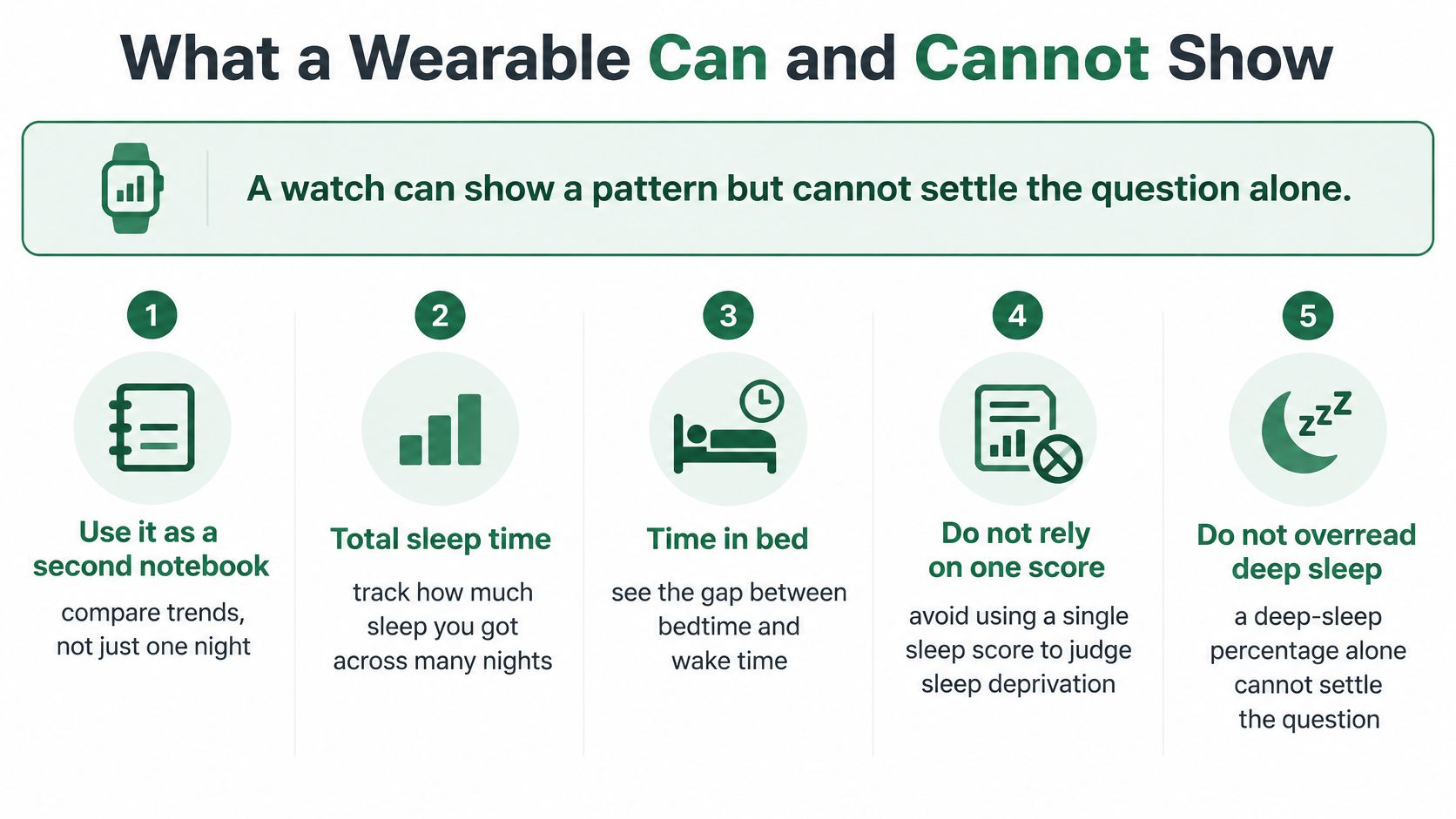
A sleep-stage estimate can look precise without being decisive. Avoid changing your entire routine because the device reports less deep sleep than you expected. The more useful question is whether its longer-term estimates agree with your diary and daytime functioning.
Shift workers should be particularly cautious about interpreting automatic summaries. Sleeping during daylight and crossing calendar dates can make a neat nightly display a poor match for the way you rest.
If checking the app makes you increasingly worried, simplify the task. Review the overall trend rather than every stage breakdown, and keep a brief handwritten account of how you functioned.
Bring an export or screenshot to a qualified professional when the picture remains confusing. Include your diary and dozing questionnaire, especially if someone reports loud snoring or breathing pauses, or you're struggling to stay awake during routine activities. Device data are supporting evidence, not permission to ignore persistent sleepiness.
Feeling used to short sleep doesn't prove you're functioning well. You can become familiar with your routine while missing changes in reaction speed, judgment, or attention during repetitive tasks.
An FAA-supported inpatient study found that five hours of daytime sleep opportunity across five days could produce impairment similar to two nights without sleep on some measures. That finding doesn't mean every short night has the same effect. It shows why accumulated restriction deserves attention even when you feel able to push through.
Use the time frames below as practical review points, not diagnostic cutoffs. You don't have to wait for a diary to be complete when safety is involved.
Rough patch or ongoing short sleep
| Pattern | Time frame | What it usually means | Next move |
|---|---|---|---|
| One late night | A single night | Temporary short sleep | Earlier, regular bedtime tonight |
| A hard week | Several nights under 7 hours | Building sleep debt | Finish the 7–14 day log |
| Most nights under 7 hours | Two weeks or more | Ongoing short sleep opportunity | Protect a longer sleep window and recheck dozing |
| Enough time in bed, still unrefreshed | 1–2 weeks | Quality issue, not just hours | Share the log with a qualified professional |
| Dozing while driving or at work | Any day | Safety issue now | Stop the task and get help promptly |
The most useful comparison is with your own usual performance. Perhaps familiar household jobs still feel easy, but a quiet meeting becomes difficult to follow. Or you complete work but need to correct details you'd normally catch immediately.
Different tasks expose different weaknesses. Getting through an active morning doesn't necessarily tell you how alert you'll be during a monotonous drive.
Ask for professional assessment when someone notices breathing pauses, when you repeatedly struggle to fall or stay asleep despite enough opportunity, or when sleepiness persists after you've protected a fuller sleep window. Bring specific examples rather than only saying you're tired.
Safety first: Dozing at the wheel is a concern today, not a diary entry to revisit later.
Don't begin a drive or operate equipment while drowsy. If you're already driving, stop somewhere safe and arrange another way to travel. Another coffee isn't a substitute for resolving unsafe sleepiness.
Before shopping for nighttime support, use our adult nighttime-options guide to frame questions about habits and expectations. A supplement or temporary burst of energy can't establish that you've recovered. Your daily functioning and, when needed, a professional assessment matter more.
Change the week before you change products. If your record shows that evening chores, scrolling, and an early alarm leave too little sleep opportunity, an optional supplement can't create the missing time.
Choose changes you can repeat on an ordinary worknight. A practical routine should fit your household, not require a perfectly quiet home or an elaborate bedtime ritual.
For a wind-down that doesn't involve another screen, Gorins Furniture & Mattress offers relaxation techniques for restful nights. Try a simple practice you enjoy, such as quiet reading or relaxed breathing, rather than adding another task you feel pressured to complete.
Our guide to nighttime supplement alternatives can help you think through preferences before choosing a product. If your record includes safety concerns or persistent sleepiness, speak with a qualified professional before adding any supplement.
For adults considering an additional wellness option, our Melatonin + Collagen Sleep Support capsules are a best seller priced at $14.95 USD. The formula is designed to support the body's natural sleep cycle and help maintain a calm nighttime routine; it doesn't determine whether you're getting enough sleep.
We're fully vertically integrated: we farm our aloe, process it in-house, and produce our own products. That gives us direct control from leaf to bottle. Our natural processing avoids chemicals, enzymes, concentrates, and charcoal filtration, with traceability and testing supporting our quality standards.
Optional support belongs beside a realistic schedule, not in place of one. Read the label, keep your observations, and judge your routine by how consistently you make room for rest and function during the day.
These statements have not been evaluated by the Food and Drug Administration. This product is not intended to diagnose, treat, cure, or prevent any disease.
At AloeCure, we offer aloe-based wellness products and optional nighttime support to complement daily habits. Review your sleep log first, then explore the product details or choose Subscribe & Save for 20% off with flexible delivery; our 90-day guarantee covers your first order.
Comments will be approved before showing up.