Your Cart is Empty

Why do so many supplement shoppers see "freeze-dried" on a bottle of aloe vera and assume they're holding a standardized, tested product? That single phrase only tells you how water left the plant. It doesn't tell you which part of the leaf went into the grinder, how much aloin remained after processing, or how much active acemannan survived the trip into each capsule.
Demand for aloe products keeps growing, with a global market report published in August 2025 by Research and Markets estimating the 2024 global aloe vera market at approximately USD 768.93 million. While Mordor Intelligence projected in its 2024 industry report (covering 2021 to 2031) that liquid formulations would account for 44.10% of the global market in 2025, plenty of buyers prefer freeze-dried aloe vera capsules for convenience, measured servings, and a taste-free routine. Knowing how to read past the front label turns guesswork into a clear verification process.
A freeze-dried aloe vera capsule is powder made by dehydrating aloe leaf material and filling it into a capsule shell, and the single most important question is which part of the leaf went in. Two bottles sitting side by side on a shelf can both say "freeze-dried aloe vera" while containing completely different fractions of the plant.
Picture a shopper picking up three bottles at a health store and flipping each one to the Supplement Facts panel. The first lists inner-leaf fillet gel, the second lists decolorized whole-leaf extract, and the third says "aloe vera leaf powder" without specifying the cut. Those three descriptions represent distinct materials with different chemical profiles, as the breakdown below shows.
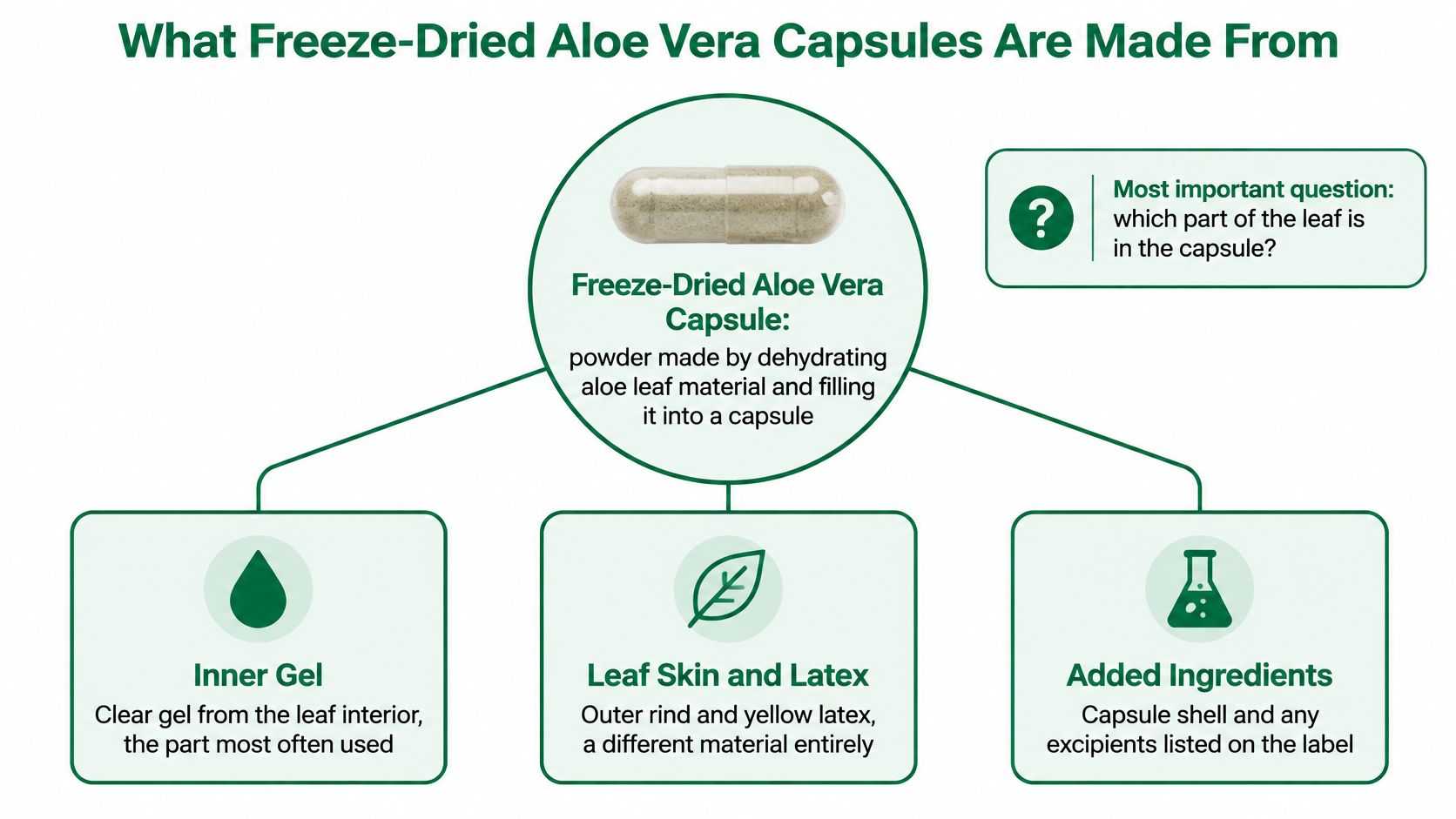
Inner-leaf gel is the clear, translucent fillet scooped from the center of the aloe leaf after the green outer rind is stripped away. It's the standard starting base for gentle daily capsules because it naturally carries very little of the bitter outer sap.
Whole-leaf material includes both the inner gel and the outer green rind, where bitter yellow compounds sit just beneath the skin. Because raw whole-leaf material contains anthraquinones (including aloin), producers commonly pass it through activated carbon to create decolorized whole-leaf extract, stripping out most of those bitter compounds while leaving a dryable extract behind.
Aloe latex is that yellow sap lining the underside of the rind, and it's a completely different substance from clear inner gel. In reviewed safety reports, oral aloe latex is associated with cramping and loose stools, so a capsule buyer should never assume "whole leaf" or unspecified "aloe powder" equals pure gel.
| Plant Fraction | What It Is | Aloin Content | Typical Use in Capsules |
|---|---|---|---|
| Inner-leaf gel | Clear gel from the centre of the leaf | Very low | Common base for capsules |
| Decolorized whole leaf | Whole-leaf extract with anthraquinones reduced by activated carbon | Reduced to low levels | Used when whole-leaf material is the stated ingredient |
| Aloe latex | Yellow sap found just under the leaf skin | High | Linked to cramping and loose stools in reviewed reports; should not be assumed to be gel |
Before putting a bottle in your cart, run the Supplement Facts panel through three fast checks:
If a bottle leaves any of those three questions unanswered, the word "freeze-dried" on the front won't bridge the gap.
Freeze-drying, technically called lyophilization, removes water from fresh aloe at low temperature under vacuum rather than baking moisture out with hot air. Think about the difference between frozen peas and sun-dried tomatoes. Frozen peas hold their bright green color and crisp cell shape because cold locks them in place, while sun-dried tomatoes shrink and darken because heat alters their sugars and pigments.
The diagram below maps the four main production stages that turn a freshly cut aloe leaf into a dry capsule powder.
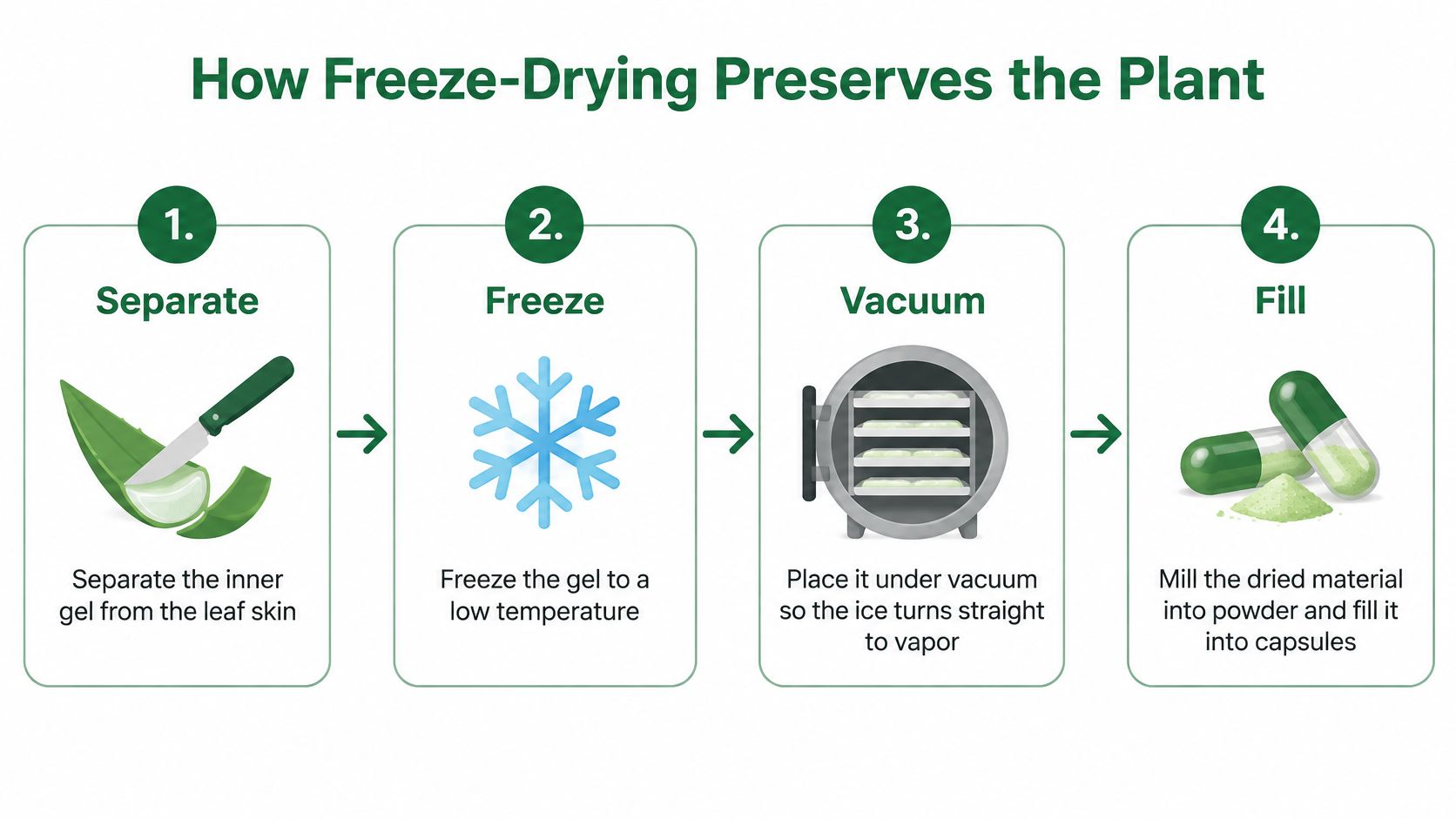
Low-temperature drying does protect fragile plant compounds better than conventional heat. A comparative study of aloe vera gel powders published in E3S Web of Conferences found that freeze-dried powder retained higher phenolic content and demonstrated stronger antioxidant activity than oven-dried powder across every extraction solvent tested. Skipping high oven temperatures reduces thermal breakdown of oxidation-sensitive molecules.
Practical boundary: Retaining more phenolic compounds in a lab beaker measures powder chemistry, not human outcomes. Freeze-drying protects delicate constituents from heat damage, but it doesn't set a standard for potency, purity, or safety.
Seeing the equipment and moisture controls in action makes it much easier to picture why handling after dehydration matters just as much as the freeze-dryer itself. The short clip below walks through how industrial lyophilization works on botanical ingredients.
Once dried aloe leaves the vacuum chamber, it acts like a sponge for ambient humidity and oxygen. Without tight moisture limits, validated water activity targets, and oxygen-barrier bottles or blister packs, even carefully lyophilized powder degrades on the warehouse shelf. Good drying preserves what went in, yet it can't fix poor raw leaves or sloppy packaging.
Most supplement buyers assume that choosing freeze dried aloe vera capsules protects the plant's flagship compound intact. Controlled drying research challenges that assumption. In a study comparing spray-drying, industrial freeze-drying, refractance-window drying, and radiant-zone drying, indexed on PubMed, every tested drying method produced an approximately 40% decrease in acemannan yield.
Acemannan is the primary acetylated polysaccharide in inner-leaf aloe gel and the marker molecule most quality-focused brands use to gauge active content. If you want a deeper breakdown of its structure and role in daily wellness routines, our guide on what acemannan is explains how this long-chain carbohydrate behaves inside the plant. Losing roughly two-fifths of that yield during dehydration proves that the drying method alone never guarantees full preservation.
It's easy to confuse phenolic retention with polysaccharide stability because both happen inside the same leaf. Keeping oven heat away protects smaller antioxidant molecules, yet acemannan is sensitive to the entire upstream chain: harvest delay, filleting stress, freezing speed, vacuum dehydration conditions, and even how the powder rehydrates. Two facilities running the exact same model of freeze-dryer can produce powders with dramatically different polysaccharide profiles if one leaves cut gel sitting in warm holding tanks while the other processes fresh leaves immediately.
Powder weight on a supplement label tells you how much dried plant sits inside the shell, not how much intact acemannan survived processing.
Suppose Bottle A and Bottle B both list 300 mg of freeze-dried aloe vera per capsule. Bottle A was dried gently from fresh inner-leaf fillet and tested after milling to verify its exact acemannan milligram count per serving. Bottle B used older gel held before freezing, experienced heavy polysaccharide degradation, and never ran a post-drying assay.
On the front label, both bottles look identical. In your daily routine, they deliver different active profiles. Asking for a batch-specific acemannan test tied to a real lot number tells you what survived manufacturing, turning a marketing adjective into a measurable number.
Because "freeze-dried" only describes water removal, a reliable label and accompanying specification sheet need hard numbers. Identity, active polysaccharide content, and contaminant limits all depend on the starting leaf and lab verification after encapsulation.
Aloin control is where U.S. labels leave the widest blind spot. The National Institute of Environmental Health Sciences reports that commercial producers often convert leaves into decolorized whole-leaf extract or apply charcoal filtration to strip out aloin, and an industry self-regulatory standard sets an upper limit of 10 parts per million (10 ppm) of aloin for orally ingested aloe products. Yet there is no general federal requirement that brands print aloin content on U.S. supplement labels, and that 10 ppm figure serves strictly as a processing and testing benchmark rather than a health claim.
Work through these seven checks before buying any bottle, and use our complete walkthrough on how to read supplement labels whenever a panel looks unfamiliar:
| Specification | What to Ask For | Strong Answer Looks Like |
|---|---|---|
| Botanical part | Inner-leaf gel, decolorized whole leaf or latex | Named plant part on the label or spec sheet |
| Aloin level | Measured aloin per batch | Result stated against the 10 ppm benchmark, with the test method |
| Acemannan per serving | Amount per capsule, tested per batch | Milligrams per serving tied to a specific batch |
| Serving basis | Raw aloe equivalent or finished powder weight | Clear statement of which basis is used |
| Moisture and packaging | Moisture level and oxygen barrier | Documented manufacturer specification |
| Facility certification | GMP and NSF status of the production site | Certificate or verifiable public listing |
| Organic status | USDA organic certificate covering handling and processing | Certificate that names the processing operation |
If you want a broader playbook on evaluating third-party lab reports across all your daily supplements, Yuve's guide on how to verify supplement purity breaks down how independent labs screen for contaminants and potency. Applying that lens to aloe capsules makes four warning signs jump off the label right away:
Many shoppers assume that if a supplement company owns its own aloe fields, every capsule it sells is automatically organic. Under federal rules, farm ownership alone proves nothing about what happens once a leaf gets harvested and hauled indoors.
The USDA Agricultural Marketing Service guide for organic processors states that an operation processing crops on the farm must obtain an organic handler certificate, and an organic handling certificate is also required for processing or packaging agricultural products. Every certified operation must maintain a written Organic System Plan detailing its processing steps, prevent commingling of organic and nonorganic lots, and block any contact with prohibited substances. Without certified handling and packaging, organic crops lose their protected status the moment they hit an uncertified processing line.
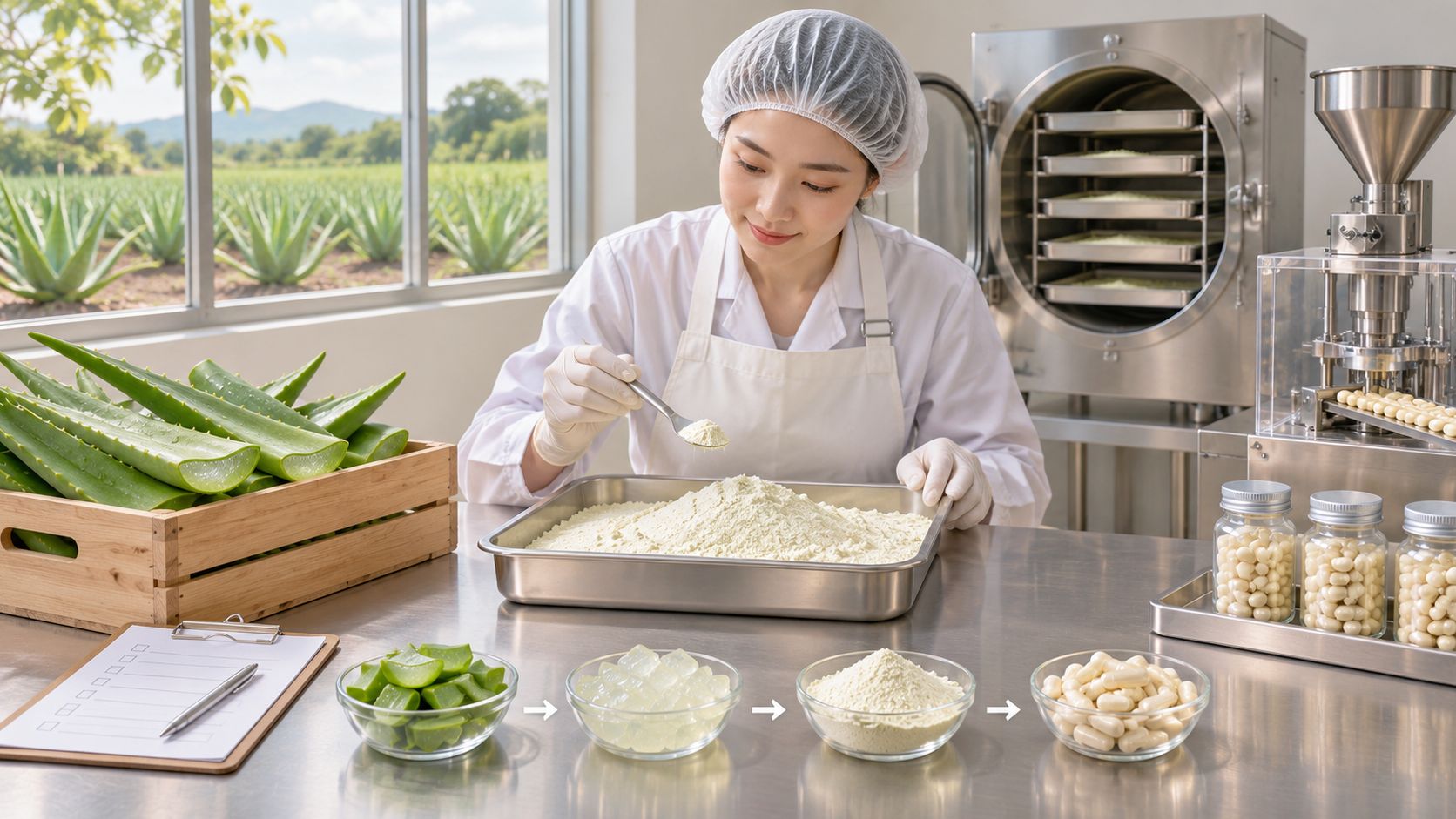
True vertical integration closes the chain-of-custody gaps that crop up when a brand buys bulk powder from third-party brokers. At AloeCure, we are fully vertically integrated: we grow our own organic aloe, hand-harvest the leaves, process them on site, and produce our own finished products rather than outsourcing to contract powder suppliers. Using our patented harvesting and manufacturing process, we turn fresh aloe leaves into finished products within 12 hours of harvest.
Speed after cutting makes a measurable difference for fresh botanicals. The moment a knife slices an aloe leaf from the mother plant, natural enzymes and oxygen begin altering the clear inner gel. Shipping cut leaves across long distances or holding raw pulp in storage tanks forces large-scale competitors to rely on chemicals, added enzymes, or charcoal filtration to stabilize and strip the material later.
We avoid chemicals, enzymes, and charcoal filtration altogether, preserving peak bioactivity and delivering higher quality than competitors that cut corners during processing. You can learn more about how certification audits protect clean handling in our overview of USDA organic supplements.
Even when a brand owns both the fields and the facility, smart buyers still check paperwork instead of trusting slogans. Look for three verifiable signals:
Freeze-drying changes the moisture level of aloe, not its basic safety profile. Independent clinical guidance from the National Center for Complementary and Integrative Health draws a clear line between plant fractions and duration of use: research suggests short-term oral use of aloe gel for up to 42 days is safe, whereas oral aloe latex can cause abdominal pain, cramps, and diarrhea.
The same NCCIH guidance emphasizes that dietary supplements are not preapproved by the FDA before they reach store shelves. Instead, manufacturers and distributors carry direct responsibility for evaluating ingredient safety and accurate labeling before marketing a product. Orally consumed aloe products may also be unsafe during pregnancy or breastfeeding, regardless of whether the aloe comes in a liquid or a capsule.
Under FDA rules for structure/function claims, supplement labels in the United States must stay strictly within normal, everyday wellness functions. Manufacturers must hold substantiation showing each statement is truthful and not misleading, notify the FDA no later than 30 days after first marketing a product with that claim, and display the statutory disclaimer prominently on the package.
Compliant capsules describe normal physiological support using clear, grounded phrasing such as:
A lawful dietary supplement label never promises to address, resolve, or prevent a named medical condition. Whenever you read a bottle in the United States, look for this exact disclaimer printed alongside structure/function wording:
These statements have not been evaluated by the Food and Drug Administration. This product is not intended to diagnose, treat, cure, or prevent any disease.
Responsible daily use comes down to three simple habits:
You don't need a chemistry degree to pick a dependable supplement, just one clear decision step before you click buy. Confirm three specifics on the product documentation: the exact plant part used, the batch aloin result with its test method, and the verified acemannan amount per serving tied to a batch date. If a brand can't answer those three points clearly, keep shopping.
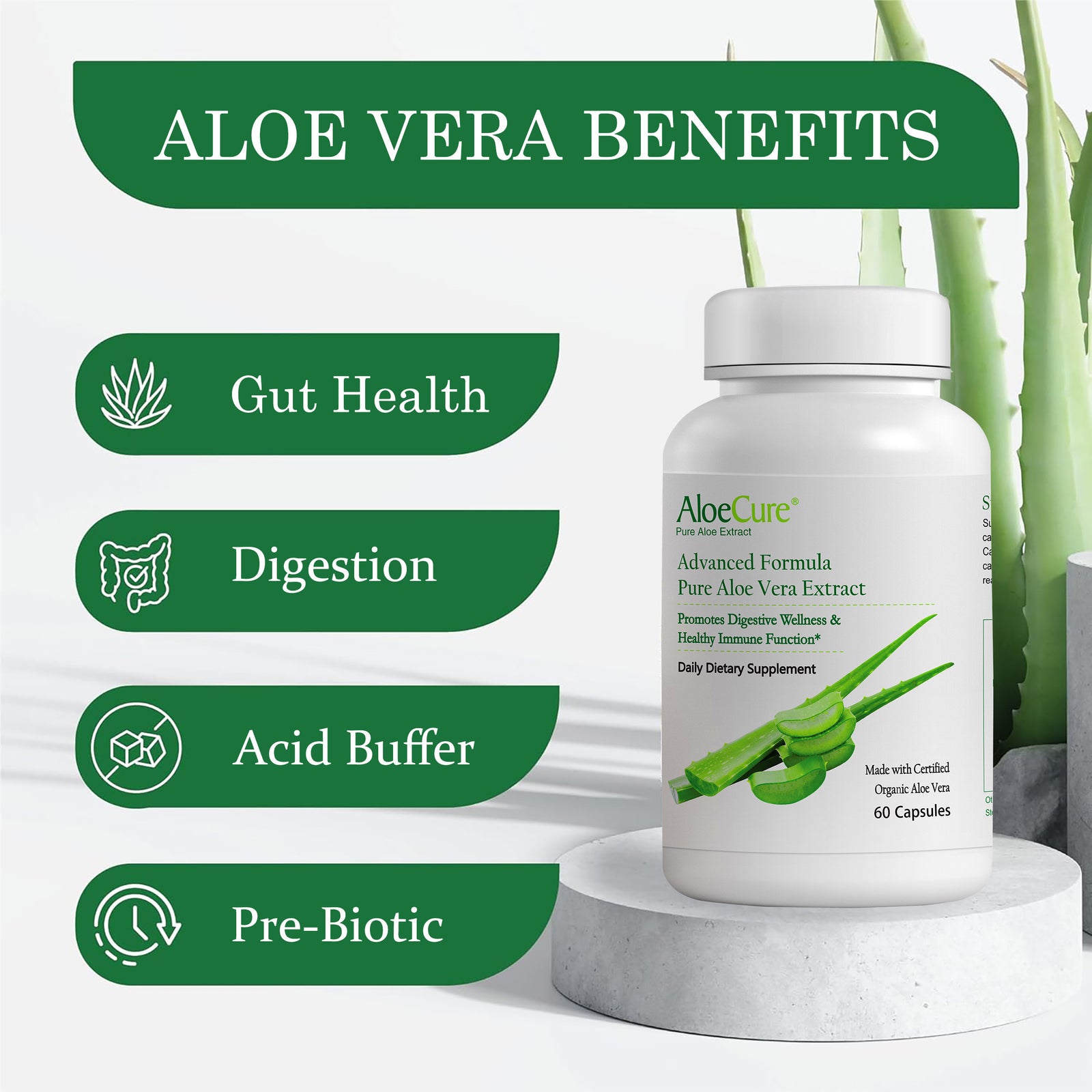
That verification standard is exactly how we build our capsule line at AloeCure. Every capsule of AloeCure Advanced Formula Aloe Capsules delivers 300 mg of pure Aloe Vera Powder with aloin removed, sourced from our own vertically integrated organic farms and manufactured to higher quality standards in an American GMP and NSF certified facility. We offer three straightforward ways to try or stock up on them:
If you already know aloe capsules support your daily wellness routine, joining Subscribe & Save cuts 20% off your order with flexible delivery scheduling. Every purchase also includes free 1-2 day priority processing and our 90-day money-back guarantee, giving you a practical safety net while you evaluate how the formula fits your routine.
Before starting any new supplement, review the safety notes above and check with a qualified healthcare professional if you're pregnant, breastfeeding, or taking daily medications. Then compare our product specifications directly against the verification table above so you can pick the bottle size or subscription plan with full confidence.
Ready to switch to capsules built from farm to bottle without chemicals, enzymes, or charcoal filtration? Explore our vertically integrated organic aloe capsules, compare the 30-count travel size and full-size bottles, and save 20% with Subscribe & Save backed by our 90-day money-back guarantee at AloeCure.
Comments will be approved before showing up.