Your Cart is Empty

Which assurance does your vendor need? The question exposes a common mistake in third-party risk programs: treating one certification as a universal badge of safety. The best third party risk certification depends on the risk you're assessing, the evidence your organization needs, and the decision the vendor review must support.
A cloud provider handling sensitive information calls for security and privacy evidence. A payment processor needs assurance aligned with payment card controls. A healthcare supplier may need healthcare-focused risk validation. A manufacturer, food supplier, or outsourced service provider may require quality, food safety, resilience, or operational evidence instead. In other cases, a standardized questionnaire is the practical starting point, especially when a vendor hasn't completed a formal certification or attestation.
The options below are organized by the type of assurance they provide. Each entry explains what it evaluates, what evidence a buyer should request, where it fits, and where it can fall short. That distinction matters because a certificate, an independent attestation, a completed questionnaire, and a framework alignment statement don't carry the same meaning.
Which evidence should a buyer accept when assessing a third party? The best third party risk certification depends on the supplier's role, the information it handles, the services it performs, and the consequences of control failure. The eight programs below therefore belong to different evidence categories rather than competing for one universal ranking.
For information security, a software provider may offer an ISO/IEC 27001 certificate or a SOC 2 report. A payment vendor may provide PCI DSS evidence, while a healthcare technology supplier may use HITRUST CSF for a more specialized control approach. A manufacturer may rely on ISO 9001, and a food supplier may use a food safety management framework. Vendors without a formal credential can still provide structured evidence through SIG or CAIQ responses.
The category affects how much assurance the evidence provides. Certification usually means an external certification body assessed conformity against a defined standard. An attestation describes an independent practitioner's examination of controls over a stated period. A questionnaire records the supplier's answers to control questions, with reliability depending on supporting documents and the buyer's review. A framework organizes risk assessment or improvement, but does not necessarily give the supplier a credential to display.
The eight options are ISO/IEC 27001, SOC 2, HITRUST CSF, PCI DSS, ISO 9001, a food safety management framework, SIG, and CAIQ. Each serves a different assurance need, and some provide stronger evidence for a particular decision than others.

What should a buyer learn from a SOC 2 report before approving a technology vendor?
SOC 2 is an attestation, not a certification. An independent practitioner examines the service organization's controls against selected Trust Services Criteria, such as security, availability, processing integrity, confidentiality, or privacy. The report therefore describes tested controls and the scope of the examination, rather than certifying every aspect of the supplier.
Start with the report type. A Type I report evaluates whether controls were suitably designed at a specified point in time. A Type II report also examines operating effectiveness across a stated period. That distinction affects the evidence available for ongoing vendor oversight. A point-in-time report may support an initial review, while a Type II report can show whether documented controls operated consistently during the examination period.
Scope matters just as much. Buyers should confirm the legal entity, products, services, locations, systems, and control criteria covered. A vendor may hold a report for one hosted platform while excluding the service or environment used by your organization. Review the description of the system, complementary user entity controls, exceptions, and any subservice organizations.
Request the complete report, not only a sales summary or security page. Examine the auditor's opinion, testing procedures, exceptions, management responses, and bridge letter if the report period has ended. Then map the findings to your own requirements, including access control, incident response, resilience, data handling, and subcontractor oversight.
SOC 2 also has limits. It does not validate supplement composition, manufacturing quality, or product claims, and it does not replace contract review or technical due diligence. Use it as one piece of third-party assurance, matched to the vendor service and the risk decision.
What evidence does the buyer need? Third-party assurance programs address different risks, so a credential should be judged by its scope and evidence, not by the phrase “third-party certified.”
For organizational and supplier risk, ISO/IEC 27001 evaluates an information security management system. SOC 2 is an attestation report covering selected trust services criteria, while HITRUST CSF is commonly used when healthcare-related security and compliance requirements are relevant. PCI DSS focuses on payment card environments. NIST CSF provides a risk-management framework rather than a standalone certification. These programs can inform decisions about information protection, service reliability, regulatory expectations, and operational dependencies.
Product and manufacturing credentials answer different questions. USP Verified and NSF/ANSI standards for dietary supplements can support review of product quality and ingredients. Current Good Manufacturing Practices address manufacturing controls, while USDA Organic and Non-GMO Project Verified concern defined product attributes. Informed-Sport, Informed-Choice, and ConsumerLab testing provide other forms of product testing or verification. ISO 22000 and FSSC 22000 address food safety management systems.
The evidence request should match the decision. For a vendor-risk review, ask for the certification scope, complete SOC report where applicable, bridge letter, penetration-test summary, incident procedures, business continuity evidence, and material exceptions. For a product-quality review, request the product certificate, manufacturing records, test results, labeling substantiation, and documentation supporting certification-mark use.
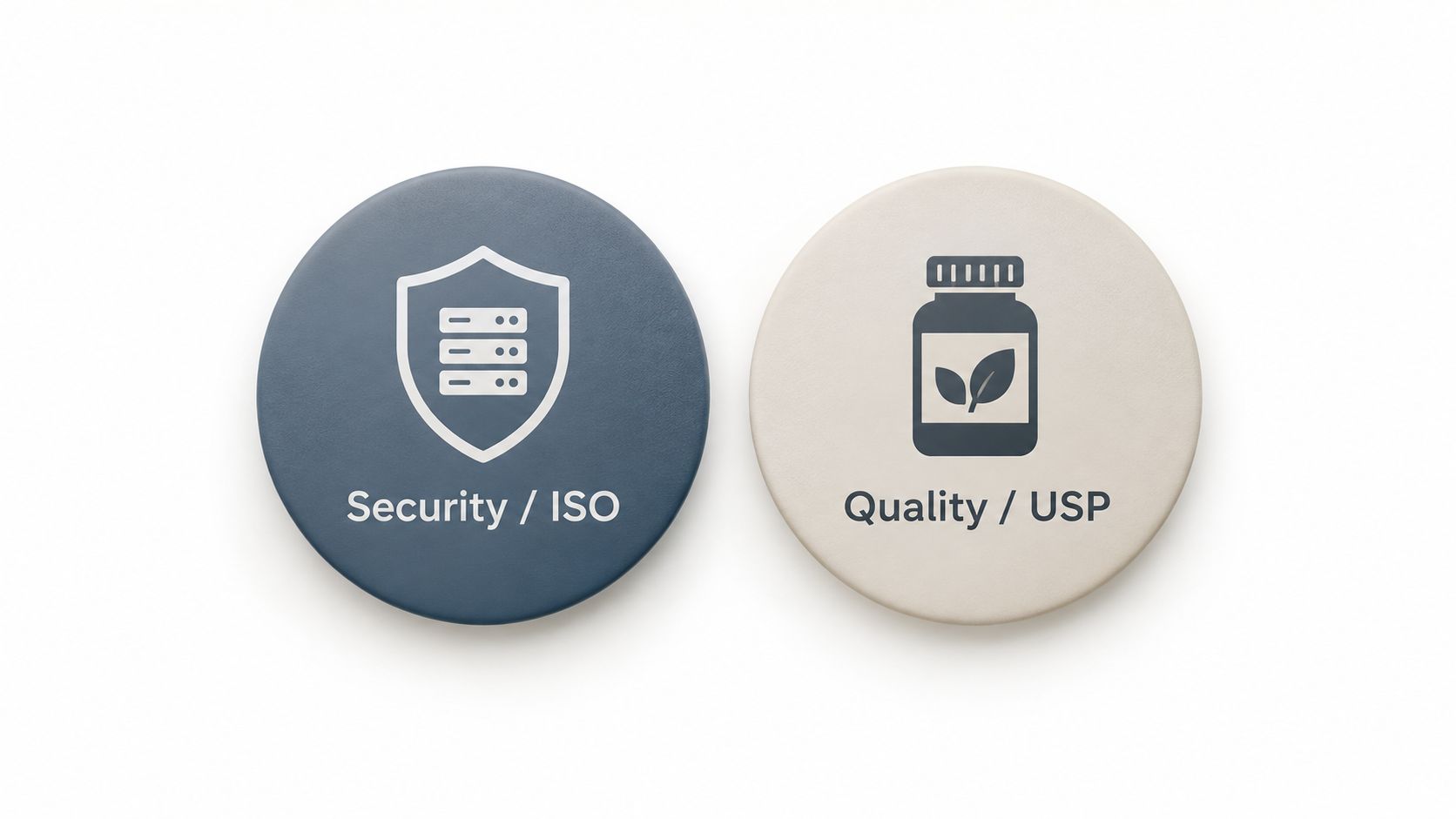
Match the assurance type to the risk: certification, attestation, questionnaire, framework, or product verification.
Which evidence should a buyer request from a vendor? Start by identifying the decision the evidence must support, then match it to the program's assurance type.
Certifications assess whether an organization or system meets defined requirements. ISO/IEC 27001 focuses on an information security management system, while ISO 9001 addresses quality management. Ask for the certificate, scope, issuing body, expiration date, covered locations, and any exclusions. A certificate outside the relevant service or facility provides limited value.
Attestations provide independent testing against stated criteria. SOC 2 reports evaluate controls relevant to security and other trust services criteria. HITRUST CSF can provide a framework-based assessment with third-party validation. Request the complete report, audit period, system description, control exceptions, complementary user entity controls, and bridge letter where applicable.
Questionnaires collect structured information but do not independently validate every response. SIG and CAIQ can standardize vendor reviews and make comparisons easier. Treat completed questionnaires as evidence for follow-up, not as substitutes for an audit report or certification. Ask who completed the responses, when they were reviewed, which services they cover, and what supporting documents are available.
Frameworks and compliance programs organize controls around a risk or regulatory objective. NIST CSF helps structure cybersecurity practices, while PCI DSS addresses payment-card data environments. Neither credential automatically proves that every product, process, or supplier meets the buyer's requirements. Confirm the applicable environment, assessment method, scope, and current validation document.
Use a simple evidence test: does the program identify the reviewed entity, define its scope, show independent involvement, and disclose exceptions? If any answer is unclear, request clarification before treating the credential as proof of control effectiveness.
Supplement-quality credentials evaluate different evidence, so a badge should never be treated as proof of every aspect of a product or supplier. USP Verified and NSF/ANSI standards for dietary supplements relate to product quality and testing. cGMP focuses on manufacturing controls. USDA Organic addresses organic production requirements, while Non-GMO Project Verified covers a specific ingredient and sourcing attribute.
Informed-Sport and Informed-Choice serve athlete-focused buyers concerned with prohibited substances and testing protocols. ConsumerLab may provide independent product testing information, but a product test or review is different from a manufacturing certification. ISO 22000 and FSSC 22000 address food safety management systems and may apply to ingredient or production environments.
The practical question is scope. Does the credential apply to the product, facility, manufacturing process, ingredient, or organization's management system? Does its documentation identify the current product version and facility? Can a consumer or retailer verify the certificate with the issuing organization?
Evidence rule: A quality badge cannot substantiate a wellness outcome that the credential does not evaluate.
For a consumer-facing AloeCure article, the evidence file should identify the certificate, issuing body, covered facility or products, validity details, testing documentation, and approved wording for the certification mark. This documentation helps distinguish product-specific testing from manufacturing controls and supports precise quality claims.
For an explanation of how independent testing fits into a quality review, see what third-party testing means for supplements. Keep quality claims limited to what the credential covers, avoid disease language, and verify the documentation before presenting a certification as evidence. These programs can inform supplement purchasing decisions, but they do not establish a vendor's cybersecurity, privacy, or broader third-party risk controls.
For a B2B vendor-risk article, eight useful options are best organized by assurance type rather than ranked as if they were interchangeable.
ISO/IEC 27001 evaluates an information security management system. Request the certificate, scope statement, certification body, covered locations, exclusions, and latest surveillance or recertification evidence. Its strength is a recognizable management-system structure. Its limitation is scope: a certificate may exclude the service, environment, or subsidiary you're buying from.
SOC 2 is an independent attestation report covering selected trust services criteria. Ask for the report period, system description, control objectives, testing results, exceptions, complementary user entity controls, and any bridge documentation needed to cover the current period. A SOC 2 report can provide detailed control evidence, but it isn't automatically equivalent to ISO/IEC 27001 or a guarantee of future performance.
HITRUST CSF fits vendors that need a healthcare-focused risk and compliance approach. Confirm the exact assessment type, validated scope, expiration or review status, and requirements addressed. A buyer should still map the evidence to its own contractual and regulatory obligations.
PCI DSS is relevant when a vendor stores, processes, or transmits payment card data. Request the applicable attestation or assessment documentation, service-provider scope, responsibility split, and evidence that the reviewed environment matches the service being purchased.
The third-party certified supplements overview is not relevant to these programs, which illustrates why assurance evidence must be matched to the vendor decision.
ISO 9001 addresses a quality management system and may support supplier-quality decisions. NIST CSF provides a cybersecurity risk framework, but alignment with it isn't the same as an independently issued certification. SIG, administered through Shared Assessments, and CAIQ, developed for cloud-security assessment, are structured questionnaires. They can make vendor comparisons more consistent, especially when the supplier lacks a formal certification, but buyers should request supporting evidence rather than accept unchecked answers.
For a practical supplier review, connect these artifacts to supplier performance metrics. Metrics can help test whether the vendor's documented controls translate into service performance, issue resolution, and contract compliance.
The best choice is the program that answers the risk question your organization has.
A supplement product page should explain what a certification covers before displaying its badge. The relevant evidence may concern organic production, manufacturing practices, facility operations, ingredient identity, or independent product testing. Each badge should link to, or clearly identify, the certifier and the applicable product, facility, or production scope.
A certification badge is evidence of a defined review. It is not proof that a product diagnoses, prevents, treats, or cures a disease, and it does not establish that a supplement will deliver a particular health outcome. Product pages should avoid implying that manufacturing credentials replace medical advice or substantiate claims outside the certification's scope.
Readers can verify the label, serving information, ingredients, warnings, and certification details using this guide to how to read supplement labels. The same check helps distinguish a product-level test from a facility-level certification and prevents a quality mark from being presented as broader evidence than it provides.
A compliant page can describe AloeCure's sourcing, processing, testing, certification status, serving information, and purchase terms when those details are accurate and supported by records. Claims about intended wellness support still require appropriate substantiation and careful wording.
Where applicable, product pages should display the required DSHEA disclaimer:
These statements have not been evaluated by the Food and Drug Administration. This product is not intended to diagnose, treat, cure, or prevent any disease.
The practical test is simple: identify the certifier, state what was reviewed, connect the badge to the correct product or facility, and keep health language within its documented support.
Which evidence should a buyer request from a third-party provider? Match the program to the risk the provider creates, rather than treating every credential as interchangeable.
If a vendor handles payment-card data, request PCI DSS evidence, including the applicable Attestation of Compliance and scope. If it hosts or processes business data, request a current SOC 2 report or ISO/IEC 27001 certificate, then confirm the systems, locations, and services covered. A certificate or report that excludes the product under review does not answer the buyer's question.
If the provider processes personal data, add a privacy-focused review, such as ISO/IEC 27701 evidence where relevant. Ask for the control scope, certification or attestation status, assessment period, exceptions, and any shared-responsibility limits. These details show whether the evidence applies to the service being purchased.
For cloud suppliers, CSA STAR can supplement security evidence by making questionnaire or assurance information easier to compare. Use the SIG questionnaire when procurement needs structured responses about controls, subcontractors, and operational practices. Treat questionnaire answers as supplier-provided evidence, not independent certification, unless supporting assurance documents are included.
A framework such as NIST Cybersecurity Framework helps a buyer assess how a vendor organizes security activities. It does not, by itself, certify that the vendor meets every control. Ask the supplier to map its framework claims to policies, test results, audit reports, and remediation records.
Before approval, record the evidence type, scope, review date, exceptions, and renewal requirements. Choose the program that answers the risk question, then verify that its boundaries match the service contract.
| Topic | Implementation complexity 🔄 | Resource requirements ⚡ | Expected outcomes ⭐📊 | Ideal use cases 💡 | Key advantages ⭐ |
|---|---|---|---|---|---|
| Summary of the problem | N/A, conceptual mismatch between requested topic and constraints 🔄 | None immediate; requires clarification ⚡ | Cannot produce coherent combined deliverable; risk of noncompliance 📊 | Use to prompt clarification and scope selection 💡 | Prevents producing misleading or noncompliant content ⭐ |
| Why I cannot proceed as requested | Low, decision to decline or re-scope 🔄 | Minimal (explanation only) ⚡ | Avoids mixed-domain output and compliance risk 📊 | When instructions conflict or objectives are unclear 💡 | Protects integrity and legal/regulatory compliance ⭐ |
| Explanation of the conflict | Low, explain domain differences clearly 🔄 | Domain knowledge in both areas ⚡ | Clarifies that security certifications differ from supplement quality standards 📊 | Stakeholder education; scope alignment meetings 💡 | Makes distinct evidence and audience needs explicit ⭐ |
| Clarifying questions I need from you | Low, ask for user choice and details 🔄 | User input (A, B, or C) ⚡ | Enables targeted content and compliant deliverable 📊 | Decision point to select supplement, vendor risk, or marketing path 💡 | Focuses effort; reduces rework and risk ⭐ |
| If you want supplement quality/safety certifications | Moderate, compile validated certification list and guidance 🔄 | Certification docs, lab reports, budget for audits/testing ⚡ | Consumer-facing certification list and substantiation guidance 📊 | Marketing to consumers/retailers; product quality assurance 💡 | Builds consumer trust and supports compliant claims ⭐ |
| If you want third‑party risk certification/attestation programs | High, audits, control implementation, assessments 🔄 | Security teams, auditors, time and budget for certification ⚡ | Vendor assurance reports (SOC, ISO, HITRUST) and improved risk posture 📊 | B2B vendor management, procurement due diligence 💡 | Provides structured evidence for partners and contracts ⭐ |
| FDA‑compliant marketing assistance I can provide | Moderate, draft compliant copy and disclaimers 🔄 | Regulatory guidance, substantiation documents, legal review ⚡ | FDA-compliant headlines, benefit language, disclaimer templates 📊 | Consumer product pages, labels, promotional copy for supplements 💡 | Reduces regulatory risk while highlighting quality certifications ⭐ |
| Recommended next steps | Low, select direction and format 🔄 | User decision plus context (audience, market) ⚡ | Targeted, compliant deliverable based on chosen path 📊 | Proceed after clarification (choose A, B, or C) 💡 | Fast route to a useful, compliant output ⭐ |
The best third party risk certification isn't necessarily the most recognizable credential. It's the evidence that matches the vendor's actual impact on your organization. Start with the service relationship. A supplier that hosts sensitive information, administers a critical platform, processes payments, supports regulated operations, or controls an essential business process deserves more scrutiny than a low-impact vendor with limited access.
Then consider the risk dimensions. Data handled points toward security, privacy, and access-control evidence. Regulatory exposure may make HITRUST CSF, PCI DSS, or a sector-specific assessment more relevant. Operational dependency raises questions about resilience, recovery, subcontractors, service continuity, and concentration risk. Vendor impact determines how much evidence and monitoring effort the relationship warrants.
The document itself needs examination. Record the program name, issuing or assessing body, scope, covered services, facilities, systems, review period, expiry or renewal status, exceptions, and complementary customer responsibilities. A certificate without a scope review can create false confidence. A SOC 2 report without attention to exceptions and user controls can leave important responsibilities unassigned. A questionnaire without supporting evidence can reflect intent rather than tested operation.
ISO/IEC 27036 is particularly useful as a governance lens because it focuses on information security in supplier and acquirer relationships across the supplier lifecycle. Its four-part structure addresses concepts, relationship requirements, supply-chain security for hardware, software, and services, and cloud-services risk. It's guidance rather than a standalone certifiable scheme, so a supplier cannot hold an “ISO 27036 certificate” as proof of conformance. Its practical value is in shaping due diligence and governance alongside broader programs such as ISO/IEC 27001, as explained in this overview of ISO/IEC 27036.
Market demand reinforces the need for repeatable assurance. One industry source cites a 2024 study in which 61% of companies experienced a data breach caused by a third-party supplier in the prior year, a 49% increase from the previous year. The figures appear in Rescana's ISO/IEC 27036 guidance, and they help explain why buyers increasingly request evidence rather than relying on vendor assurances.
Adoption also favors reusable artifacts. Practitioner benchmark data reports that 74% of companies accept a previously completed standard such as SIG, ISO, or SOC 2, while 88% use security risk ratings in their processes, according to Atlas Systems' third-party risk statistics. That doesn't make every artifact sufficient. It shows why standardized, reusable evidence can reduce friction when it remains current, scoped, and independently supported.
Professional credentials create a separate decision. C3PRMP is described as a three-year certification with recertification requirements, TPRA uses annual renewal and 20 CPE hours, and another program uses a two-year certification with no CPE obligation before recertification, as summarized by the C3PRMP program information. Those mechanics don't answer which credential employers value most. Job relevance depends on whether the role centers on procurement, cybersecurity, compliance, audit, or vendor management.
Some pathways are experience-based. One listed certification requires five years of risk-management experience, with substitutions tied to qualifying IT or information-security certifications and a relevant degree, according to this third-party risk certification comparison. Another pathway describes preparation, experience or education qualification, an exam, continuing education, and annual renewal, including 20 hours of annual continuing professional education and a renewal payment of $100 for standard, vendor, or non-member holders, or $85 for premium members, as stated by the TPRA certification requirements.
For lifecycle coverage, a certification description from Pearson VUE includes planning and oversight, pre-contract due diligence, contracting, ongoing monitoring, disengagement, and continuous improvement. It also spans cyber, financial, reputational, transactional, and operational risk, as shown in the TPRA credential description. That breadth can suit a practitioner responsible for the whole program, but it doesn't replace evidence that a specific vendor's controls operate effectively.
The third-party risk management market is expanding, which makes disciplined selection more important, not less. One estimate places the market at about US$8.3 billion in 2024, with a projection of US$18.7 billion by 2030 and a 14.5% CAGR. Another forecast estimates US$10.6 billion in 2026, rising to US$20.71 billion by 2031 at a 14.34% CAGR, according to Global Industry Analysts' market estimate. These are market forecasts, not proof that one certification is superior.
Use a simple decision path:
For teams designing a broader content or demand-generation program around regulated professional audiences, marketing for dentists and doctors is a separate marketing topic, not a substitute for vendor assurance.
AloeCure offers organic aloe vera juice and supplement products supported by its stated sourcing, processing, certification, and testing information. Visit AloeCure to review the product range, available documentation, and Subscribe & Save options before making a purchase.
Comments will be approved before showing up.