Votre panier est vide

Sustainable agriculture is really just a way of farming that works with nature, not against it. The goal is to build a food system that's healthy, productive, and can stand the test of time. It’s a forward-thinking approach that carefully balances environmental health, economic stability for farmers, and the social well-being of communities.
This balance ensures we can meet our needs today without shortchanging future generations.
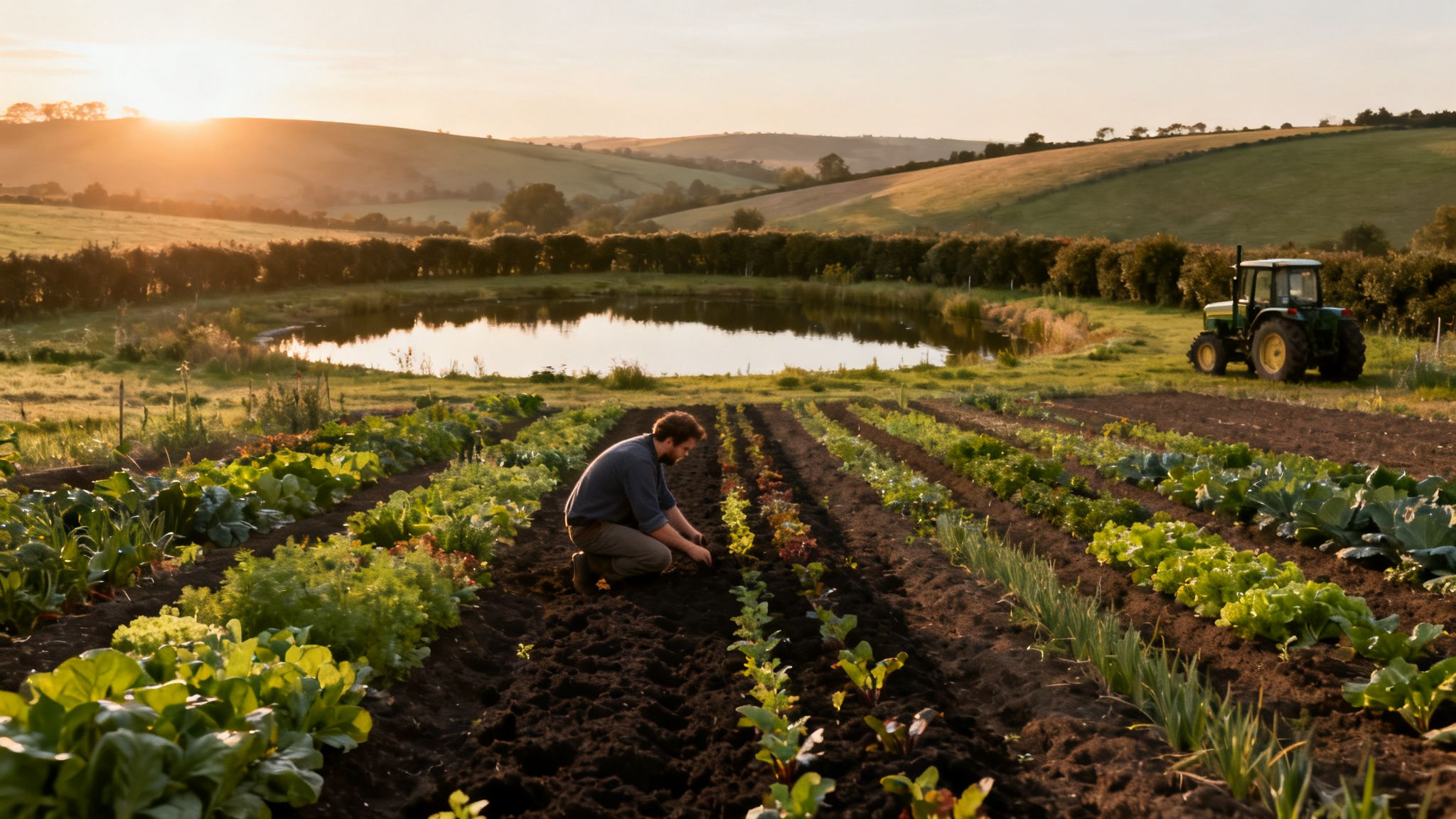
Picture a farm that operates more like a thriving natural ecosystem than an industrial factory. Instead of constantly taking from the land, it actually gives back and regenerates resources. The soil gets richer every year, the water stays clean, and a diverse range of plants and animals flourish. This is the heart of what sustainable agriculture practices aim to achieve.
It’s less of a rigid checklist and more of a guiding philosophy. Think of it like a smart investment in our planet. Conventional farming can sometimes act like a bank account with only withdrawals, taking nutrients from the soil and using up water. Sustainable farming, on the other hand, makes continuous deposits by nurturing the land, leading to long-term health and productivity.
This isn't just some niche concept anymore; it's a global movement that's picking up serious steam. As more people become conscious of where their food comes from, the demand for products grown with integrity is surging.
This shift is easy to see in the market's growth. One analysis projects the global sustainable agriculture market will jump from USD 21.7 billion in 2024 to USD 59.3 billion by 2034. That boom is being driven by consumer demand and big steps forward in eco-friendly farming tech. It’s a clear sign of a collective desire for a more responsible food system. You can dig into the specifics of these trends in the full market report.
To really understand how these principles come together, it helps to look at them as three interconnected pillars. Each one is essential for creating a truly sustainable system that can last.
| Pillar | Core Goal | Key Practices |
|---|---|---|
| Environmental Stewardship | To protect and improve the natural environment, conserving resources and promoting biodiversity. | Crop rotation, cover cropping, organic inputs, water conservation, integrated pest management. |
| Economic Profitability | To ensure farms are financially viable and can provide a stable livelihood for farmers and their families. | Diversifying crops, reducing input costs, direct-to-consumer sales, value-added products. |
| Social Equity | To support fair treatment for farmworkers and strengthen rural communities. | Fair labor practices, community engagement, providing access to healthy food, preserving traditional farming knowledge. |
These pillars aren't separate goals; they're intertwined. A farm that destroys its soil (environmental) won't be profitable for long (economic), and that instability can harm the local community (social). True sustainability means all three are thriving together.
The key takeaway is that sustainable agriculture isn’t about sacrificing productivity for environmental ideals. Instead, it’s about finding intelligent, nature-based solutions that support both. It creates a system that is not only good for the planet but also builds resilient farms that can thrive for generations to come.
For companies committed to superior quality, like AloeCure, sustainability isn't just a buzzword—it's the foundation of everything we do. By being fully vertically integrated, we control every single step, from farming our own organic aloe to producing our final products. This control allows us to implement and guarantee the absolute highest standards of sustainable care.
Ultimately, understanding what sustainable agriculture practices are empowers you to make more informed choices. It helps you support brands that prioritize quality from the ground up, ensuring the products you bring into your home are cultivated with the utmost care for both you and the planet.
To really get what sustainable agriculture is all about, you have to look past the specific techniques and understand the philosophy behind them. These aren't just farming methods; they're a holistic approach built on five interconnected principles.
When you weave them all together, they create a farming system that's both resilient and productive—one that actually works with nature, not against it. Each pillar supports the others, creating a powerful synergy. Let's break them down one by one.
Everything starts with the soil. At the heart of any truly thriving farm is healthy soil, which is so much more than just dirt. Think of it as a living, breathing ecosystem absolutely packed with microorganisms, fungi, and rich organic matter. It's the single most valuable asset a farmer has.
Healthy soil acts like a giant, natural sponge. It holds onto moisture, making crops far more resilient during dry spells and cutting down the need for heavy irrigation. It also grips essential nutrients, making them available for plants to absorb for strong, vibrant growth. Nurturing the land is foundational, and knowing the basics of creating healthy soil is the first step for any grower.
Water is a precious, finite resource, and sustainable farming treats it that way. This principle is all about using water efficiently and making sure that any water leaving the farm is as clean as it was when it arrived. This is a huge shift from conventional practices that can lead to chemical runoff polluting nearby rivers and streams.
Smart water stewardship involves a few key strategies:
Drip Irrigation: This method delivers water right to the plant's roots, which means less waste from evaporation.
Rainwater Harvesting: Collecting and storing rainwater in ponds or tanks provides a free, reliable water source for drier times.
Cover Cropping: Planting "cover crops" in the off-season helps the soil soak up more water, preventing erosion and runoff.
By focusing on water conservation, sustainable farms protect local water quality and build in a buffer against unpredictable weather.
Nature loves diversity, and the best farms mimic that. Instead of massive fields growing a single crop (a practice called monoculture), this principle encourages a rich mix of plants, animals, and insects. This biodiversity creates a more balanced, self-regulating ecosystem right on the farm.
Planting different crops helps break pest and disease cycles naturally. Creating habitats like hedgerows or strips of wildflowers invites beneficial insects—like pollinators and pest predators—to move in. This natural balance means less reliance on chemical pesticides and a more stable environment overall.
A biodiverse farm is a resilient farm. By creating a complex web of life, farmers can harness nature's own systems to support crop health, pollination, and pest management, creating a stronger, more productive operation.
Sustainable agriculture is, by its nature, forward-looking. It’s about building farms that can adapt to and withstand environmental changes. This means using practices that both reduce the farm's carbon footprint and prepare it for whatever the weather throws its way.
Healthy soil is a powerhouse here, too. When it’s rich in organic matter, it can pull huge amounts of carbon out of the atmosphere and lock it away. Plus, diversifying crops and even income streams makes a farm less vulnerable if one crop fails due to a drought or flood. It's about playing the long game.
The final piece of the puzzle ensures the system works for people, too. A farm can't be truly sustainable if it isn't profitable for the farmer or if it doesn't support the well-being of its workers and the local community.
This pillar is all about fair labor practices and creating safe, equitable working conditions. It also encourages building strong local food systems that connect farmers directly with the people who eat their food, keeping money and jobs within the community. This social and economic foundation is what gives the sustainable agriculture movement its long-term strength.
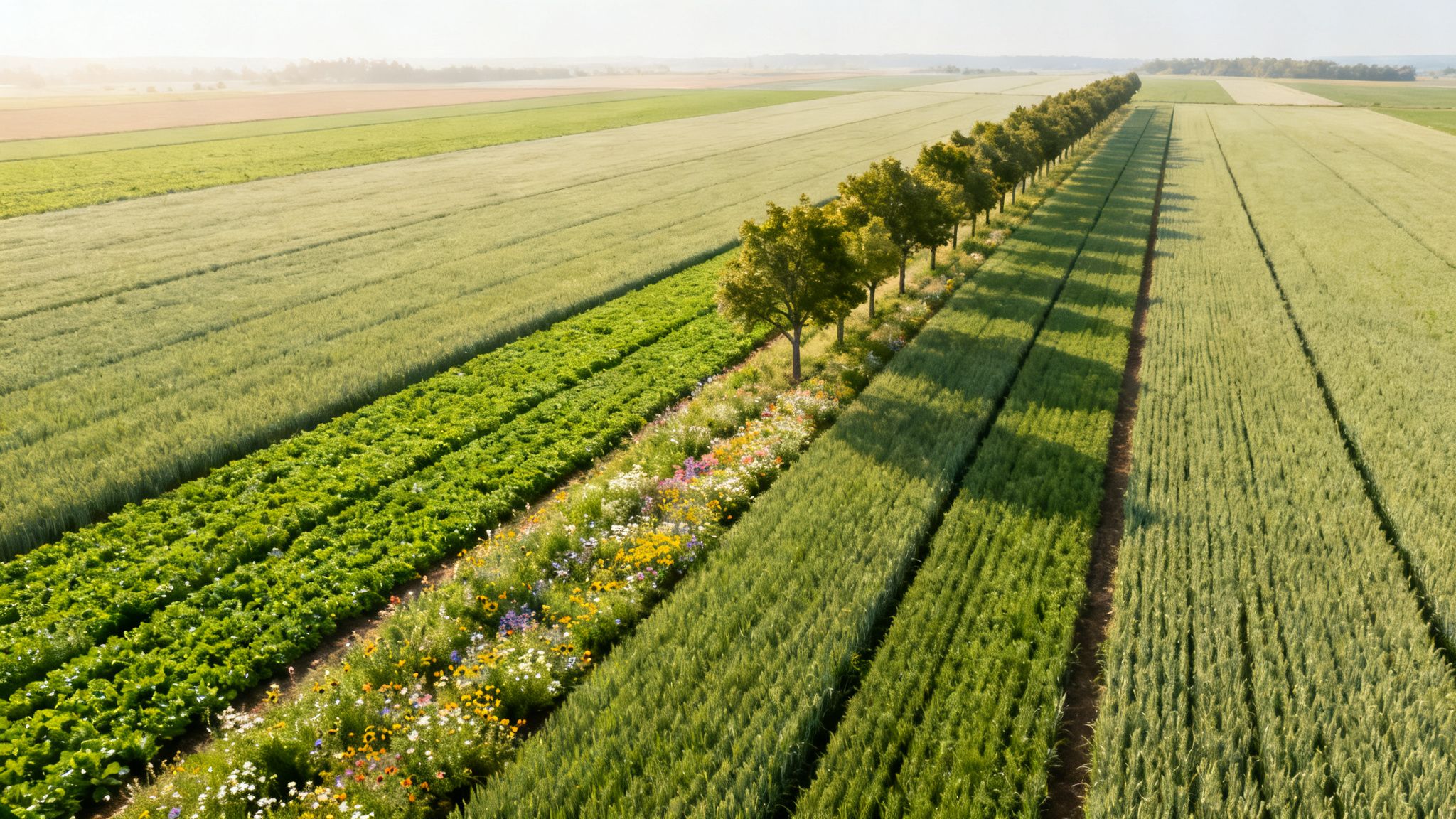
Understanding the theory is one thing, but seeing sustainable agriculture work in the real world is where it gets exciting. Farmers across the globe are putting smart, practical techniques to use, building healthier land and more resilient businesses.
These aren't just ideas from a textbook; they are proven strategies that bring the core principles of soil health, water conservation, and biodiversity to life. Let’s dig into some of the most effective practices you’ll see on a sustainable farm.
One of the oldest tricks in the book—and still one of the most powerful—is crop rotation. Instead of planting the same crop in the same spot year after year, farmers change it up.
Imagine a field of corn, which is a "heavy feeder" that uses a lot of nitrogen from the soil. The following season, the farmer might plant soybeans, a legume that naturally adds nitrogen back into the earth. It's a brilliant give-and-take.
This simple switch achieves a few critical goals:
Breaks Pest Cycles: Many pests and diseases target specific plants. By rotating crops, farmers interrupt their life cycles without having to reach for harsh chemicals.
Builds Healthy Soil: Different plants have different root systems and nutrient needs. This variety improves the soil's structure and fertility over time.
Reduces Weeds: Alternating crops can naturally outcompete and suppress certain weeds, creating a cleaner field for the next harvest.
Ever drive by a farm in the off-season and see a field covered in green instead of bare dirt? You're likely looking at a cover crop. These are plants grown not to be sold, but to protect and improve the soil between main harvests.
Think of it as a living blanket for the earth. Cover crops like clover or rye prevent wind and water from washing away precious topsoil. When they’re eventually worked back into the ground, they add a rich dose of organic matter, boosting fertility for the next season.
A field with a cover crop is a field that’s actively regenerating. This practice is a cornerstone of building the healthy, living soil that is fundamental to long-term sustainability and productivity.
Agroforestry is an ingenious approach that mixes trees and shrubs right in with crops and livestock. The goal is to create a multi-layered, productive ecosystem that functions more like a natural forest.
A farmer might, for instance, plant rows of nut trees between their rows of vegetables. The trees provide shade, act as a windbreak for more delicate plants, and even offer another source of income. This integrated system boosts biodiversity and makes the entire farm more resilient to climate swings.
Instead of trying to wipe out every single bug, Integrated Pest Management (IPM) takes a much smarter approach. It focuses on keeping pest populations below a harmful level by using a combination of common-sense techniques.
IPM starts with prevention, like encouraging natural predators—think ladybugs that eat aphids—and planting pest-resistant crop varieties. It’s a thoughtful process that only turns to targeted interventions as a last resort, minimizing disruption to the farm’s natural balance. Many producers are embracing these methods, including those in organic cold pressed olive oil production.
Organic farming is one of the clearest expressions of sustainable principles, focusing on natural inputs and regenerating the soil. This isn't a niche market anymore; globally, organic farmland expanded to nearly 240 million acres in 2022. This explosive growth is driven by people wanting products they can trust, grown without synthetic pesticides and fertilizers. You can explore the latest USDA data on organic production to see the trend.
At AloeCure, these principles are at the heart of everything we do. Our farms are certified organic by both the USDA and EU. We’re also fully vertically integrated, meaning we grow, harvest, process, and produce our own aloe. This end-to-end control is our promise that our products meet the highest standards of purity and quality—a commitment you can feel in every bottle.
These statements have not been evaluated by the Food and Drug Administration. This product is not intended to diagnose, treat, cure, or prevent any disease.
When you choose a product grown with sustainable farming in mind, you’re doing more than just buying something. You’re casting a vote for a healthier planet, stronger farms, and better-quality goods for you and your family. The positive effects reach far beyond the farm, creating ripples that touch our environment, communities, and personal well-being.
These thoughtful farming methods directly lead to cleaner air and water. By skipping harsh synthetic chemicals and instead building rich, living soil, farmers help keep harmful runoff from entering our waterways. That same healthy soil also acts like a natural sponge for carbon, pulling CO2 out of the atmosphere and locking it in the ground where it belongs, which helps support a stable climate.
There's a direct, undeniable link between how something is grown and its final quality. When plants are raised in nutrient-dense, biologically active soil, they have access to a full buffet of minerals and natural compounds. This careful cultivation leads to more vibrant and robust plants.
For you, this means products that are a true expression of their natural potential. When farmers prioritize soil health over shortcuts, they can grow ingredients of exceptional quality. This attention to detail really matters when you're choosing wellness products, especially for items like our organic aloe vera juice where the purity of the plant is everything. You can learn more about the positive qualities linked to thoughtfully grown aloe in our article on the benefits of organic aloe vera juice.
Sustainable agriculture also builds stronger, more stable farms. By diversifying crops, conserving water, and cutting back on expensive external inputs, farmers create businesses that are better prepared to handle whatever economic or environmental challenges come their way. That kind of resilience is crucial for long-term food security.
Unfortunately, there's a big gap in funding this critical transition. Despite its importance, climate finance for agrifood systems makes up only 7.2% of the global total—nowhere near what’s needed to scale up these beneficial practices. While innovative approaches like controlled environment agriculture are gaining traction, broader support is essential to build a food system that can reliably feed communities for generations. Discover more insights about climate investment in agriculture.
Choosing sustainable products is a direct investment in a better future. It supports farmers who act as stewards of the land and encourages a system that prioritizes long-term health over short-term gains.
At AloeCure, this is the philosophy we live by. As a fully vertically integrated company, we manage every single step—from tending our certified organic aloe fields to bottling the final product. This hands-on approach is our promise of quality and sustainability. We don’t just follow sustainable practices; we live them every day to bring you products of unmatched purity. By choosing AloeCure, you are supporting a company deeply committed to the health of the planet and the well-being of its customers.
These statements have not been evaluated by the Food and Drug Administration. This product is not intended to diagnose, treat, cure, or prevent any disease.
It's one thing to read about the principles of sustainable agriculture, but it’s another to see them in action. At AloeCure, sustainable farming isn’t just a concept we support—it’s the foundation of everything we do. Our entire process is a living example of how a true commitment to ethical, eco-friendly practices creates products of unmatched quality.
It all starts with our complete vertical integration. Unlike many brands that source ingredients from various third-party suppliers, we own and operate our own USDA and EU-certified organic aloe vera farms. This hands-on approach gives us total control over every single step, from the moment an aloe shoot is planted to the moment the final product arrives at your door. This is our farm-to-bottle promise.
Our commitment to purity is most evident in our proprietary, chemical-free processing method. Within just 12 hours of being carefully hand-harvested, our aloe leaves are processed right there on our farms. We deliberately avoid the harsh chemicals, charcoal filtration, and high-heat pasteurization that many large-scale producers rely on—methods known to strip away the plant’s natural goodness.
Our gentle approach is designed to preserve the aloe’s delicate bioactive compounds, making sure the final product is as close to nature as you can get. To see exactly how we maintain this incredible level of quality, you can explore The Fresh Aloe Difference on our website. This dedication is what truly sets AloeCure apart.
We believe genuine sustainability demands complete transparency. We’re so proud of our farming practices that we’ve even turned our certified sustainable farms into agro-tourism destinations. Each year, we welcome over 250,000 visitors who come to walk through our organic fields and learn about our methods firsthand.
This open-door policy is a testament to our confidence, and it inspired us to create our unique 8-step traceability promise. This system allows us to track every single bottle of AloeCure right back to the very plot of land where its aloe was grown.
This level of traceability is more than a quality control measure; it's our guarantee to you. It’s proof that the product in your hand is the direct result of careful, sustainable farming and meticulous, chemical-free processing.
Our commitment is unwavering because we know that investing in the health of our soil, the purity of our water, and the vitality of our crops is the only way to create products that genuinely support your well-being.
As a consumer, your everyday choices have a powerful ripple effect. When you consciously choose products grown with care, you’re sending a clear message to the entire industry that how our food is grown really matters. Supporting this movement is more straightforward than you might think; it all starts with making informed decisions.
Every dollar you spend is a vote for the kind of farming you want to see in the world. By actively seeking out brands that are transparent and committed to ethical practices, you help build a food system that prioritizes long-term health over short-term shortcuts. This puts the power in your hands to champion a healthier planet and a more resilient agricultural future.
One of the easiest ways to spot genuinely sustainable products is to look for trusted, third-party certifications right on the label. These seals are much more than just logos—they are proof that a company has met tough standards for environmental stewardship and purity.
Keep an eye out for these key certifications:
USDA Organic: This is the gold standard in the United States, verifying that products are grown and processed without synthetic pesticides, fertilizers, or GMOs.
EU Organic: This is the European Union's equivalent, known for its strict and comprehensive standards covering everything from soil health to animal welfare.
When a brand like AloeCure invests in achieving both of these certifications, it shows an unwavering commitment to the highest global standards of quality and sustainability.
A truly sustainable company isn't shy about its process; in fact, it’s proud to share its story. Look for brands that are open about where and how their ingredients are grown. This level of transparency is a huge indicator of integrity.
For example, companies that manage their entire supply chain—from farming and processing all the way to production—offer a level of quality control that’s hard to beat. It's why AloeCure is so open about our farm-to-bottle promise. We want you to know exactly where your products come from. You can discover more about the difference this makes by exploring our guide to finding the best organic aloe vera juice.
Your choices can drive real change. By supporting brands that are transparent, certified organic, and vertically integrated, you are directly investing in a more sustainable and responsible food system for everyone.
Making a conscious choice to support companies that embody these values makes a real difference. It encourages more farmers to adopt practices that protect our planet and ensures you receive products of superior quality. Start today by choosing brands that put sustainability first.
These statements have not been evaluated by the Food and Drug Administration. This product is not intended to diagnose, treat, cure, or prevent any disease.
As you start paying more attention to where your food and supplements come from, it's natural to have questions. Getting a handle on these key ideas helps you make choices that truly match your values. Let's clear up a few of the most common questions we hear.
It's a great question, and the two are definitely related, but they aren't the same thing. Think of it this way: Organic farming is a specific, certified standard with a clear set of rules, mainly banning synthetic pesticides and fertilizers. It's a key tactic.
Sustainable agriculture is the bigger strategy. It’s a broader philosophy that often uses organic methods as a cornerstone, but it also zooms out to include things like water conservation, protecting biodiversity, ensuring fair conditions for workers, and making sure the farm can thrive for generations.
So, 'organic' is a label with strict guidelines, while 'sustainable' is the overarching goal. At AloeCure, our farms are certified organic, which is a critical piece of our much larger commitment to total sustainability.
Sometimes, yes, and there's a good reason for it. The price often reflects the true cost of farming in a way that rebuilds and invests in the land, rather than just taking from it. This kind of farming is more hands-on and requires a lot more long-term planning and labor.
But what consumers often discover is the incredible value that comes with that investment—higher-quality, more nutrient-dense products that are better for you and the planet. And for companies like AloeCure that manage everything from the soil to the shelf, we can create efficiencies that let us offer premium, sustainable products at a fair value. We also offer things like subscriptions to make consistent wellness even more accessible.
This is the big one. The key is to look for transparency and proof. A company that’s genuinely walking the walk is proud of its process and has nothing to hide.
Here are a few things to look for:
Official Certifications: Don't just take their word for it. Look for official seals like USDA Organic or EU Organic. These aren't just pretty logos; they're backed by intense, third-party verification.
The Full Story: Dig into their website. Do they tell you how they farm? Do they explain their processing and traceability? A company committed to sustainability will gladly share details, like AloeCure's 8-step promise.
An Open Door: Truly sustainable brands are eager to educate and build trust through their actions, not just their marketing. They welcome questions and show you how it's all done.
The bottom line is to look past the buzzwords. A brand's real commitment to sustainability shines through in its certifications, its transparency, and its willingness to show you exactly how your products are made, right from the ground up.
At AloeCure, our certified organic farms and complete control from farm to bottle are our guarantee of both quality and sustainability. We're passionate about creating products that support your well-being while taking care of our planet.
These statements have not been evaluated by the Food and Drug Administration. This product is not intended to diagnose, treat, cure, or prevent any disease.
Les commentaires sont approuvés avant leur publication.