Tu carrito está vacío
Envío y manipulación gratuitos con todos los pedidos superiores a $25
Envío y manipulación gratuitos con todos los pedidos superiores a $25

Sustainable farming is less about a specific checklist and more about a mindset. It’s about growing food in a way that works with nature, not against it, balancing environmental health, economic stability, and social well-being. Think of it as a commitment to farming that ensures future generations can enjoy the same healthy land we do.
This philosophy is about building resilient food systems that don't just produce food, but also cultivate healthy ecosystems.
So, what are sustainable farming practices, really? It’s not just one technique. It’s a holistic view of a farm as an entire, living ecosystem. This isn't just a fringe idea anymore; the global sustainable farming market is projected to hit $2.79 billion by 2032. This boom is being driven by new technologies and a powerful, renewed focus on restoring the health of our soil. You can dive deeper into these market trends and what's fueling them at coherentmarketinsights.com.
At its heart, sustainable farming is built on three core pillars. Grasping how they work together is the key to seeing the whole picture.
These principles aren't separate goals to be checked off a list. Instead, they’re interconnected, working together to create a farming system that is both robust and responsible. A farm simply can't be truly sustainable if it's failing in any one of these areas.
This table breaks down the three pillars that form the foundation of sustainable agriculture.
| Pillar | Core Objective | Example Practice |
|---|---|---|
| Environmental Wellness | To protect, preserve, and even enhance natural resources like soil, water, and local wildlife. | Planting cover crops to prevent soil erosion and add organic matter back into the earth. |
| Economic Viability | To ensure farmers can earn a fair living, remain profitable for the long haul, and reduce reliance on expensive external inputs. | Integrating different crops and livestock to create multiple income streams and natural fertilization cycles. |
| Social Equity | To support the well-being of farmworkers and local communities by ensuring fair labor practices and access to healthy food. | Sourcing materials locally and creating jobs that strengthen the community's economy. |
A farm that only focuses on profit at the expense of its soil isn't sustainable. Neither is one that enriches the environment but can't support the farmer's family. True sustainability is found in the balance.
At AloeCure, these pillars are the bedrock of our operations. We believe that producing the highest quality aloe vera means taking care of our land, our team, and our community. Our vertically integrated model, from farming our own organic aloe to processing it ourselves, allows us to uphold these principles at every step.
This commitment is more than just a business strategy; it’s a promise of quality and transparency. By controlling the entire journey from our fields to your home, we ensure that every product reflects our dedication to responsible agriculture. This farm-to-bottle approach is how we deliver the pure, potent aloe vera you can trust.
To really get what sustainable farming is all about, you have to look past simple definitions and dig into the big ideas behind it. Think of these not as strict rules, but as guiding principles that help build a strong, resilient way of farming. By focusing on these five core concepts, farmers can create systems that are productive, responsible, and truly built to last.
This picture does a great job of showing the three pillars these principles support: Environment, Economy, and Social.
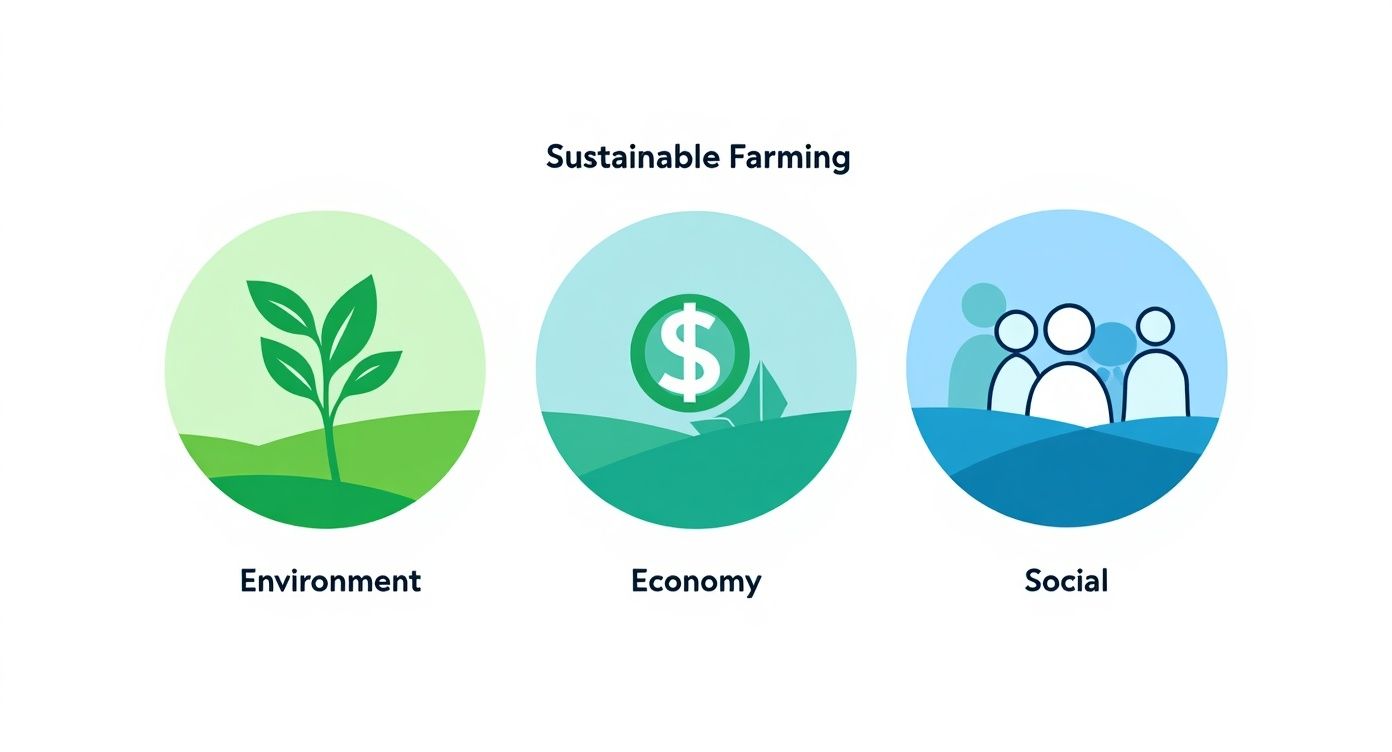
It’s a simple reminder that true sustainability only happens when environmental health, economic viability, and social fairness are all working together.
Sustainable agriculture starts from the ground up—literally. Instead of seeing soil as dirt, this principle sees it as a living, breathing ecosystem packed with microorganisms, fungi, and organic matter. Healthy soil is the bedrock of a healthy farm.
Practices like using organic compost and planting cover crops actively feed this underground world. This creates a rich, fertile foundation that holds water better and gives crops the nutrients they need, cutting down the reliance on synthetic inputs. It's like investing in the farm's single most valuable asset.
Water is a finite resource, and sustainable farming regards it that way. This principle is all about using water wisely and protecting its quality for everyone. It’s about making every single drop count.
That means shifting away from wasteful methods like flood irrigation and adopting smarter tech. Some great examples include:
Drip Irrigation: This gets water right to the plant's roots, which means way less evaporation and runoff.
Rainwater Harvesting: Collecting and storing rainwater in tanks or ponds gives farmers a backup supply for dry periods.
Mulching: A simple layer of organic material over the soil helps it hold onto moisture, so you don't have to water as often.
These practices don’t just save a precious resource; they help farms become more resilient to an unpredictable climate.
A sustainable farm is a bustling, diverse environment, not a sterile monoculture. Biodiversity—the variety of plants, animals, and microorganisms—is absolutely critical for a balanced and self-regulating farm.
When a farm has a rich mix of life, natural processes can take over. Helpful insects can manage pests, different plants provide homes for pollinators, and a variety of crops keeps the soil from being stripped of any one nutrient. This approach builds a much stronger ecosystem that can handle whatever challenges come its way.
A farm rich in biodiversity is like a well-diversified financial portfolio. It spreads the risk and builds long-term security, ensuring the system doesn't crash if one element fails.
Efficiency is another key piece of the puzzle. This principle is all about cutting dependence on fossil fuels and reducing the waste a farm produces. The goal is to create a closed-loop system where resources are reused and recycled, not just thrown away.
This could mean composting farm waste to create natural fertilizer or installing solar panels to power equipment. By slashing inputs and turning "waste" into a valuable asset, farmers can lower their operating costs and shrink their environmental footprint at the same time.
Finally, sustainability isn’t just about the land. It’s about the people and the business, too. A farm has to be profitable to stick around for the long haul, and it needs to support the well-being of its workers and the local community.
This principle focuses on things like fair labor practices, safe working conditions, and being a positive contributor to the local economy. At AloeCure, our vertically integrated model is a perfect example. By farming, processing, and making our own products, we can guarantee quality while creating stable jobs and investing in our community. This complete-picture approach is what makes a farm truly sustainable for generations to come.
So, what does sustainable farming actually look like on the ground? This is where the big-picture principles get their hands dirty. We're talking about the specific, tangible techniques farmers use every day to build richer soil, conserve precious water, and create a farm that works with nature, not against it. These methods are the practical answer to bringing the core ideas of sustainability to life in the field.
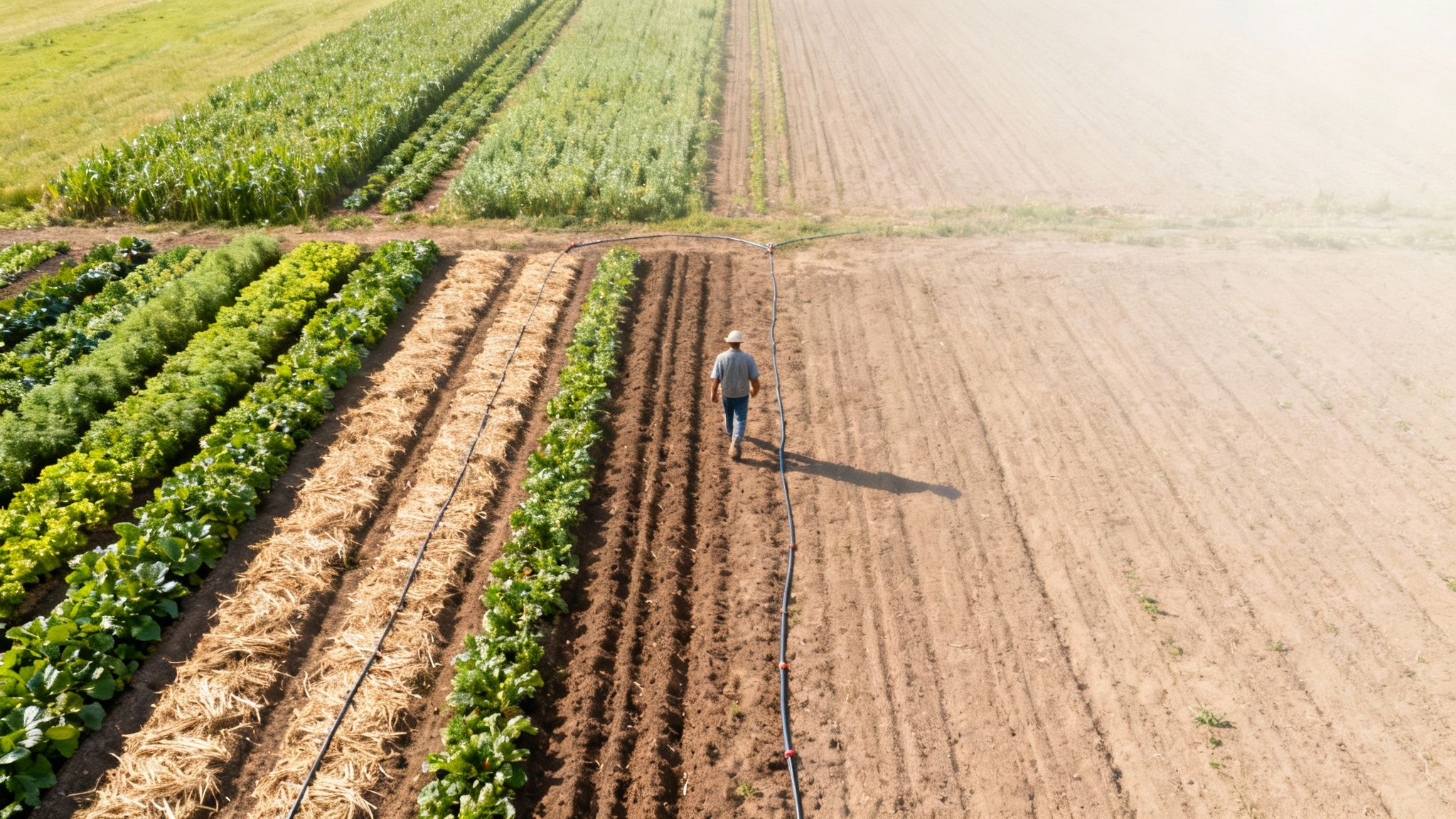
At AloeCure, this isn't just theory. Our own USDA-certified organic farms are living proof of these methods in action. We don't just talk the talk; we're actively using these practices to grow the premium-quality aloe vera that ends up in our products. It’s our way of ensuring every bottle starts with a deep respect for the land.
You can’t have a healthy farm without healthy soil. It’s that simple. Instead of viewing soil like a resource to be used up, the goal is to constantly feed and enrich it. This is done through a few clever techniques that team up with natural cycles.
Crop Rotation is a classic for a reason. Think of it as cross-training for your fields. Instead of planting the same crop year after year, which depletes specific nutrients and invites pests, farmers switch it up. They might plant a "heavy feeder" like corn one season, then follow it with a nitrogen-fixing legume like soybeans the next to naturally put nutrients back into the soil. This simple change breaks up pest cycles and boosts fertility without reaching for a chemical additive.
Cover Cropping is another game-changer. This means planting a "green blanket" of crops like clover or rye during the off-season rather than leaving fields bare and exposed. This living mulch protects the soil from being washed or blown away, keeps weeds down, and adds a huge dose of organic matter when it's worked back into the earth. It’s like giving the soil's microscopic helpers a feast.
These soil-first practices are a huge deal globally. A 2025 FAO report estimates that around 1.7 billion people live where land degradation has caused major drops in crop yields. Methods like cover cropping are essential for turning that trend around and building stronger food systems.
Sustainable farming also means finding smarter ways to handle common challenges like bugs and irrigation. The focus shifts from simply reacting with chemicals to creating a proactive system that keeps things in balance.
Integrated Pest Management (IPM) is a more thoughtful approach to pest control. Before spraying anything, farmers use a whole toolbox of other tactics. This could mean introducing beneficial insects that eat pests (think ladybugs!), setting traps, or choosing crop varieties that are naturally pest-resistant. It’s about creating a balanced farm ecosystem where pests don't get the upper hand. This is also how we ensure our aloe vera is cultivated in a clean, natural environment. If you want to learn more about how we use the purest aloe, check out our guide on pure aloe gel for skin.
Water-Wise Irrigation is all about making every drop count. Instead of old-school sprinklers that lose a ton of water to evaporation, farmers use methods like drip irrigation that deliver water right to the plant's roots. This precision is a lifesaver, especially in areas where water is scarce.
Even the way farmers prepare their fields for planting can make a huge difference. While traditional plowing can damage soil structure and lead to erosion, sustainable alternatives work to protect it.
Reduced Tillage or No-Till Farming is exactly what it sounds like: disturbing the soil as little as possible. Farmers plant seeds directly into the leftover residue from the previous crop instead of plowing the whole field. This simple change helps in a few big ways:
Improve Water Retention: The undisturbed soil acts more like a sponge, holding onto moisture.
Prevent Erosion: That layer of old crop residue acts as a shield against wind and rain.
Increase Organic Matter: It lets the complex web of life in the soil do its thing without interruption.
When you pair these techniques with responsible livestock integration, you get a truly holistic system. For instance, specialized programs like a Certificate in Livestock Management teach practical ways to raise animals in a way that complements the entire agricultural system. By weaving all these practices together, farmers create a farm that’s not just productive today, but resilient for generations to come.
It's one thing to know what sustainable farming practices are, but the real magic happens when you understand why they matter. Moving to these methods creates a positive ripple effect that reaches far beyond the farm gate, touching everything from environmental health to the economic stability of farming communities.
These aren't just abstract ideas; they're real-world results that build a better, more resilient food system for all of us. Adopting sustainable practices fundamentally changes a farm's relationship with its land from one of extraction to one of regeneration.
One of the clearest wins for sustainable agriculture is its impact on the environment. By focusing on soil health and working with natural cycles instead of against them, these practices help create healthier, more self-sufficient ecosystems.
Instead of draining resources, sustainable methods actively rebuild them.
Improved Water Quality: Smart techniques like using cover crops and reducing tillage prevent precious topsoil and agricultural chemicals from washing into nearby streams and rivers. This keeps our waterways cleaner and supports aquatic life.
Enhanced Biodiversity: By avoiding harsh chemicals and creating diverse habitats with things like hedgerows and a variety of crops, farms can become a sanctuary for essential pollinators like bees and beneficial insects that act as natural pest control.
Carbon Sequestration: Healthy soil is a carbon-storing machine. Practices that build up organic matter, such as composting and no-till farming, literally pull carbon dioxide from the atmosphere and lock it safely in the ground.
Sustainability is also just plain smart business. When farmers can cut back on expensive inputs like synthetic fertilizers and pesticides, they build more financially sound and independent operations. That kind of economic resilience is a huge deal for long-term success.
Take cover crops, for example. A farmer who uses them can naturally boost soil fertility, meaning they don't have to buy as much synthetic fertilizer. Mitchell Hora, a seventh-generation Iowa farmer, saved $106.24 per acre in fertilizer costs in a single year just by making that one change. That's money that can be put right back into the farm, creating a cycle of continuous improvement.
At AloeCure, our commitment to sustainable, organic farming isn't just an environmental choice—it's a quality promise. By nurturing our soil and plants naturally, we cultivate aloe vera that is pure and potent. This focus on quality from the ground up allows us to create products that support wellness, and you can explore more about the benefits in our article on organic aloe vera juice.
The positive effects from sustainable farming spread to the wider community, too. When farms are profitable and environmentally sound, they create stable jobs and help rural economies thrive. This approach also leads to a more transparent food system where you can feel good about where your food is coming from.
Plus, cutting down on food loss and waste is another key piece of the puzzle. The OECD-FAO Agricultural Outlook 2025-2034 points out that combining waste reduction with targeted decreases in fertilizer use could lower global agricultural greenhouse gas emissions by an estimated 7 million tonnes of CO2 equivalent. You can learn more about these agricultural projections on oecd.org by reading the full report.
At the end of the day, these methods ensure we’re producing high-quality food in a way that nourishes both people and the planet, securing a healthier future for generations to come.
It's one thing to talk about the theory behind sustainable farming, but seeing it in action is where the story really comes alive. Let's move from the "what" to the "how" with a real-world example of a company built from the ground up on these very principles. This shows that sustainability isn’t just an add-on; it’s the entire foundation.
At AloeCure, our whole approach is built on vertical integration. That’s just a way of saying we don’t buy our aloe from a third party—we control the entire journey ourselves. We own and operate our own USDA and EU-certified organic aloe farms, manage our own modern processing facilities, and create our own final products. This gives us complete oversight, ensuring every single step meets our strict standards for both quality and responsibility.
Our farm-to-bottle model is the cornerstone of our promise to you. By managing the entire process, we can put sustainable techniques into practice that lead directly to higher-quality aloe. We’ve always believed that what’s good for the earth is good for our plants.
Here are a few of the specific practices we use on our farms:
Organic Soil Amendments: We feed our soil with natural compost and organic matter. This creates a rich, fertile environment for our aloe to thrive in without any need for synthetic chemicals.
Water Conservation: We use precision irrigation methods that deliver water right to the plant roots, which minimizes waste and conserves this precious resource.
Hand-Harvesting: Our aloe is carefully harvested by hand. This allows us to select only the most mature, nutrient-dense leaves while protecting the parent plant so it can continue to grow.
This meticulous, hands-on approach is what we call The Fresh Aloe Difference. It’s our commitment to purity and potency, a difference you can truly feel. You can learn more about our unique process and what sets our aloe apart.
We are so confident in our sustainable practices that we invite the world to come and see them firsthand. Our farms double as agro-tourism destinations, welcoming over 250,000 visitors every single year.
This open-door policy is all about transparency. It allows people to walk our fields, learn about organic aloe cultivation, and see our dedication up close.
By inviting visitors to our farms, we’re not just showing them how we grow aloe vera. We’re demonstrating that a business can be a steward of the land, proving that sustainable, responsible farming is not only possible but is the key to producing superior products.
This level of openness builds trust and connects you directly to the source of your wellness. When you choose AloeCure, you’re not just buying a product; you're supporting a system that values the land, empowers its community, and delivers unmatched quality from our fields to your family. It's sustainability you can see, touch, and trust.
As a consumer, you have more power than you might think. Every time you buy food, you’re casting a vote for the kind of agriculture you want to see in the world. Supporting sustainable farming doesn't mean you have to completely change your life—it starts with making more conscious choices at the checkout counter.
When you deliberately choose products from brands that are serious about farming responsibly, you help drive demand for better methods. This encourages more farmers to adopt practices that build healthy soil and protect our natural resources for the long haul.
Walking down the grocery aisle can feel overwhelming with all the different labels. But a few key certifications can make it easier. The USDA Organic seal is probably the most familiar one. If you see it, you know the product was grown without synthetic pesticides, fertilizers, or GMOs, following strict government rules.
But a label is only part of the story. While certifications are a good place to start, true sustainability is about more than just what's not in your food. It also includes economic stability for farmers and social fairness for workers. That's why it's so important to look for brands that are transparent beyond just a seal on the box.
The best way to be sure a company is truly practicing what it preaches is to look for transparency. A brand that is willing to show you exactly how its products are grown and made is demonstrating a genuine commitment.
The clearest sign of a company's commitment to sustainability is when they control their entire process from start to finish. This is called vertical integration. When a brand owns its farms, runs its own processing facilities, and makes its own products—like we do at AloeCure—it provides a level of quality control and accountability that’s hard to beat.
This farm-to-bottle approach means we can confidently stand behind our sustainable methods at every single step of the journey. There are no mysterious third-party suppliers or unknown farming practices in the mix. It's a straight, clear line from our organic fields right to your home.
When you choose products from vertically integrated companies like AloeCure, you’re not just supporting one brand; you're pushing for a more honest and responsible food system for everyone.
You can also support the movement in other ways:
Shop at Farmers' Markets: This is a great way to talk directly to the people growing your food. Don't be shy! Ask them how they manage pests or what they do to keep their soil healthy. Their answers will tell you a lot about their farming philosophy.
Join a CSA Program: Community Supported Agriculture (CSA) programs connect you directly with a local farm. You basically buy a "share" of the harvest and get a box of fresh produce all season long.
By seeking out brands that are proud to share their story, you’re doing more than just buying a product. You’re investing in a healthier planet and a food system we can all trust. Explore our full line of products and sign up for a subscription to save 20% on your journey toward supporting sustainable wellness.
To bring everything into focus, let’s go over some of the most frequent questions people have about sustainable agriculture. This should clear up any lingering doubts and give you a better feel for what these practices really mean for our food and our planet.
This is a great question, and it’s a common point of confusion. The two terms get thrown around together, but they’re not the same thing. While being USDA Organic is often a key part of sustainability, the idea of "sustainable" is much bigger and looks at the entire system.
Think of it like this: organic standards are mostly focused on the environmental side of things by saying "no" to synthetic fertilizers and pesticides. Sustainable farming takes that a step further by also including economic success for the farmer and social equity for the community. It’s a more complete and resilient model.
This concern comes up a lot, but the answer is all about thinking long-term. Sure, some intensive, conventional methods might squeeze out higher yields in the short run, but they often do it by draining the life out of the soil. That’s not a winning strategy for future generations.
Sustainable methods, on the other hand, are all about building rich, living soil and encouraging biodiversity. This creates incredibly resilient farms that are better at handling challenges like drought and can produce strong, consistent yields year after year. It's a crucial piece of the puzzle for long-term global food security.
Sustainability isn’t just about getting the most out of this year’s harvest; it’s about guaranteeing great harvests for decades to come by investing in the health of the land itself.
The single most important thing to look for is transparency. Certifications are a good starting point, but the real proof is a company’s willingness to show you exactly how its products are made, from the field to the final product.
Look for businesses that own their own farms and control the whole process—a vertically integrated model like AloeCure's. This setup offers the clearest possible proof of their commitment. When a company invites you to see their methods for yourself, you can feel confident their sustainable practices are more than just a marketing slogan; it's just who they are.
For 25 years, AloeCure has lived out this commitment through our vertically integrated, farm-to-bottle promise. We grow, harvest, and process our own USDA-certified organic aloe to ensure purity and quality you won't find anywhere else. Come experience the difference that true sustainable farming makes.
Explore our products and sign up for a subscription to save 20% at AloeCure.com
These statements have not been evaluated by the Food and Drug Administration. This product is not intended to diagnose, treat, cure, or prevent any disease.
Los comentarios se aprobarán antes de mostrarse.