Tu carrito está vacío
Envío y manipulación gratuitos con todos los pedidos superiores a $25
Envío y manipulación gratuitos con todos los pedidos superiores a $25

You've probably stood in the aisle with one hand on a bottle of aloe drink and the other on your phone, trying to figure out whether you're looking at a clean aloe beverage or just flavored water with a botanical label. The front of the bottle may say original, organic, or pure, but that doesn't tell you much by itself. The full story sits in the leaf fraction, the processing method, and the small print.
A shopper usually notices the bottle before the plant. The label is green, the liquid looks pale, and the front panel promises something calm and natural. Then the questions start. Is this a true aloe drink, or just water with a splash of aloe flavor?
An original aloe drink is built around aloe material from the leaf itself, not just a passing hint of aloe in a mixed beverage. In practice, the difference comes down to what part of the leaf was used and how carefully it was handled. The cleanest versions rely on the inner-leaf gel, while less refined products may use broader whole-leaf material that includes parts buyers usually don't want in a daily drink.
A label worth your attention gives you clues, not just marketing words. Look for language about inner-leaf gel, purified aloe juice, or processing that removes the outer rind and latex layer. That tells you the maker is trying to control the compounds that change taste, safety, and consistency.
Practical rule: if the front of the bottle sounds exciting but the ingredient panel stays vague, assume the beverage is closer to a flavored drink than a carefully made aloe product.
A true aloe-forward bottle usually feels more like a simple functional beverage than a dessert drink. It may be lightly flavored, but aloe still sits at the center of the formula. That's different from a product that uses a fruit profile first and aloe only as a supporting note.
For a first-time buyer, the easiest test is this. Read the ingredient list and ask whether aloe is the main character or just a supporting ingredient. If the label makes the plant fraction clear, you're already shopping more intelligently.
Aloe's history starts long before it became a shelf drink. The earliest documented human use of Aloe vera appears in Sumerian clay-tablet records from about 2200 BC, where the plant was described as a laxative, and historical use was also recorded in Egypt, Greece, and China. Later, Spain and the Netherlands cultivated aloe in Barbados and Curaçao, and aloe was sold in parts of Europe during the 17th century. Commercial cultivation in the United States began in Florida during the 1920s. A fuller historical overview sits here.
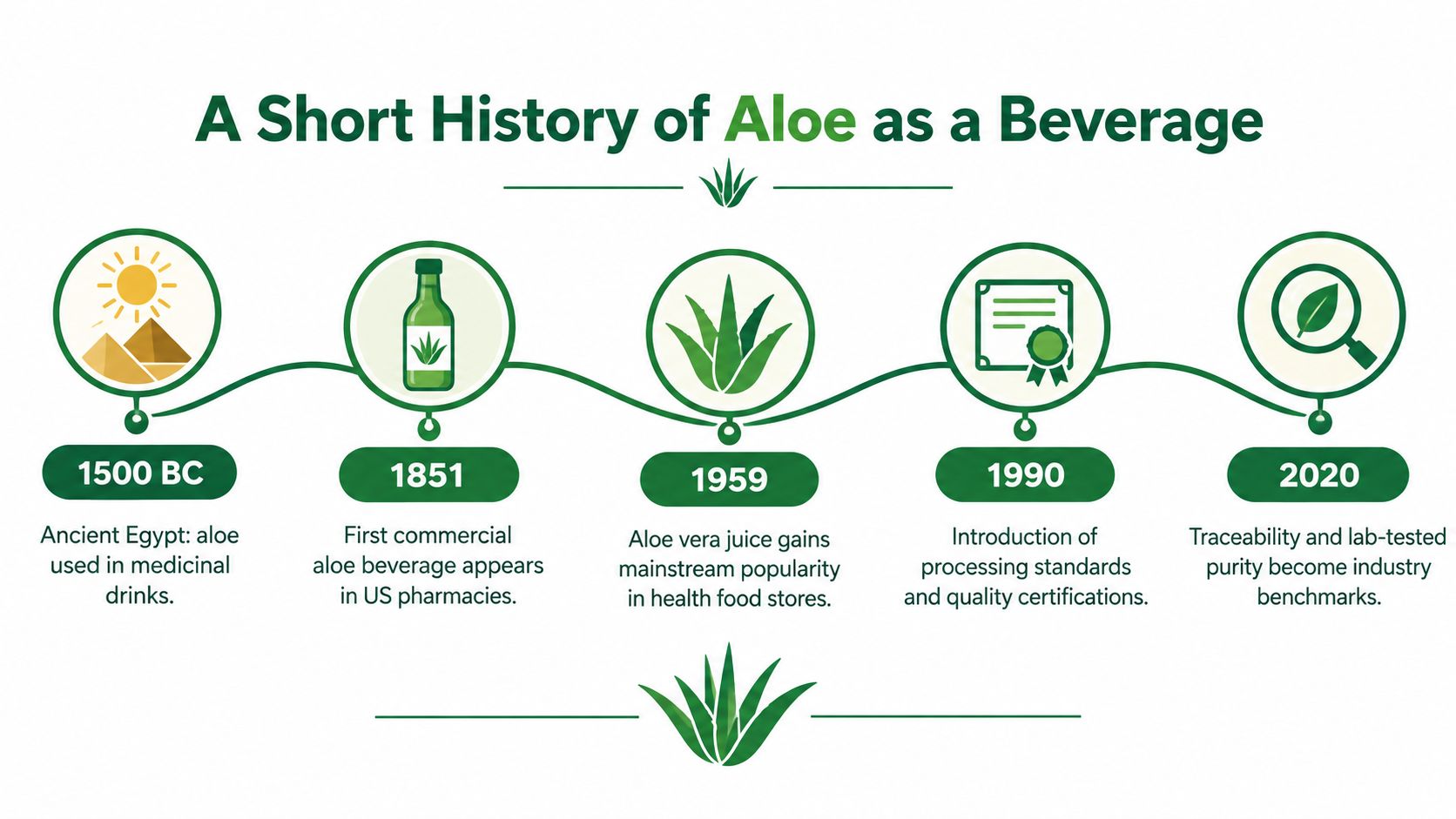
The modern beverage category is much newer than the plant's medicinal history. Aloe gel extracts began appearing in health foods and beverages in the 1970s in the United States and parts of Europe, which pushed aloe out of mainly topical and medicinal use and into packaged consumer products. That shift matters because once aloe became a drink, buyers needed clearer standards for purity, flavor, and sourcing.
The commercial beverage market expanded fast enough that producers had to define what counted as a quality aloe product. Some leaned into aloe juice as a wellness drink, while others built broader food applications such as yogurt, candies, and ice cream. The category grew up around packaging, shelf life, and branding, not around centuries of beverage tradition.
That's why today's bottle deserves closer reading than a traditional folk-use story would suggest. A modern aloe drink isn't automatically better because it is newer, and it isn't automatically trustworthy because it sounds ancient. It's a processed beverage, and the processing choices are what separate a careful formula from a vague one.
The key label question is simpler than it first looks. Was the drink made from inner-leaf gel, or from whole-leaf material that may include latex? That matters because the latex layer, which sits between the rind and the inner gel, contains anthraquinones, especially aloin. Those compounds are the reason aloe can taste harsher and behave differently from one product to the next.
The International Aloe Science Council uses an oral-product benchmark of less than 10 mg/L, or less than 10 ppm, aloin for aloe products, and the National Institute of Environmental Health Sciences notes that many liquid aloe products contain less than 1 ppm, while solid or semisolid products can contain 10 to 100 times more. A careful buyer doesn't need to calculate the chemistry, but they do need to know whether the maker is measuring and controlling aloin rather than hoping the label language covers it. The technical benchmark and processing distinction are laid out here.
| Plant Fraction Used in Aloe Beverages | Aloin Profile | Typical Quality Posture |
|---|---|---|
| Inner-leaf gel | Lowest when latex is removed correctly | Cleanest label story, mild taste, easiest to standardize |
| Decolorized whole-leaf | Reduced through filtration and processing | Can still be acceptable if the aloin level is measured and controlled |
| Non-decolorized whole-leaf | Higher risk of carrying more anthraquinones | More likely to taste bitter and behave like a laxative product |
The bottle should tell you more than “made with aloe.” You want to know whether the maker removed the rind and latex, whether the juice was filtered or decolorized, and whether the finished product carries a measurable aloin specification. Terms like pure, natural, and whole leaf are too loose on their own.
A premium bottle gives you a processing story, not just a plant name.
If a brand can't explain the aloe fraction, the aloin target, and the processing stage, you're left guessing. That's a poor place to be when the whole point of the drink is consistency.
Organic on a bottle is a certification claim, not a loose compliment. The USDA says the word organic can appear only when agricultural products and ingredients are produced and handled under USDA organic rules or an equivalent approved certification program. For the made with organic category, at least 70% of the ingredients must be certified organic, and the label can't display the USDA Organic Seal or use the word organic on the principal display panel. The USDA's label rules are here.
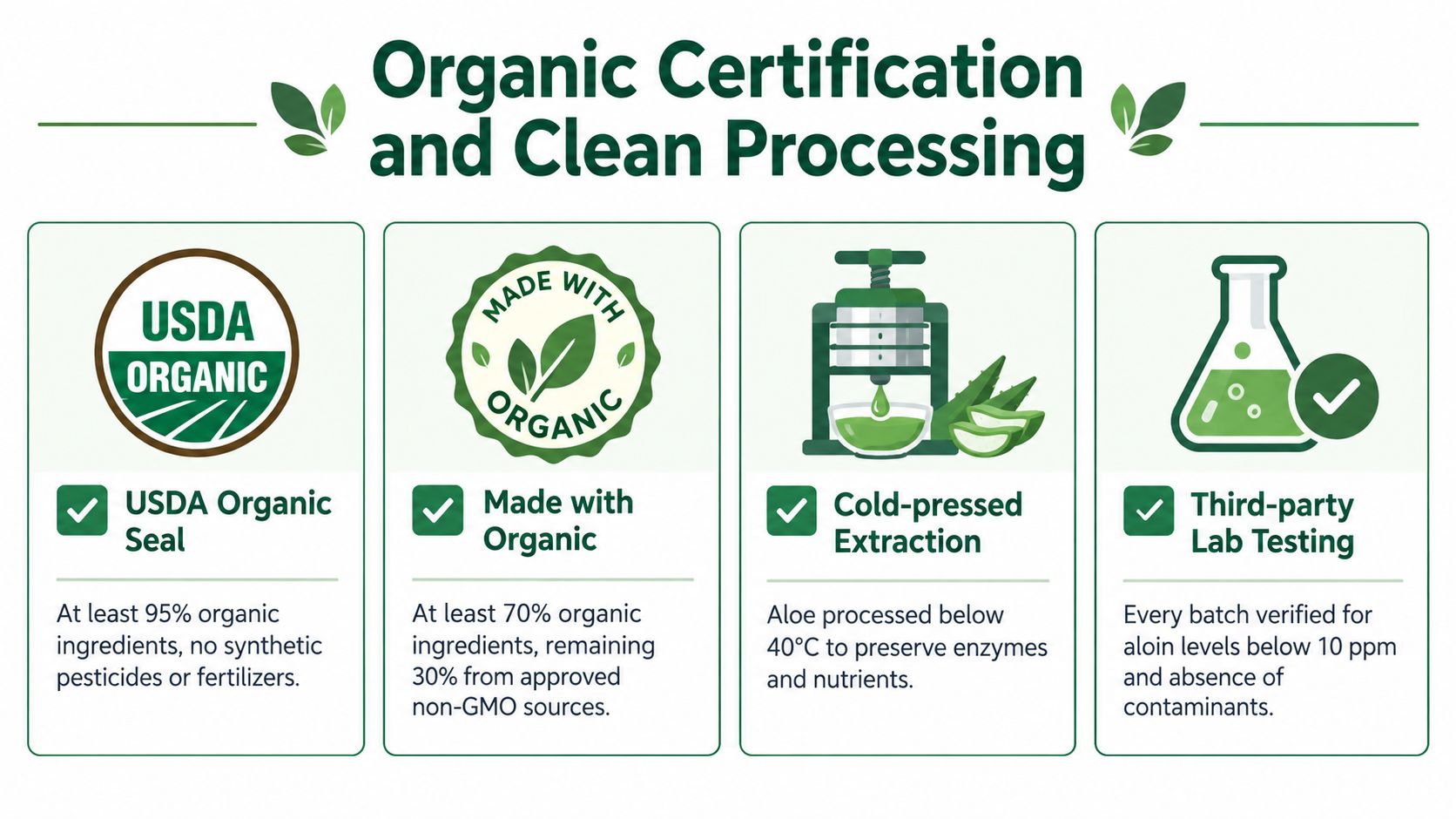
Certification matters, but clean processing matters too. A bottle can be organic and still be handled in a way that strips away clarity, adds processing aids, or makes the sourcing story hard to follow. A careful buyer should look for both the certification mark and the processing method.
In a well-run aloe operation, the goal is simple, keep the juice close to the plant and away from unnecessary handling. AloeCure processes aloe on-site within 12 hours of harvest, which helps preserve a tighter farm-to-bottle chain and reduces the amount of time raw aloe sits before it's turned into a drink. More about that approach is described here.
That's a very different posture from formulas that rely on chemical steps, charcoal filtration, or enzymes to force a product into shelf stability or a smoother taste profile. Those methods may solve a manufacturing problem, but they also tell you the beverage needed more intervention to get where it ended up.
If a product is proud of its sourcing and handling, it should be able to say so plainly. That's the clearest signal you can ask for.
A good aloe drink should fit into a normal routine without trying to act like a medicine cabinet. The safest and cleanest way to describe it is through structure/function language, which keeps the focus on ordinary wellness and normal body function. A bottle can support healthy digestive function, promote everyday wellness, and help maintain normal body function without making disease claims.
That language matters because people often buy aloe for the way it fits into daily life. They want something light, plant-based, and easy to keep on hand. They don't need a dramatic promise, they need a beverage that feels compatible with breakfast, lunch, or a quiet evening routine.
Practical rule: if a bottle sounds like a medicine, put it back. If it sounds like a steady wellness habit, you're in the right lane.
The best formulations stay close to that idea. They offer a simple serving, a clear aloe source, and a readable label that tells you what's inside. That gives the drink a real role in routine use, instead of turning it into a vague cure-all.
AloeCure's Pure USDA Organic Aloe Vera Juice is one example of a drink positioned around inner-leaf aloe and everyday use, but the broader lesson applies to any brand. Look for clarity, not hype. Choose a beverage that supports normal function, stays within compliant language, and leaves out the drama.
Clean aloe tastes gentle, slightly earthy, and less aggressive than many buyers expect. That's why light natural flavors work so well, they don't have to fight the aloe, they just round it out. Grape softens the edges, while lemon adds brightness without turning the drink into candy.
The simplest way to use it is to keep the serving ritual easy. Some people pour it straight into a glass, while others add it to cold water as part of a morning habit. If a bottle settles in the fridge, a quick shake usually brings the liquid back together before serving.
Aloe works best when it's easy to repeat. If the taste is too intense or the routine feels fussy, the bottle usually ends up untouched. A well-made original aloe drink should feel simple enough to keep on the counter and pleasant enough to become habitual.
Start with the label, not the marketing banner. A good bottle should make it easy to verify organic certification, inner-leaf sourcing, processing transparency, and a measurable aloin specification. If the brand can't explain those basics, the rest of the promise is weak.
Next, look for proof that the company handles more than one step of the journey. A vertically integrated model is easier to trust when it's visible, because it ties farming, processing, bottling, and testing into one chain. That matters more than a pretty front label.
For readers comparing aloe drinks with other low-sugar beverage swaps, the 8 low-sugar drink swaps roundup is a useful way to think about how different drinks fit into a daily routine. It's not about replacing one habit with a perfect one; it's about choosing the option you'll keep.
AloeCure's own product pages also describe an 8-step traceability promise, fast processing, and a 90-day money-back guarantee, which are the kinds of details worth looking for if you're comparing brands. Their aloe brand overview is here, but the larger rule is simple. Buy the bottle that tells you exactly what it is.
The bottle tells you almost everything you need to know if you read it carefully. First, check the plant fraction, because inner-leaf gel and whole-leaf material are not the same thing. Second, check the processing, because clean handling and aloin control separate a thoughtful drink from a vague one. Third, check the traceability, because a brand that can follow its aloe from farm to bottle is giving you more than a marketing story.
That's the cleanest way to shop for an original aloe drink. Look for a beverage that fits normal wellness, feels simple to use, and gives you enough label detail to make a confident choice. Once you learn to read the bottle this way, the aisle gets a lot less confusing.
If you want a clearer aloe routine, take a look at AloeCure, where the product lineup centers on organic aloe juice and straightforward label details. You'll find farm-to-bottle processing, traceability, and subscription options that make it easier to keep a daily bottle on hand.
Los comentarios se aprobarán antes de mostrarse.