Tu carrito está vacío
Envío y manipulación gratuitos con todos los pedidos superiores a $25
Envío y manipulación gratuitos con todos los pedidos superiores a $25

You're in bed with the lights low, your phone glowing in one hand, and your mind replaying the day in the other. You want something gentle that supports a better nighttime routine, but product pages make the choice feel harder than it should. The useful question isn't which capsule has the boldest promise. It's which formula fits your specific sleep situation, has a transparent label, and supports habits you can sustain.
A natural sleep supplement can be one part of that plan. It shouldn't replace consistent sleep and wake times, a calmer evening environment, or professional guidance when sleep problems persist. The quality-first approach starts with understanding what an ingredient is designed to support, then checking whether the product delivers it clearly and responsibly.
A natural sleep supplement is best understood as a small nudge, not a switch that forces sleep. Melatonin, for example, is connected primarily with the body's sleep-wake timing. Magnesium provides nutritional support related to neuromuscular function and neuronal signaling. Herbal and amino-acid formulas may be positioned around relaxation and a calmer bedtime routine, but their evidence varies.
That distinction matters because “poor sleep” can describe several different experiences. One person may occasionally take a long time to fall asleep after travel. Another may wake easily because their evening schedule changes from night to night. Someone else may have a persistent pattern that deserves a conversation with a qualified professional rather than progressively higher supplement servings.
Practical rule: Match the product to the sleep experience you want to support, not to the most dramatic wording on the front of the bottle.
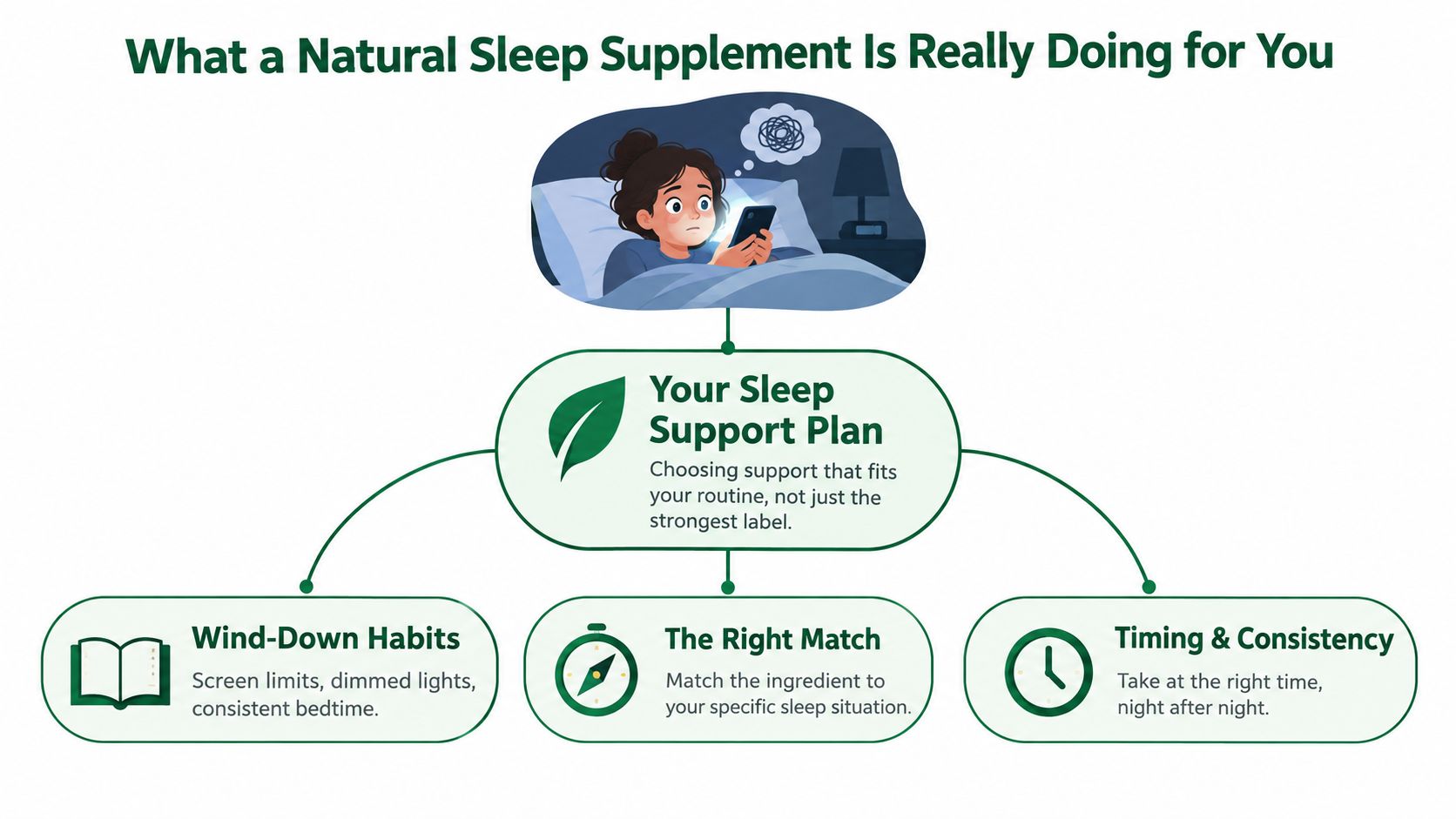
A useful plan combines three elements: wind-down habits, an ingredient that fits the goal, and careful timing. Dimmed lights, fewer stimulating screens, and a consistent bedtime give the body predictable signals. A supplement can then support a normal sleep routine instead of carrying the entire burden.
For readers comparing formulas such as AloeCure's Melatonin + Collagen Sleep Support Capsules with other products, the important questions are practical. Does the label state the ingredients and amounts? Does the brand explain sourcing and quality controls? Are the directions and warnings easy to find? For additional ideas about sleep routines and comfort, readers dealing with facial or jaw discomfort can explore better sleep for orofacial pain patients.
| Ingredient Family | Typical Role in a Nighttime Routine | Reader Question It Answers |
|---|---|---|
| Melatonin and calming herbs | Supports sleep-wake timing or a calmer wind-down | Am I trying to shift bedtime signals or settle into the evening? |
| Magnesium | Provides nutritional support for normal neuromuscular function | Could my routine benefit from a clearly stated mineral form? |
| Collagen peptides | Supplies amino acids as part of a broader nighttime wellness formula | Do I want a combination product with more than one wellness purpose? |
| Amino-acid and botanical blends | Promotes relaxation as part of a quiet bedtime ritual | Am I looking for support for a busy, active mind? |
The strongest choice usually isn't the longest ingredient list. It's the formula that answers a specific need while making its limits, directions, and quality standards easy to understand.
You get into bed at a reasonable hour, but your brain still feels like the kitchen light is on. That mismatch is a useful place to start, because sleep is not a single switch. It is a coordinated process. Your circadian rhythm sets the rough timing, and sleep pressure builds through the day, so your body is ready to drift into lighter and deeper stages at night.
Those signals are easy to blur. Bright light late in the evening can push your body toward alertness. Screens do the same for many people. Caffeine may still be active later than it seems. Stress can keep the nervous system on guard, even when you are tired. A steady wake time, lower light at night, and a familiar wind-down routine give your body clearer cues to follow.
Melatonin works within that timing system. It is better understood as a signal about darkness and schedule than as something that forces sleep. Evidence summarized by the National Center for Complementary and Integrative Health found that a meta-analysis of 19 randomized, placebo-controlled trials involving 1,863 participants reported a 7.06-minute reduction in sleep-onset latency, an 8.25-minute increase in total sleep time, and improved overall sleep quality. Those changes matter most when your body clock is slightly out of step, not when your evening habits keep sending mixed signals.
Magnesium sits in a different lane. It supports normal neuromuscular function and neuronal signaling, so people often connect it with relaxation. That biological role makes sense. The research picture is still mixed, though. A review of 7,582 adults across nine studies found that observational findings and randomized trials did not line up clearly, so the effect of supplementation on sleep remains uncertain (PubMed review).

Botanicals and amino acids are often added for a calmer bedtime experience, but they are not all doing the same job. Before you judge any formula, get the foundation in place first. The plain basics often do the most work: a consistent morning, a repeatable evening, and a bedroom that feels quiet and dim. If you want help turning that into practice, this guide on how to build a sleep schedule walks through the routine step by step.
A sleep formula often looks complicated until you sort it into ingredient families. Once you do, the label reads less like a promise and more like a map. You can ask a calmer, more useful question: what is each ingredient here to do?
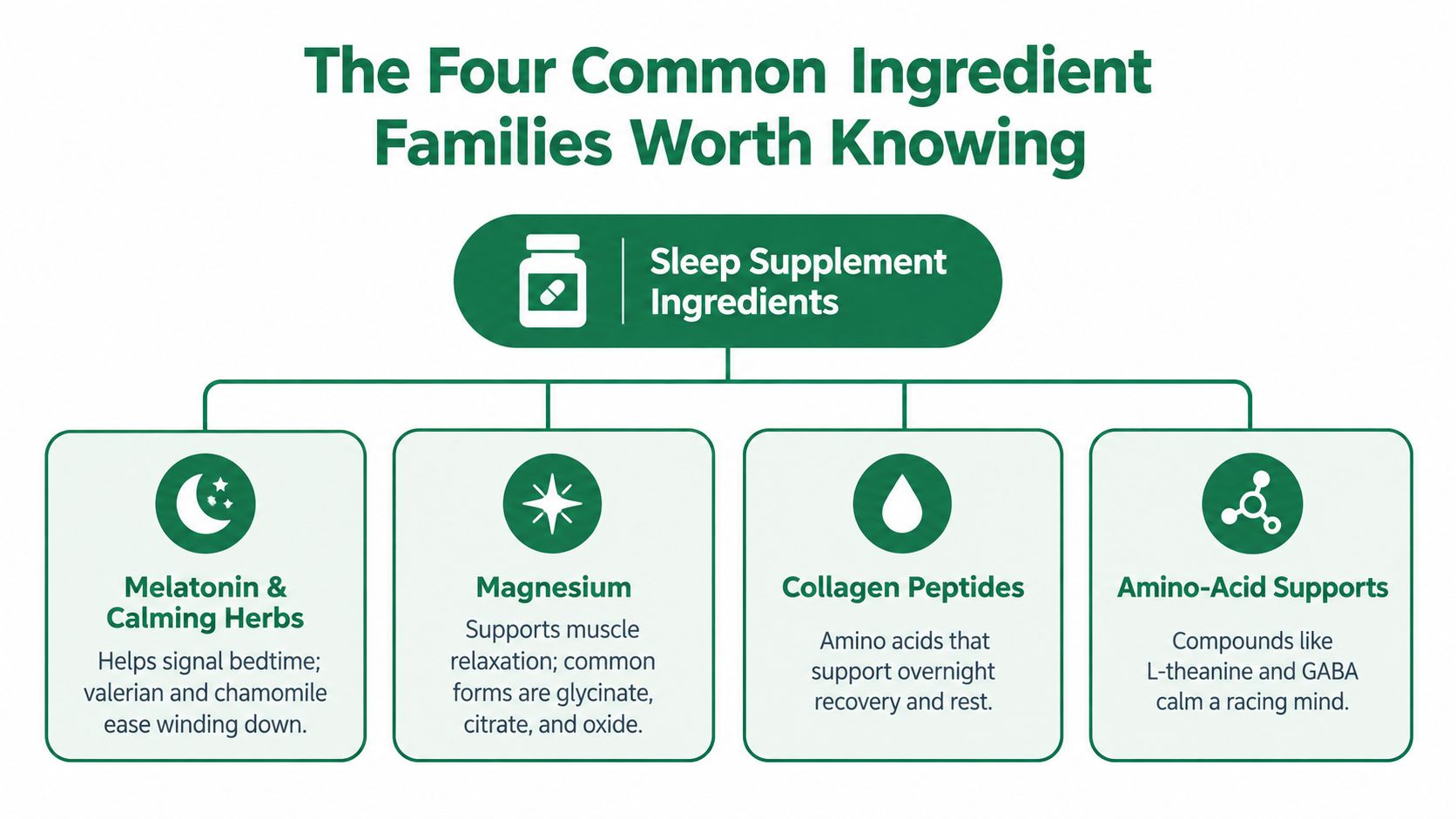
Melatonin belongs in its own lane because its main job is timing. It is commonly used when sleep feels off-schedule, such as after travel or shift changes, rather than as a catch-all answer for every restless night. That distinction matters when you read a label. A formula built around melatonin should be clear about circadian support, not vague about “knocking you out.”
Herbs such as valerian and chamomile are usually included for a different reason. They are typically framed around relaxation and bedtime ease. The evidence behind valerian is mixed, and product language should stay modest. Good labels describe support for a calm evening routine or relaxation instead of making medical-style promises.
These ingredients are not interchangeable. A product that combines them can still make sense, but only if the brand explains why each one is there and how the pieces fit together.
Magnesium often appears in forms such as glycinate, citrate, or oxide. That can confuse shoppers because the form name is not the same as the amount of elemental magnesium you get in a serving. A cleaner label spells that out so you can compare products fairly instead of guessing from the front of the bottle.
Its role is usually broader than “sleep ingredient.” Magnesium is more accurately described as nutritional support involved in normal neuromuscular function and relaxation-related processes. If a formula presents it that way, the product is usually easier to judge.
Collagen peptides sit in a different category again. They provide amino acids and may be added to a nighttime formula aimed at broader wellness support. That does not make collagen a substitute for melatonin or an herb traditionally used for relaxation.
Label honesty matters here. If collagen is included, the product should say what role it is meant to play instead of letting every ingredient blur together under one sleepy headline.
Glycine, L-theanine, lemon balm, and similar ingredients are often used to support relaxation at bedtime. Their proposed effects are not identical, and the amount of explanation on the label tells you a lot about product quality. A thoughtful product page will connect each ingredient to a specific purpose, such as relaxation, routine support, or another normal body function.
If you want a practical comparison of options beyond melatonin, this guide to melatonin alternatives for sleep is a useful next read. The goal is not finding the longest ingredient list. It is choosing a formula whose ingredients, amounts, and purpose all make sense together.
Natural supplements and prescription options sit on different sides of a decision, but neither category is automatically right for everyone. A supplement may appeal to someone who wants a routine-support option for occasional or situational sleep disruption. Prescription care may be appropriate when sleep concerns persist, interfere with daily life, or need a more individualized evaluation.
The first difference is purpose. Melatonin is mainly associated with circadian timing, while many prescription options are selected for specific sleep patterns under professional supervision. A supplement label can support normal sleep-wake cycle function, but it cannot promise to diagnose, mitigate, treat, cure, or prevent a disease.
| Question | Natural supplement | Prescription option |
|---|---|---|
| How quickly might it work? | Depends on the ingredient, timing, and individual response | Depends on the specific option and clinical direction |
| Could it cause morning grogginess? | Drowsiness is possible, especially with melatonin products | Side effects vary and require professional review |
| Is habit formation a concern? | Many readers choose supplements because they want routine support without a drug-style approach, but “natural” doesn't remove all safety questions | The risk profile depends on the specific prescription |
| How easy is it to stop? | Often straightforward when label directions are followed, though personal guidance may still be useful | Stopping or changing some options should be discussed with the prescriber |
| What does it cost? | Varies by formula, serving directions, and purchase plan | Varies by option, coverage, and care pathway |
The comparison shouldn't become a contest. Prescription care can be the responsible choice for persistent concerns, and a supplement may be a reasonable option for a reader seeking targeted support around a changing schedule or bedtime routine. If you're unsure, a clinician or pharmacist can review your situation, especially when you already use other products.
The next question is more concrete: whether the product you're considering is clearly made, accurately labeled, and responsibly marketed.
A high-quality sleep supplement should make evaluation easy. Start with the Supplement Facts panel, then move outward to directions, warnings, sourcing, testing, and manufacturing information. If the label hides the meaningful details behind a proprietary blend, you can't easily compare the product with another formula or understand what you're taking.
Look for clearly stated amounts of melatonin and, when included, elemental magnesium. The form of magnesium matters because magnesium glycinate, citrate, and oxide are different compounds. For botanicals, check whether the label names the plant part, extract, or standardized amount rather than using only a broad blend name.
A product page should also explain serving size and timing. Directions such as “take at bedtime” are more useful than vague language about taking the product whenever needed. Follow the product's own instructions instead of combining several formulas just because they share a nighttime theme.
FDA's dietary-supplement manufacturing framework, 21 CFR Part 111, requires manufacturers to verify the identity of every dietary ingredient they receive, unless an approved exemption applies. That supports practical quality markers such as identity testing, written specifications, documented verification, and consistent production practices (FDA manufacturing guidance).
Third-party certifications and testing can add useful context, but readers should look for specifics. Does the brand identify what it tests? Does it explain sourcing? Does it provide a way to understand lot control, manufacturing standards, or product specifications?
A vertically integrated business model can also make sourcing easier to follow. AloeCure describes a model in which its parent company farms and processes its own aloe before producing finished products. That level of control may make the raw-material path easier to document, but it doesn't by itself prove that every product is superior to every competitor.
FDA permits structure/function claims when they describe support for a normal body function and are truthful and not misleading. Safer examples include:
Disease-related or drug-like promises cross a different regulatory line. FDA also requires the prescribed disclaimer for qualifying structure/function claims and notification within 30 days after first marketing a product with that claim (FDA claims guidance).
Use this quick checklist on any product page, including AloeCure's:
For a closer walkthrough of panel language, use this guide to reading supplement labels.
There isn't one universal best natural sleep supplement because there isn't one universal sleep complaint. A person adjusting to a new time zone is solving a different timing problem from someone who wants a calmer transition from work to bed. Starting with the situation keeps the decision grounded.
A melatonin-focused product may fit a reader who wants support for sleep-wake timing, especially when the schedule has shifted. The realistic expectation is modest support for falling asleep, not a guaranteed result or a promise of uninterrupted sleep.
Melatonin is the ingredient family most closely connected with circadian timing. Strategic timing matters more than increasing the serving, and readers should follow the product label rather than improvising with larger amounts.
Magnesium or a calming botanical blend may appeal to someone seeking nutritional or relaxation support. The evidence for magnesium remains unsettled, and valerian evidence is inconsistent, so a transparent label is more valuable than a dramatic promise.
A simple formula can be enough. A combination containing melatonin and collagen peptides may suit someone who wants sleep-wake cycle support alongside a broader nighttime wellness routine. Another reader may prefer magnesium with a botanical ingredient. More ingredients don't necessarily mean a better match.

Persistent or worsening sleep complaints deserve more than repeated dose increases. A professional can help consider sleep schedule, breathing during sleep, movement-related discomfort, mood, stress, and other contributors without treating a supplement as a substitute for evaluation.
The following video offers another perspective on building a calmer nighttime routine:
A good starting plan is simple: name the sleep situation, select one clearly labeled ingredient family, follow the directions, and track what happens. That approach gives you useful feedback without turning the evening into a chemistry experiment.
A sleep supplement works best when you treat it like part of a routine, not a knob to keep turning upward. Start with the label, then line up the timing with your evening. With melatonin products, earlier is not always better, and more is not always stronger. Expect modest support for falling asleep, not a guaranteed result. Higher amounts can also bring more next-day drowsiness, headache, or dizziness, which is one reason to stay close to the serving directions and avoid improvising with the dose.
Consistency matters more than perfection. Take the product the same way each night for a short trial, and pair it with a repeatable wind-down cue your brain can recognize, such as dimmer lights, a book, light stretching, or quiet music. One NIH label record for a melatonin supplement directs adults to take one to two tablets only at bedtime, warns that melatonin may cause drowsiness, advises against driving or operating machinery after use, and recommends checking with a doctor if medications are involved.
Then track what happens, briefly.
Keep that log for the first couple of weeks. The goal is not to build a perfect spreadsheet. The goal is to spot a pattern. If your notes show small, steady improvement, the product may be a reasonable fit. If nothing changes, or you feel worse in the morning, that is useful information too.
A simple check-in helps set expectations. Sleep supplements often work gradually, and response can vary from person to person. For a practical overview of that timeline, read how long supplements take to work.
Choose a natural sleep supplement by asking four questions. What sleep situation am I addressing? What does the label really contain? Does the manufacturer verify ingredient identity and follow good manufacturing practices? Can I use this product as part of a routine I can sustain?
A formula such as AloeCure's Melatonin + Collagen Sleep Support Capsules is one option to evaluate through that lens. Read the directions, review the ingredients, and keep expectations aligned with the evidence and your personal goal.
These statements have not been evaluated by the Food and Drug Administration. This product is not intended to diagnose, treat, cure, or prevent any disease.
Explore AloeCure to review its Melatonin + Collagen Sleep Support and other wellness formulas with clear product information. If the formula fits your routine, Subscribe & Save offers 20% off subscriptions and flexible delivery.
Los comentarios se aprobarán antes de mostrarse.