Tu carrito está vacío
Envío y manipulación gratuitos con todos los pedidos superiores a $25
Envío y manipulación gratuitos con todos los pedidos superiores a $25

No, carbohydrates are not bad by default. Carb type, amount, and what they replace determine their effect, and a typical 2,000-calorie day corresponds to approximately 225-325 grams of carbohydrate.
The popular advice to cut bread, rice, fruit, and beans puts very different foods into the same category. That makes eating feel simpler, but it doesn't help you distinguish a satisfying meal from a sugary drink. A better approach is to judge carbohydrate foods by their processing, fiber, portion size, and place in your overall diet.
Carbohydrates are a major source of energy, not a dietary mistake. Your body breaks down digestible carbohydrates into sugars it can use for fuel, including glucose that supports brain activity and working muscles. That doesn't mean you need to eat sugar directly or build every meal around starch.
The Dietary Guidelines for Americans 2020–2025 set an acceptable carbohydrate range of 45-65% of total calories for people ages 4 and older, with a carbohydrate Recommended Dietary Allowance of 130 grams per day. These are different reference points: the percentage range describes a balanced dietary pattern, while the allowance is a reference intake, not a personalized prescription or a ceiling.
The following ranges translate that guideline percentage into daily grams. They're reference calculations, not instructions to increase your calorie intake or hit the upper end.
| Daily calories | Carbohydrate share (45-65%) | Grams of carbohydrate per day |
|---|---|---|
| 1,600 kcal | 45-65% | 180-260 g |
| 2,000 kcal | 45-65% | 225-325 g |
| 2,400 kcal | 45-65% | 270-390 g |
| 2,800 kcal | 45-65% | 315-455 g |
The range leaves room for protein and fat. It also allows considerable flexibility in food traditions, preferences, activity levels, and meal planning.
Counting carbohydrate grams doesn't tell you what those grams brought along. Beans provide fiber and other nutrients; a sugary drink delivers carbohydrate in a very different package. The dietary guidelines emphasize vegetables, fruits, whole grains, and other nutrient-dense foods rather than treating all carbohydrate sources as interchangeable.
Say you're recording breakfast, lunch, dinner, and snacks across a day that matches the middle calorie example. Your log includes oats, fruit, beans, rice, vegetables, and a sweetened drink. Just seeing a substantial carbohydrate total doesn't tell you which food deserves attention.
Look at the entries instead. Keeping the beans while replacing the sweetened drink changes the quality of the day without requiring you to reject carbohydrates altogether.
For readers exploring a more individualized eating pattern, Venus Health Co.’s practical PCOS diet guidance offers an additional meal-planning resource. Use specialized guidance alongside advice from a qualified clinician rather than assuming a general carbohydrate range fits everyone.
Practical rule: Before removing a carbohydrate food, identify what you'd lose with it and what you'd eat instead.
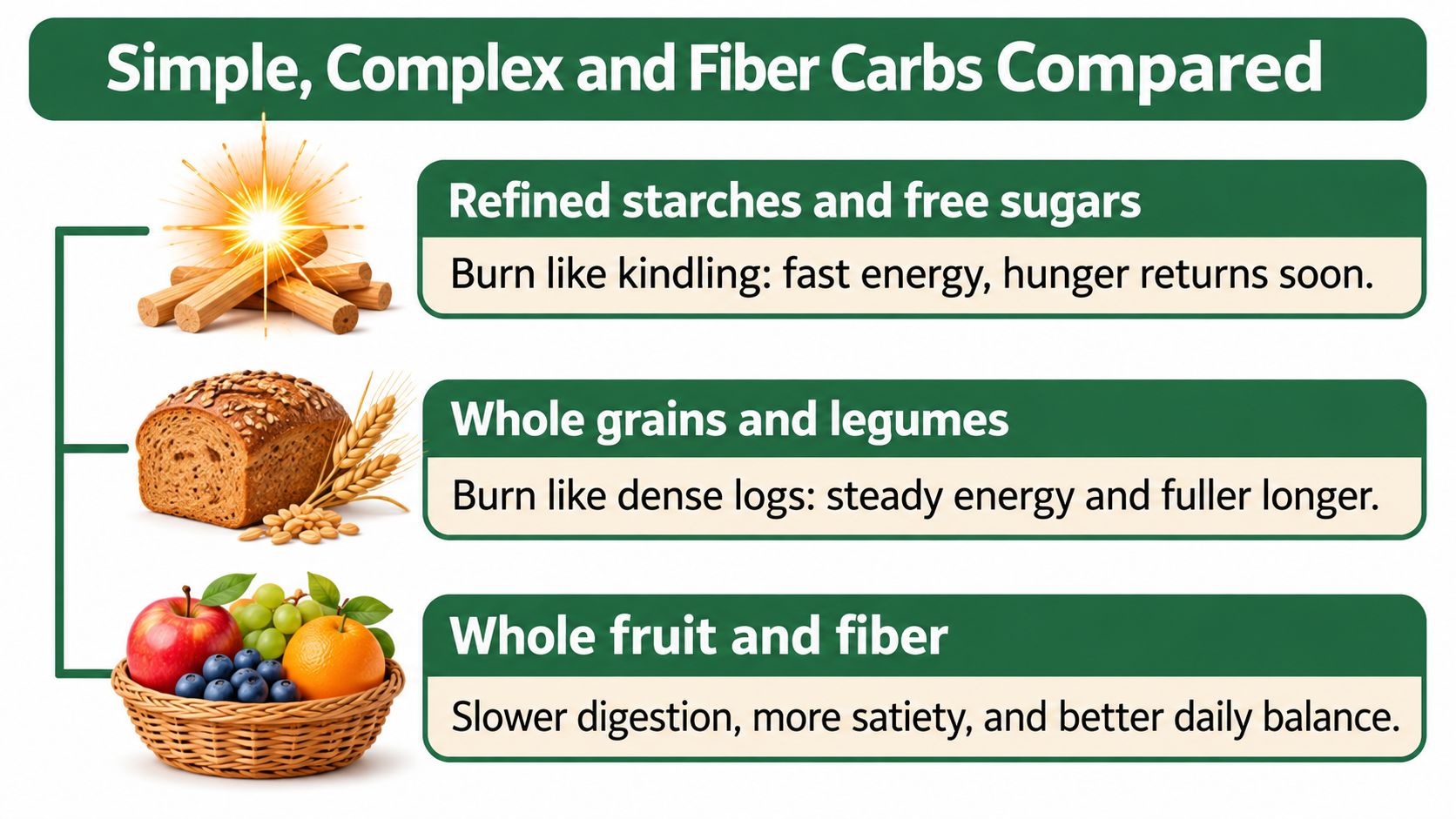
Refined starches and free sugars work like kindling. They burn fast and a meal built on them alone often stops feeling satisfying sooner. Whole grains, legumes, and whole fruit work more like dense logs. Their fiber and intact structure generally slow digestion, so the same amount of carbohydrate can carry further through the morning.
The visual below separates these food packages rather than dividing all carbohydrates into good and bad.
Simple carbohydrates are sugars, including glucose, fructose, and sucrose. You will find sugars in table sugar, honey, juice, soda, and whole fruit, but the surrounding food matters as much as the sugar name. Fruit brings water, fiber, and cell structure. Candy and soda do not.
Complex carbohydrates include starches found in grains, potatoes, and legumes. Complex describes chemical structure, not automatic nutritional value. White bread contains starch, yet its finely milled structure can make it readily digestible.
Fiber is also carbohydrate, but your body does not fully digest it. Certain fibers support normal digestive function, slow aspects of digestion and absorption, and provide material that gut bacteria can ferment. For a closer look at these larger carbohydrate structures, explore polysaccharide examples in everyday foods.
Adults should consume at least 25 grams of naturally occurring dietary fiber daily from whole grains, vegetables, fruits, and pulses, according to the World Health Organization's carbohydrate guidance. That same guidance recommends keeping free sugars below 10% of total energy, about 50 grams on a 2,000-calorie diet.
Specific fiber grams vary by food and serving. The pattern below shows what each category typically brings to a meal.
| Carb type | Typical foods | Fiber per typical serving | Digestion speed |
|---|---|---|---|
| Refined starches | White bread, white rice, plain crackers | Low | Often fast |
| Free sugars | Soda, candy, fruit juice, sweetened cereal | None from sugar itself | Often very fast |
| Whole grains | Rolled oats, brown rice, barley | Moderate to high | Usually moderate |
| Legumes | Lentils, chickpeas, black beans | High | Usually slow |
| Whole fruit and vegetables | Apple, berries, broccoli | Moderate to high | Moderate to slow |
These are broad patterns, not a ranking that fits every recipe. Finely grinding a grain, cooking a food until very soft, or adding fat, protein, and sugar can change how a meal behaves. A brown colored loaf shows why labels still matter. Color can come from caramel coloring or added sugars. A whole grain named first in the ingredient list is a clearer signal than shade alone.
Compare the package, not only the carbohydrate grams. An apple and apple juice may both taste sweet. The apple keeps its fiber and structure, while most juice leaves much of that fiber behind.
Look at processing next. White rice, white bread, and plain crackers have lost much of the bran and germ. Rolled oats, brown rice, barley, lentils, and beans keep more of the original structure plus fiber.
Then ask what a swap replaces. Keeping beans, oats, or fruit while replacing soda or sweetened cereal improves fiber and reduces free sugars without rejecting carbohydrates. That replacement test is more useful than a carb percentage alone.
Use this video as another way to think through carbohydrate choices.
For packaged foods, use a consistent label routine:
After you eat digestible carbohydrate, glucose enters your bloodstream and becomes available for energy. A rise after a meal is a normal physiological response. The useful question is how the food, portion, and rest of the meal shape that response.
The glycemic index, often shortened to GI, compares a carbohydrate food's blood-glucose response with a reference food. Harvard Health's explanation of the glycemic index describes a 0-100 scale, with pure glucose assigned 100; its examples contrast a food rated 28, producing a response about 28% as large, with one rated 95, which behaves much more like glucose.
Not every food value is established by that reference. Where a specific value isn't confirmed, the table uses the practical comparison rather than implying a precise measurement.
| Food | Glycemic index (glucose = 100) | Typical serving |
|---|---|---|
| Pure glucose | 100 | Reference standard |
| White bread | Generally higher | A slice |
| Boiled white rice | Generally higher | A cup cooked |
| Rolled oats | Generally lower than highly refined cereal | A cup cooked |
| Apple | Generally lower | A medium apple |
| Lentils, boiled | Generally lower | A cup cooked |
Preparation and product differences matter. A food's name alone doesn't establish its exact response, and the serving examples aren't what determines its index value.
Glycemic load adds the amount of available carbohydrate eaten to the comparison. That addresses a limitation of glycemic index: the index doesn't tell you how much carbohydrate is in your actual serving.
Nor does a single-food test reproduce every mixed meal. Rice eaten alone isn't the same eating situation as rice served with fish, vegetables, and olive oil. For background on how refining changes a common grain ingredient, see how enriched wheat flour compares with less-refined options.
Use glycemic index as a comparison tool, not a permission slip or a reason to fear an otherwise balanced meal.
Build a mixed plate rather than choosing foods solely by a score. Pair starch with protein, an unsaturated-fat source, and non-starchy vegetables; choose whole fruit when you want a fruit serving rather than relying on juice.
Readers curious about appetite signaling can explore GLP-1 science from Weight Method for additional context. If you follow a medically supervised eating plan, discuss substantial carbohydrate changes with your clinician before making them.
A pastry and a bowl of oatmeal with berries and nuts can both supply carbohydrate. They don't necessarily provide the same fullness, eating experience, or balance of nutrients. That distinction is more useful than asking whether breakfast contains carbs.
Body weight reflects energy intake and expenditure over time, with appetite, activity, habits, and other personal factors influencing both. Carbohydrate alone doesn't automatically cause fat gain, and removing it doesn't guarantee a sustainable eating pattern.
This illustration connects energy balance with the quality of the foods you choose.
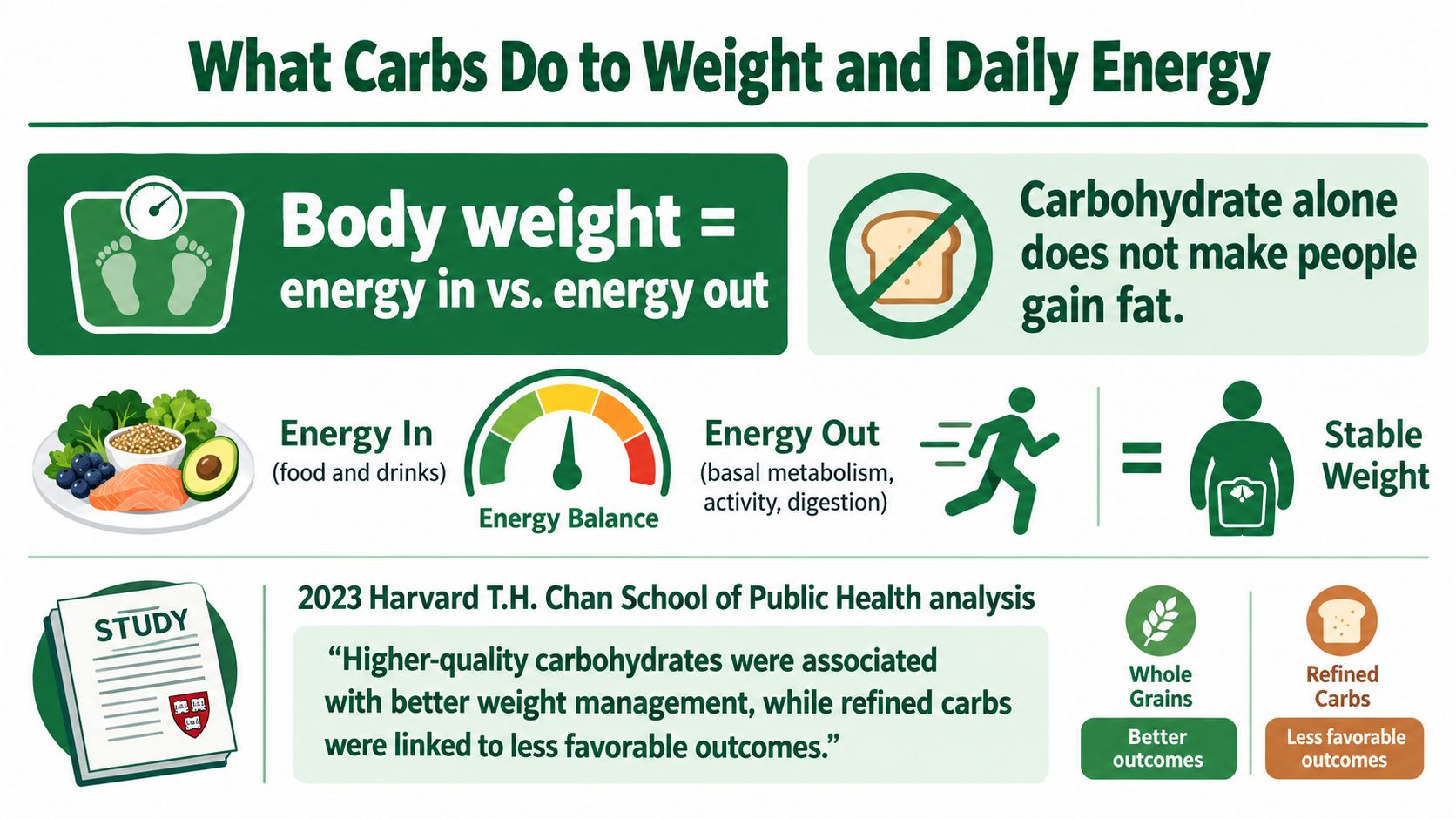
A 2023 analysis of 123,332 adults, described in Harvard T.H. Chan School of Public Health's findings on low-carbohydrate diet quality, found that patterns emphasizing plant-based proteins and fats, healthy carbohydrates, and fewer refined carbohydrates were associated with slower long-term weight gain.
That's an association, not proof that changing a particular food directly caused the difference. People who choose those patterns may also differ in activity, routines, and other behaviors. Still, the finding doesn't support treating every low-carbohydrate diet as equivalent.
Apply it at lunch: lentil soup with vegetables offers a different balance from a bowl of white-flour noodles eaten alone. You don't have to ban noodles; adding beans, vegetables, and protein can make the meal more substantial.
Fiber-rich foods often require more chewing and add volume to a meal. Those features can help you feel satisfied, whereas a small refined snack may be easy to eat quickly without feeling like much food.
Carbohydrate also supports demanding physical activity. If a sharp reduction leaves you feeling flat during training, reconsider the amount and timing of your fuel rather than assuming fatigue proves the plan is working. Readers pursuing structured fitness goals may find Telomyx VO2 max testing in Chester useful for understanding aerobic fitness, although fitness testing doesn't establish an individual carbohydrate prescription.
Use a practical checklist:
Large population studies can identify patterns that short experiments might miss. They can also tempt readers to turn an association into a universal rule. A carbohydrate percentage describes only part of what someone eats.
An ARIC prospective cohort analysis and meta-analysis in The Lancet Public Health30135-X/fulltext), totaling 432,179 participants, found that carbohydrate intake near 50-55% of total energy was associated with the lowest mortality risk. Intake below 40% and above 70% was associated with higher pooled risk, with hazard ratios of 1.20 and 1.23, respectively, compared with the reference range.
Those findings don't prove that eating a particular percentage makes someone live longer. Researchers observe dietary patterns rather than assigning people to maintain identical menus over their lifetimes.
Food reporting can be imperfect. Total energy intake, food quality, socioeconomic circumstances, and the foods people choose instead of carbohydrate can also influence the result. A population-level pattern isn't a personalized target.
The replacement question: If you remove a food, assess the nutritional value of what takes its place, not just the smaller carbohydrate total.
Within the analysis, lower-carbohydrate patterns emphasizing animal-derived protein and fat were associated with higher mortality, while patterns emphasizing plant sources were associated with lower mortality. That comparison supports examining the whole menu rather than awarding a health label based on a macronutrient percentage.
Randomized trials answer a different question because researchers assign dietary approaches and compare results over a defined period. The Scientific Report's discussion of carbohydrate restriction notes that diets providing fewer than 130 grams of carbohydrate daily can reduce triglycerides and raise HDL cholesterol.
Those changes don't establish that every version of a lower-carbohydrate diet improves long-term outcomes. A favorable change in a measured marker is useful information, but it isn't a complete assessment of nutritional adequacy or long-term well-being.
To evaluate your own pattern:
The most useful conclusion isn't that everyone needs the same carbohydrate share. It's that a percentage alone cannot describe a diet's quality.
Start with a replacement you can repeat, not a food group you intend to avoid forever. These swaps preserve familiar eating occasions while changing the ingredients that fill them.
| Swap out | Swap in | Why it helps |
|---|---|---|
| Soda or sweetened juice | Sparkling water or whole fruit | Reduces sugar from drinks; whole fruit adds fiber |
| White bread | 100% whole-grain bread with a whole grain first | Usually supplies more fiber; compare labels |
| Sugary breakfast cereal | Rolled oats with fruit | Adds fiber and a less-refined grain |
| White rice | Brown rice, barley, or quinoa | Offers less-refined alternatives with fiber |
| Chips or crackers | Raw vegetables with hummus | Adds fiber, protein, and volume |
You don't need to make every substitution at once. Keep the change that fits your budget, tastes, and cooking routine, then build from there.
As a starting template, fill half your plate with non-starchy vegetables, a quarter with whole grains or legumes, and a quarter with protein. Add a modest amount of unsaturated fat, such as olive oil, nuts, or avocado.
For a concrete portion trial, use a cup of cooked grains or legumes as the starch portion at lunch or dinner and a piece of whole fruit as a snack. These are examples, not requirements: adjust for appetite, activity, and any individualized guidance.
Try a two-week experiment:
A daily aloe juice or capsule can be an optional addition to a whole-food routine, not a replacement for dietary fiber or balanced meals. Look for clearly stated serving directions and wording focused on normal function, such as supports healthy digestive function and helps maintain normal body function.
The publisher farms its own aloe, hand-harvests it, processes it within 12 hours without chemicals, enzymes, concentrates, or charcoal filtration, and produces its own finished products. That vertically integrated approach provides oversight from farm to finished formula; it shouldn't be confused with evidence that a supplement offsets an unbalanced diet.
If you're monitoring carbohydrate intake, consult the guide to aloe vera juice and keto eating, then check the actual product's serving size, total carbohydrate, and sugar label. Juice and capsules aren't automatically interchangeable.
Review product details and purchase terms before ordering, including Subscribe and Save at 20% off, the 90-day money-back guarantee, and free shipping on qualifying orders.
These statements have not been evaluated by the Food and Drug Administration. This product is not intended to diagnose, treat, cure, or prevent any disease.
AloeCure offers aloe vera juices and capsules as optional additions to an everyday wellness routine built around balanced, fiber-rich meals. Visit the product pages to compare formats, check serving information, and choose a one-time purchase or Subscribe and Save option that fits your routine.
Los comentarios se aprobarán antes de mostrarse.