Tu carrito está vacío
Envío y manipulación gratuitos con todos los pedidos superiores a $25
Envío y manipulación gratuitos con todos los pedidos superiores a $25

Have you ever wondered why two bottles labeled aloe vera leaf supplement can have very different quality, safety, and everyday usefulness? The plant name tells you what was harvested, but it doesn't tell you which part of the leaf reached the bottle, how the outer layers were removed, or whether the finished product was tested for unwanted compounds.
Aloe can be a thoughtful addition to a wellness routine when consumers understand its anatomy and processing. The most important decision is not merely whether a label says “aloe.” It's whether the product provides a clearly identified inner-leaf material, careful anthraquinone control, traceable sourcing, and transparent manufacturing.
An aloe vera leaf is more complex than the clear gel shown in many product images. It has an outer green surface, a yellow latex layer beneath that surface, and an inner fillet made largely of gel. Manufacturers can use the whole leaf, separate the inner gel, or process the material to remove unwanted constituents. Those choices change the character of the final supplement.
That difference matters because an aloe vera leaf supplement isn't one standardized material. A liquid made from purified inner-leaf gel isn't equivalent to a powdered whole-leaf extract. A capsule may also use a concentrated or dried form, while a juice may preserve the gel in a liquid base. Consumers need to read beyond the plant name and identify the preparation type.
A useful way to evaluate a product is to follow its journey:
Practical rule: Treat “aloe” as the beginning of your investigation, not the conclusion.
Aloe has a long history of traditional use, which helps explain its continuing place in modern wellness. Historical summaries trace its use across several ancient cultures, while later developments moved aloe into formal food and supplement channels. That heritage can add context, but it doesn't replace modern quality controls. A long history of use can't guarantee that every contemporary preparation is identical or suitable for every person.
For a daily wellness choice, prioritize source transparency, plant-part clarity, and analytical testing. These details tell you more than broad language about purity or potency. They also prepare you to compare inner-leaf products with whole-leaf formulas without assuming that all products share the same safety profile.
Think of an aloe leaf as a fruit with a protective rind. The green outer layer helps shield the plant, the yellow latex sits just inside that surface, and the inner fillet contains the clear gel commonly associated with aloe. Each layer has a different composition, so the manufacturing goal should be clear before you choose a supplement.
The inner-leaf gel is the soft central material. Manufacturers may separate it from the outer layers and stabilize it for use in juice, powder, or capsules. Whole-leaf extracts include more of the leaf's surrounding material. If the latex remains, the product can contain anthraquinones such as aloin, compounds associated with a stronger laxative action.
The distinction isn't merely a marketing preference. The National Center for Complementary and Integrative Health overview of aloe vera states that short-term oral use of aloe gel up to 42 days is considered safe, while oral aloe latex can cause abdominal discomfort and loose stools. The same source links oral aloe leaf extracts used for periods ranging from 3 weeks to 5 years with acute liver reactions. These findings reinforce why the plant part and preparation method deserve close attention.
A practical label comparison looks like this:
| Label detail | What it may indicate |
|---|---|
| Inner-leaf gel or inner fillet | The manufacturer identifies the central gel material |
| Whole-leaf extract | More of the original leaf is included, so processing details become especially important |
| Decolorized whole leaf | The producer has used a process intended to reduce colored compounds and anthraquinones |
| Aloin specification | The company monitors a key quality marker rather than relying only on the ingredient name |
The independent review of aloe vera preparation and anthraquinone content notes that inner-leaf gel and low-anthraquinone decolorized materials are generally viewed as safer than non-decolorized whole-leaf extracts. It also reports that commercially drinkable products are often benchmarked at no more than 10 parts per million of aloin, while liquid products may contain under 1 part per million and solid or semi-solid products may contain 10 to 100 times higher levels.
Aloe's recorded history is extensive. Historical sources note use in Northern Africa as early as 20–30 B.C., while other summaries trace aloe to ancient Egyptian records from the 16th century BC and Sumerian clay tablets dated around 2100 BC (historical review of aloe vera use). That continuity explains the ingredient's recognition, but the quality of today's supplement still depends on what happens after harvest.
For a visual explanation of the distinction, see this guide to the difference between whole-leaf aloe and inner aloe gel.
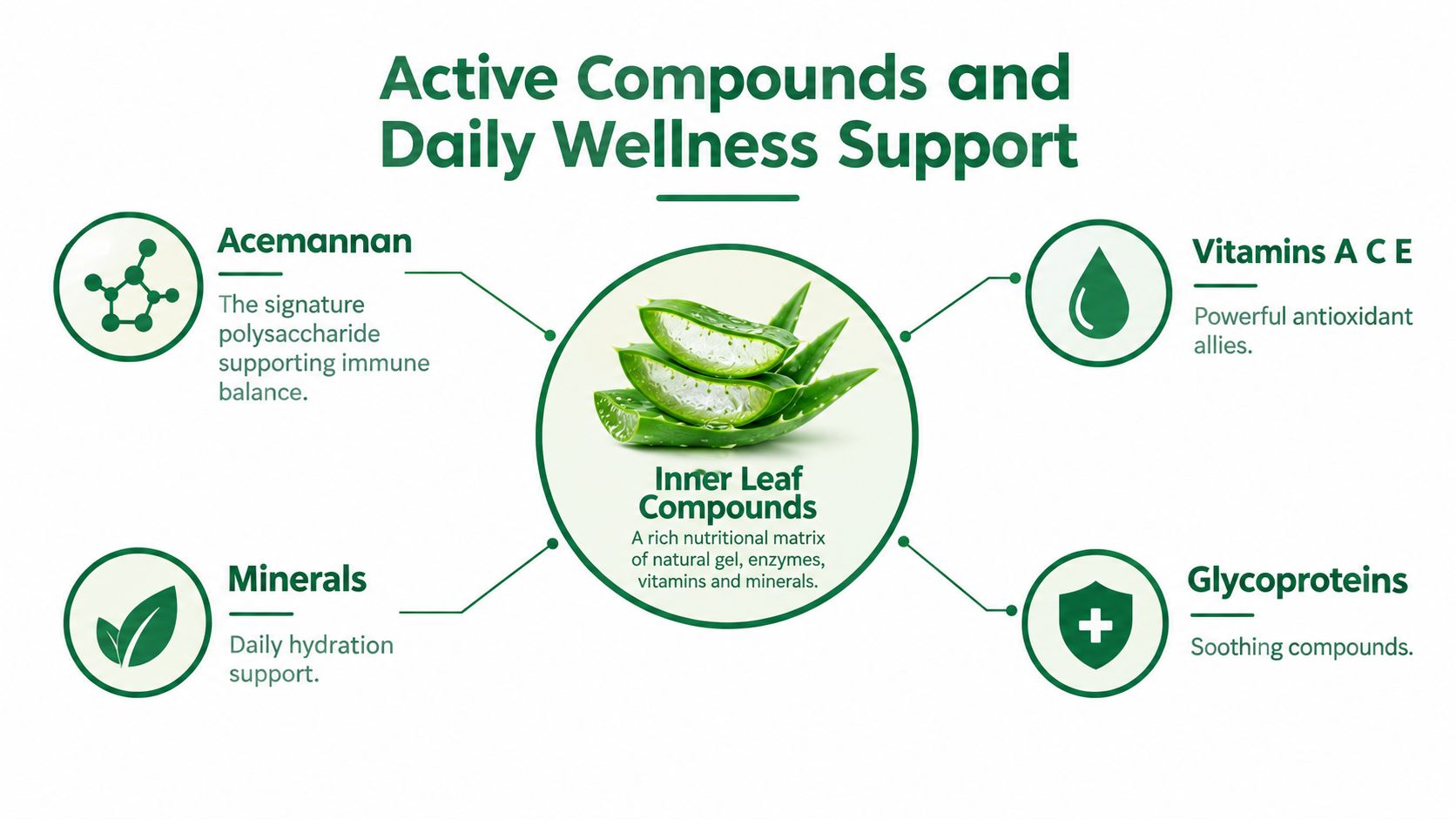
The inner gel contains a mixture of polysaccharides, glycoproteins, minerals, and other plant constituents. Acemannan, a polysaccharide associated with aloe gel, is one of the compounds most often used to describe the ingredient's botanical identity. Rather than treating acemannan as a miracle component, evaluate whether the manufacturer explains how it preserves and measures the material.
A responsible structure/function description might say that an aloe formula supports healthy digestive function, promotes everyday wellness, or helps maintain normal body function. Those phrases describe a supplement's intended wellness role without suggesting that it can address a specific medical condition. They also keep the conversation focused on consistency, formulation, and individual tolerance.
Consumers looking for broader food-based habits may find it useful to compare aloe with other whole-food choices. For example, the Bearded Brothers snack collection offers context on how some shoppers build convenient, plant-focused foods into a wider routine. That kind of resource complements, rather than replaces, careful evaluation of a supplement label.
Aloe gel is not a single isolated ingredient. It is a botanical matrix, and processing can affect which constituents remain in the finished product. Heat, concentration, filtration, storage, and exposure to air may all influence the character of the material. A company that provides clear specifications gives consumers a stronger basis for comparison than one that lists only “aloe leaf.”
The guide to acemannan in aloe vera can help readers understand why this polysaccharide receives attention in aloe formulations. Still, the presence of a named compound doesn't automatically prove a particular outcome. Look for a clear plant part, a defined extraction approach, and testing that covers both desirable constituents and unwanted anthraquinones.
A supplement may be described as supporting normal digestive function or helping the body maintain everyday balance. These are general wellness statements, not guarantees of a particular result. Individual responses can vary with the formula, serving size, diet, and the person's existing health circumstances.
The FDA guidance on structure/function claims says these statements must be truthful and not misleading. It also requires the marketer to submit the claim notification within 30 days after first marketing the product with that claim and to display the required FDA disclaimer. Consumers should therefore see a distinction between a permitted wellness statement and language that promises a medical outcome.
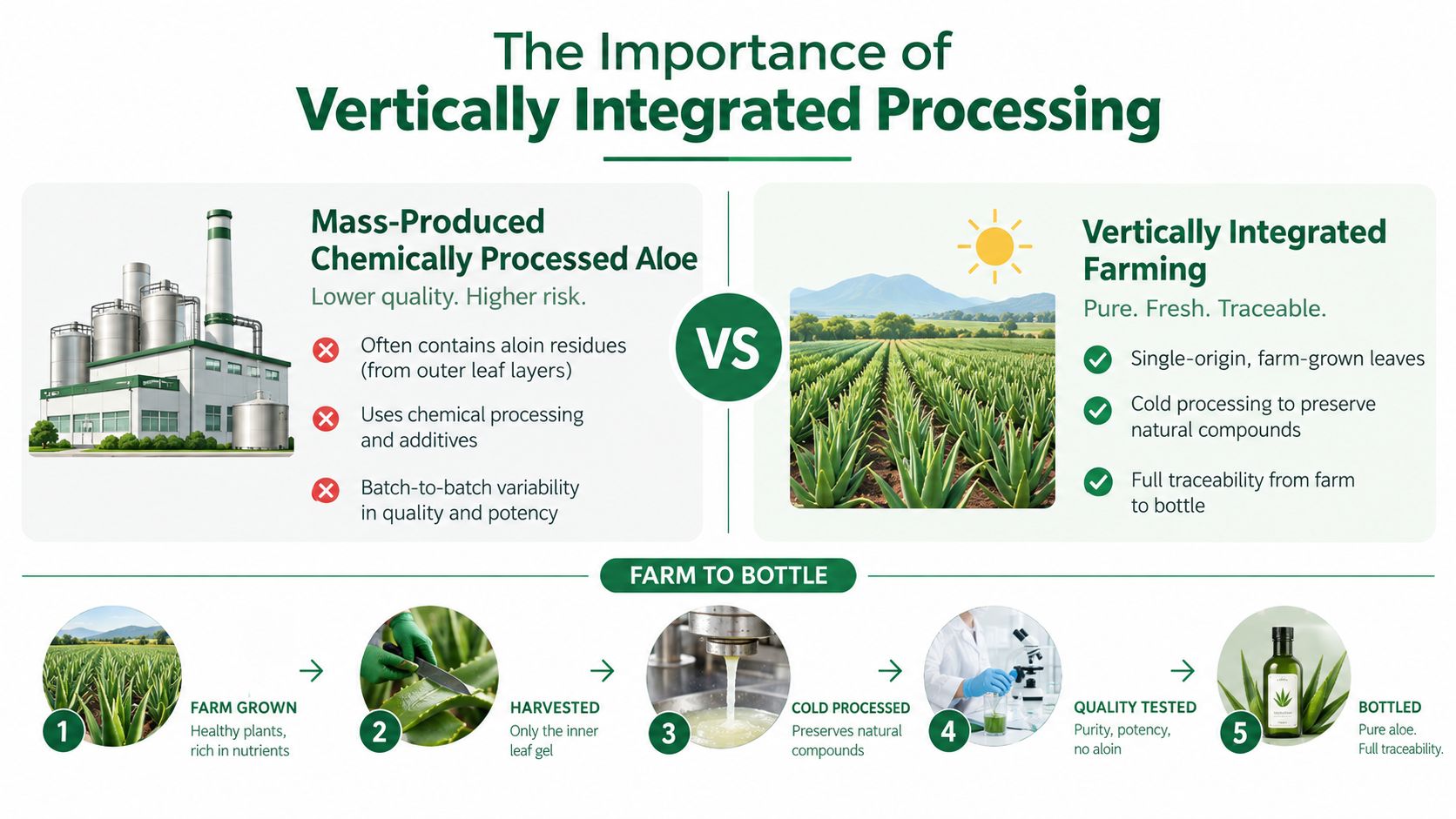
A vertically integrated aloe operation controls more of the path from cultivation to finished product. Instead of buying leaves or extracts through several unrelated suppliers, the producer manages farming, harvest, processing, and manufacturing within one connected system. That structure can make traceability easier and reduce uncertainty about where a raw material changed hands.
Processing choices deserve as much attention as cultivation. Some manufacturers use methods such as charcoal filtration, enzymes, or chemical processing to modify aloe material. Those approaches may serve a manufacturing purpose, but consumers should ask what the process removes, what it preserves, and whether the producer verifies the final anthraquinone level.
The National Institute of Environmental Health Sciences information on aloe vera highlights why this control matters. It reports that aloin levels in most liquid aloe products are under 1 part per million, while solid or semi-solid products may contain 10 to 100 times higher levels. It also explains that aloe is a dietary supplement rather than a regulated drug, so consumers don't receive an automatic guarantee of strength, purity, or safety.
A farm-to-bottle model can support several practical controls:
The word “natural” isn't enough by itself. A producer should explain how it handles the latex layer, how it stabilizes the gel, and how it tests for compounds that consumers may want minimized. A claim about avoiding certain processing aids also needs to sit beside credible quality documentation.
The toxicology record makes this especially important. The U.S. National Toxicology Program reported clear evidence of carcinogenic activity in 2-year studies of non-decolorized whole-leaf aloe vera extract in rats, including increased large-intestine tumors (NTP technical report on non-decolorized whole-leaf aloe). This is animal evidence, not a prediction about every aloe product, but it supports a cautious approach to non-decolorized whole-leaf material and stronger expectations for processing disclosure.
What separates a high quality aloe vera leaf supplement from a polished label? Start with the ingredient panel, where the plant part and processing details should be clearer than they are on the front. A product may highlight organic farming, plant heritage, or a named compound, yet still leave unclear whether it contains inner-leaf gel, whole leaf, powder, or a blend.
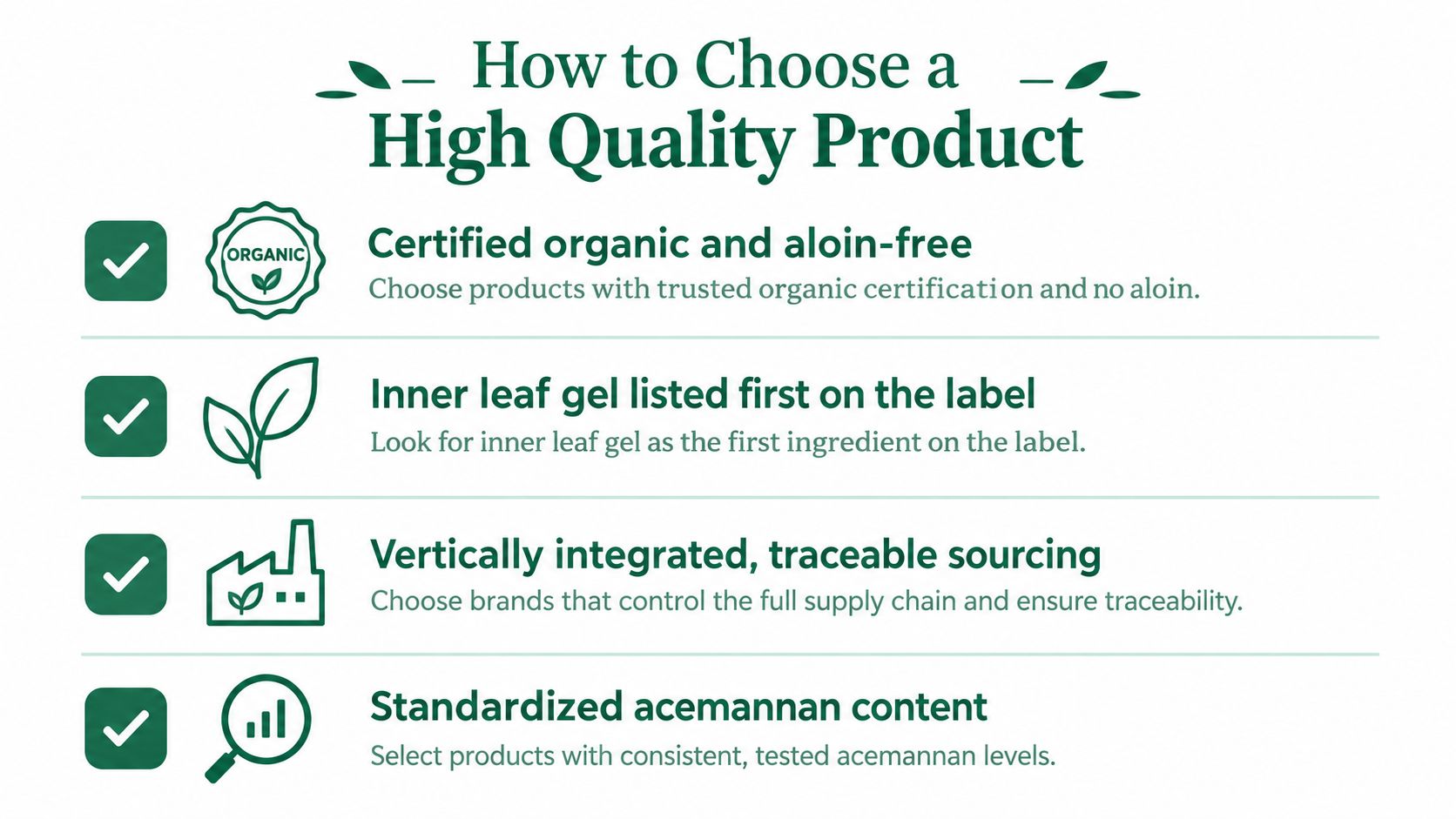
Identify the plant part. Look for inner leaf, inner fillet, or clearly described decolorized material. If the label says only “aloe leaf,” ask the manufacturer whether the latex layer is included.
Look for anthraquinone testing. A responsible company should explain how it measures aloin and related compounds. A certificate of analysis or finished-product specification gives more useful detail than a general purity statement.
Check the source. Organic certification can support claims about farming standards, but it does not describe every processing step. Look for the growing location, manufacturing address, batch identification, and a way to connect the finished product with its source material. For a brand-level comparison, see this guide to the best aloe vera juice brand.
Assess traceability. Traceability records should show how material moves from cultivation through extraction, testing, and packaging. The value lies in the records and explanations, not in a numbered promise.
Vertically integrated farming and processing can make those records easier to connect. The same organization may oversee cultivation, extraction, and packaging, giving shoppers a clearer route for checking how the gel was handled. Ask whether the extraction avoids chemical processing aids and whether the company explains how it stabilizes the material.
Review serving instructions. Follow the label rather than assuming that more aloe provides more support. Liquid, powder, and capsule formats may have different concentrations and serving directions.
Ask about testing. Third-party certification and independent laboratory testing can add useful checks, particularly when the company names the test and identifies whether it covered the raw material or finished product.
Notice the wording. Be cautious with guaranteed results or language linked to medical outcomes. The FDA small-entity compliance guide for structure/function claims explains that such claims cannot explicitly or implicitly connect an ingredient with a disease or use terms such as “cure,” “treat,” “correct,” or “prevent.”
For a practical comparison, review the Kiki Health aloe capsules at Vitamin Planet. Comparing labels can show whether a company identifies the plant part, serving directions, certifications, and testing details.
The FDA dietary supplement labeling guide distinguishes structure/function statements from health claims. Structure/function language describes a substance's role in normal body structure or function. Health claims concern reduced disease risk and require FDA evaluation and authorization. This distinction helps separate general wellness wording from a medical promise.
The best format is the one that fits your routine and makes label compliance easy. A liquid can work for someone who already measures a morning drink, while capsules may suit a person who travels or prefers a compact format. Neither format is automatically superior. The plant part, anthraquinone control, serving guidance, and storage instructions matter more than whether the product comes in a bottle or capsule shell.
A simple routine might begin with reading the full label before the first serving. Check the recommended amount, whether the product should be taken with food, and whether it requires refrigeration after opening. Don't increase the serving because a previous product seemed mild, since different formulas can contain different concentrations.
Some consumers prefer natural or flavored aloe juice, while others choose an advanced capsule formula for convenience. Flavoring can make a liquid easier to use regularly, but it also makes the ingredient panel worth checking for sweeteners and other additions. Capsules can simplify portability, yet they still need clear information about the type of aloe extract inside.
People who are pregnant, breastfeeding, underage, or managing ongoing health concerns should ask a qualified healthcare professional before using an oral aloe product. The National Library of Medicine reference on aloe also emphasizes that safety changes according to preparation, duration, and personal circumstances. Stop using a product and seek professional guidance if you develop an unexpected or persistent reaction.
Consistency should never mean ignoring feedback from your body. A well-designed routine is adjustable, label-led, and based on a product whose source and processing the manufacturer can explain.
Choosing an aloe vera leaf supplement is less about finding the loudest promise and more about understanding the material inside the bottle. The central questions are straightforward: Which part of the leaf was used? How were the outer layers handled? What does the company test? Can it trace the product from farm to finished package?
Inner-leaf gel and carefully controlled low-anthraquinone preparations generally offer a clearer quality path than non-decolorized whole-leaf products. That doesn't make every inner-leaf formula identical, and it doesn't remove the need to follow serving directions. It does give consumers a practical framework for comparing products based on formulation rather than branding alone.
FDA guidance allows general well-being and structure/function statements when the marketer has substantiation that the statement is truthful and not misleading and submits the required notification no later than 30 days after first marketing the product with that claim (FDA information on structure/function notifications). Responsible product education should keep those boundaries visible and avoid presenting a supplement as a substitute for professional care.
The required disclaimer is:
These statements have not been evaluated by the Food and Drug Administration. This product is not intended to diagnose, treat, cure, or prevent any disease.
A vertically integrated, organic producer can offer a more traceable route from cultivation to capsule or juice. Before buying, compare the ingredient panel, processing explanation, testing information, certifications, and customer terms. A guarantee can also make it easier to evaluate a product without committing to a formula that doesn't suit your routine.
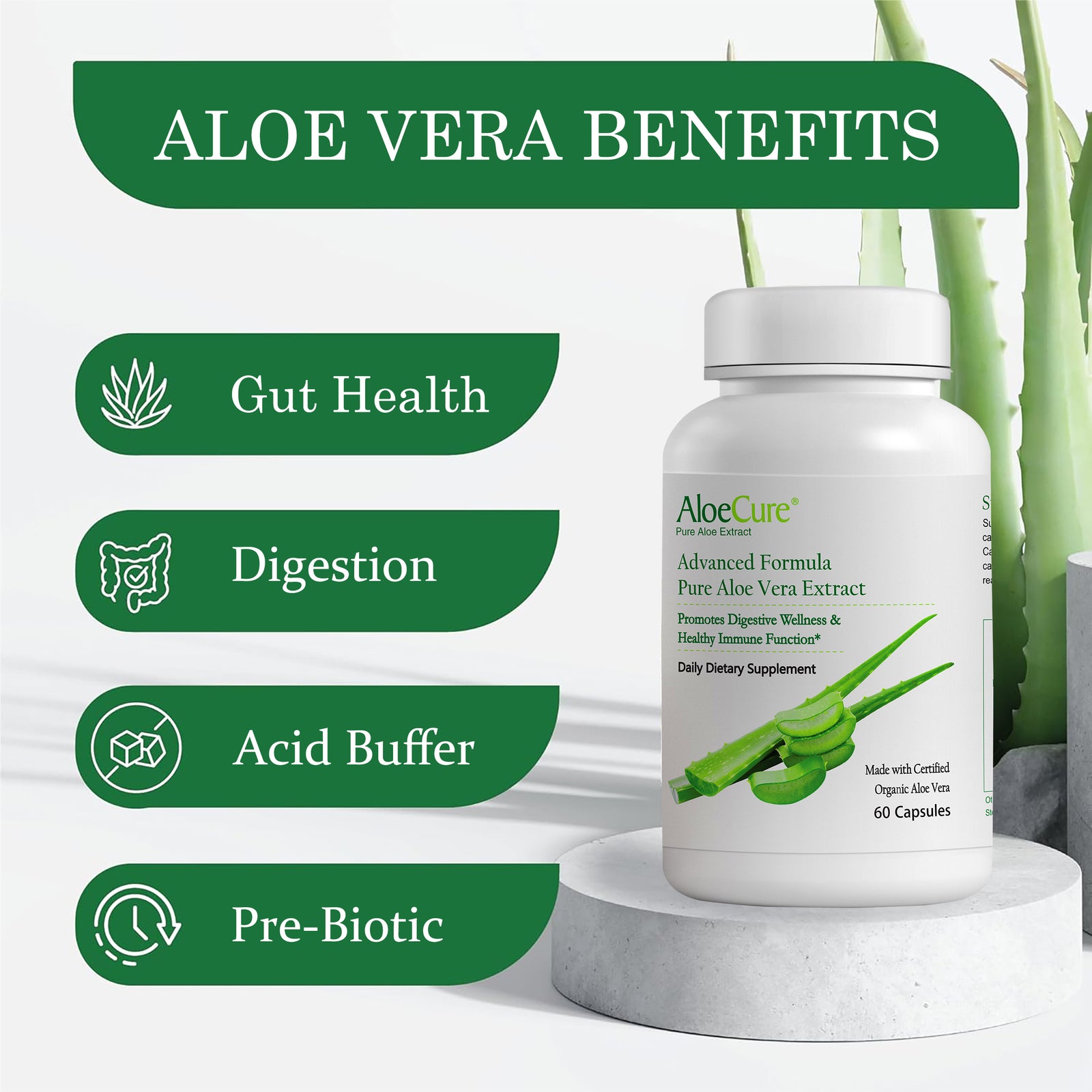
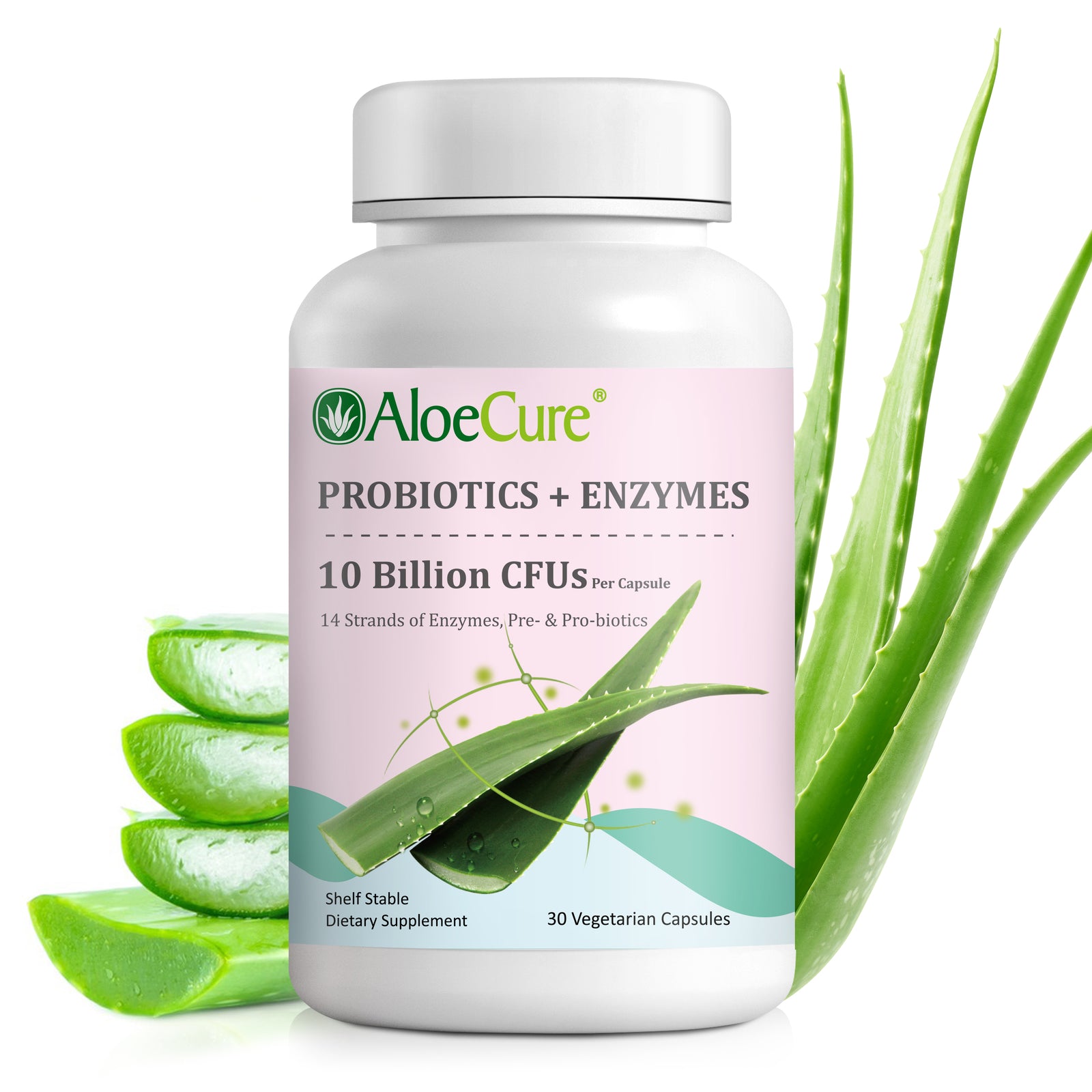
AloeCure offers farm-to-bottle organic aloe vera juice and inner-leaf aloe capsules, with its own cultivation, processing, and product manufacturing under one connected system. You can visit AloeCure to review the formulas, explore the 90-day money-back guarantee, and choose Subscribe & Save for 20% off eligible subscriptions.
Los comentarios se aprobarán antes de mostrarse.